Research Article
Kavalactone delivery and between-batch variability across five preparers in traditionally hand-prepared kava: An exploratory study of the 12-ounce shell
- 1 American Kava Association; Root of Happiness Kava, Rancho Cordova, California, USA
- 2 Root of Happiness Kava, Rancho Cordova, California, USA
Correspondence: Tyler Blythe, admin@americankavaassociation.org · ORCID: Tyler Blythe 0009-0006-7884-0650
- DOI
- Pending Crossref registration
- Received
- 1 November 2026
- Accepted
- 12 November 2026
- Published
- 14 November 2026
- Volume
- Volume 2 (2026)
- Article
- 023
- Article type
- Research Article
- Version
- 1.1 (version of record)
- Review
- Computational Manuscript Review (CMR) · Editorially accepted
- Handling editor
- Tyler Blythe, Editor-in-Chief (also an author)
- License
- CC BY 4.0 · © 2026 The Author(s)
Abstract
This exploratory study measured kavalactone and flavokavain delivery per 12 fl oz (355 mL) serving in six hand-prepared kava batches made to one recipe by five commercial preparers with 2 to 12 years of experience. Three batches came from each of two Root of Happiness lots: House Fijian, a commercial lot, and House Vanuatu, a lot rejected for service at the company's bars and donated for research. Each batch used 226.8 g of as-received ground kava and 5.68 L of water at 38 °C in two hand-squeezed washes. Unclarified aliquots of the six beverages and samples of both lots were assayed by LC-DAD at an ISO/IEC 17025:2017-accredited laboratory, and the spent marc of every batch was dried and weighed. Mean total kavalactone delivery was 337.0 mg per shell for House Vanuatu (CV 8.6%) and 377.7 mg for House Fijian (CV 6.7%). Within each lot, batches that left more dry marc delivered less kavalactone (lot-normalized r = −0.95, n = 6; hypothesis-generating). Flavokavain delivery was 28.6 and 3.8 mg per shell. As raw material, House Vanuatu exceeded both voluntary flavokavain criteria of the Harmonized Multinational Kava Standards (0.609% against a 0.4% ceiling; 12.8% of total kavalactones against 5%), and House Fijian met both. Apparent kavalactone transfer was 49.2% and 35.8% on a volume basis (50.9% and 36.8% by beverage mass). Beverage chemotypes were 245613 (House Vanuatu) and 462315 (House Fijian, two of three batches). Because four of the five preparers made a single batch, preparer and batch effects are not separated.
Keywords: Piper methysticum; kava; kavalactones; hand preparation; between-batch variability; per-serving measurement; beverage potency; marc; kava bar
Introduction
Traditional kava is prepared as an aqueous suspension by mechanically working plant material in water and straining the beverage (Lebot, Merlin, & Lindstrom, 1997). In the commercial setting examined here, staff prepare batches by hand to a house recipe and dispense the beverage by volume. A defined serving volume does not, by itself, specify its kavalactone content. For commercial preparation, the practical questions are how much kavalactone a serving contains under a stated recipe and how much the measured concentration varies across preparations by different staff.
Previous beverage measurements provide serving-level context (Balick & Lee, 2002; Brown et al., 2007; Jhoo et al., 2006), and beverage chemotypes have been compared with source material for Isa and Mahakea roots and rhizomes (Wang et al., 2015). Companion studies examine kavalactone delivery and its association with suspended plant material under standardized and mechanized preparation (Blythe & Bowman, 2026; Blythe, Bowman, & Masifilo, 2026). The present study asks the narrower operational question of per-serving delivery and between-batch variability when commercial preparers follow one hand-mixing recipe.
Six batches from two Root of Happiness lots were prepared by five staff members, three per lot, with one preparer contributing to both lots. The primary objectives were to quantify kavalactones per 12 fl oz (355 mL) serving and to describe within-lot variability. Secondary objectives were to compare beverage and raw-material profiles, quantify flavokavain delivery and place the raw material against published criteria, estimate finished volume and apparent transfer from the recovered marc, and relate dry marc mass to potency.
Materials and Methods
Kava Materials
Two ground-kava lots from Root of Happiness Kava Company were used: House Vanuatu (LOT HVF-0901526), peeled chips of multiple varieties from Santo Island, Vanuatu, and House Fijian (LOT HFF-0901526), 60% lateral roots and 40% peeled chips from Fiji. House Fijian is a commercial lot. House Vanuatu was a lot the company had rejected for service at its bars; it was donated for research and was not sold or served (see Raw-Material Flavokavain Content Against Published Criteria). The particle grind size was 70 mesh for House Vanuatu and 60 mesh for House Fijian. Each lot came from a single homogenized production batch, and a subsample of each was analyzed with the beverages. Portions of 226.8 g (0.5 lb) were weighed from one sealed container per lot on an AvaTek PC32 portion-control scale. All input masses are as received; input moisture was not determined. The workbook rounds the start weight to 227 g; all calculations use 226.8 g, which changes no reported value.
Preparers and Randomization
Five kava bar employees with 2 to 12 years of daily preparation experience prepared the six batches. Their codes, P1–P5, are pseudonyms; Table 1 links each code to its sample, lot and experience. Lot assignment was randomized giving three batches per lot. Four preparers made one batch each; P3, the most experienced, made one of each lot. Preparers followed the fixed recipe and otherwise used their ordinary technique. Tyler Blythe and Travis Lowin supervised preparation and sampling. P1 is a co-author (see Conflicts of Interest).
Preparation Protocol
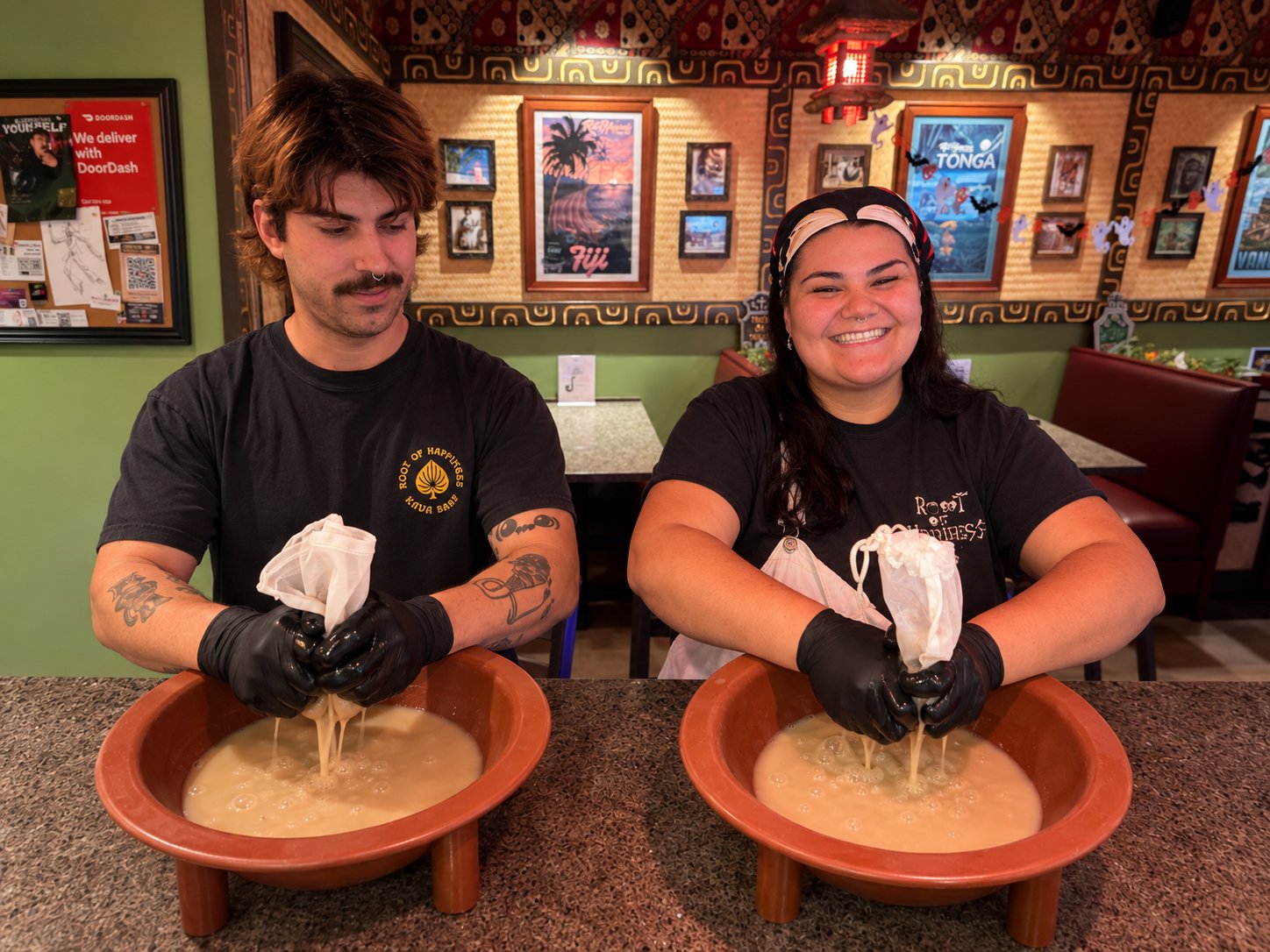
Each batch combined 226.8 g of ground kava with 5.68 L (6 US quarts) of filtered municipal water at 38 °C (39.9 g L⁻¹, 1:25 w/v, as received), divided into two 2.84 L washes of the same material. For each wash the kava was placed in an 8 × 10-inch, 150 µm nylon strainer bag (Root of Happiness Kava Company, Las Vegas, NV), immersed, hand-squeezed and kneaded for two minutes at the preparer's ordinary working force, then expressed until free drainage ceased. Water temperature was checked before each wash with a Taylor 9306N thermometer. The two washes were combined and stirred; no blending or mechanical agitation was used. The 5.68 L charge is the water added, not the finished volume (see Marc Recovery and Finished Volume). Figure 1 illustrates hand preparation; it is a demonstration photograph, not a study batch.
Beverage Sampling
Batches were prepared on September 19, 2026, at the Root of Happiness Rancho Cordova, California, location. Immediately after stirring, an 8 fl oz (237 mL) aliquot of each batch was drawn into a labeled PET bottle, held at 38 °F (3 °C) until shipment on September 20 and sent with ice packs in an insulated container; the laboratory received the samples on September 21, 2026. The whole aliquot, particulates included, was analyzed without clarification, filtration or centrifugation, because the companion mass-balance study estimated, in partition estimates it describes as model-derived and exploratory, that most beverage kavalactone is particle-associated (Blythe, Bowman, & Masifilo, 2026). One aliquot per batch was analyzed.
Marc Recovery and Finished Volume
The spent marc of each batch was recovered from the bag, dried at 38 °C to constant weight (3.0% residual moisture, checked by moisture analyzer) in an Avantco 1000 W food dehydrator as in Blythe and Bowman (2026), and weighed to 0.1 g. Input mass not recovered in the marc (226.8 g minus dry marc) includes material carried into the beverage, input moisture and any handling losses; it is not a direct measurement of beverage solids.
One water-loss value per lot is recorded in the calculation workbook (Supplementary File S1): 75.7 mL for House Vanuatu and 151.5 mL for House Fijian, or 1.33% and 2.67% of the 5,680 mL charge as measured with a large graduated cylinder. Dividing each by the lot-mean dry marc gave retention coefficients (r_lot) of 1.871 and 2.039 mL g⁻¹, from which:
Vret (mL) = mmarc (g) × rlot (mL g⁻¹)
Vfinal (mL) = 5680 mL − Vret
Finished volumes are therefore model outputs, reported to the nearest 10 mL; shells per batch = V_final ÷ 355 mL.
Laboratory Analysis
The six major kavalactones and flavokavains A, B and C were quantified in both lots and all six beverages by Cambium Analytica (Traverse City, MI) under method LAB-TM-067, Determination of Kavalactones & Kavains by LC-DAD (certificates DTS-260911-042 to -049; Supplementary File S2). The certificates carry the laboratory's ISO/IEC 17025:2017 accreditation (#108157) but do not state whether LAB-TM-067 falls within its scope. Samples were received on September 21, analyzed on September 23–24 and reported on September 25, 2026. Limits of quantitation were 0.0020 mg g⁻¹ for kavalactones and 0.0002 mg g⁻¹ for flavokavains A and B in beverages, and 0.39–0.42 and 0.039–0.042 mg g⁻¹ in raw material. Flavokavain C is reported at lower precision; its beverage LOD and LOQ print as 0.000 mg g⁻¹, a display rounding rather than non-detection.
Beverages were analyzed as received and reported in mg g⁻¹; the laboratory converted these to a 355 mL serving at an assumed density of 1.00 g mL⁻¹. Given the solids load, the true density is likely slightly higher, which would make per-shell values marginally low. Raw materials were reported as % w/w as received. The certificates do not describe how the settled bottle was resuspended and subsampled, or the method's repeatability for a liquid suspension. Each certificate reports one result; its test identifier carries a run suffix (-01, -02 or -03, listed in Supplementary File S1) that the certificates do not define, and no repeat-run or replicate results were reported.
Calculation Framework
Per-shell delivery is the beverage concentration times the 355 mL serving:
KLshell (mg) = Cbev (mg mL⁻¹) × 355 mL
Total kavalactone charged to each mix (KL₀, in grams) was calculated from the raw-material result and the weighed as-received input:
KL₀ = 226.8 g × KLraw (% w/w) ÷ 100
and apparent transfer into the beverage (T, %) was calculated from the measured beverage concentration and the modeled finished batch volume:
T (%) = [(Cbev × Vfinal) ÷ (1000 × KL₀)] × 100
where V_final is the modeled finished volume and the factor of 1000 converts grams to milligrams. This volume basis counts only the water not retained in the marc. Because concentration is reported per gram of whole suspension, transfer was also computed on a beverage-mass basis (water not retained plus input mass not recovered in the marc), and the nominal basis (5,680 mL) is given for reference. Flavokavain transfer was computed the same way. With the marc weighed but not assayed, T is not a closed mass balance, and it differs from the KL₀ − KLm estimator of the companion study (Blythe, Bowman, & Masifilo, 2026).
Chemotypes follow the six-digit convention of Lebot and Lévesque (1989; see also Lebot, Merlin, & Lindstrom, 1997), ranking the six kavalactones by mass (1 = desmethoxyyangonin, 2 = dihydrokavain, 3 = yangonin, 4 = kavain, 5 = dihydromethysticin, 6 = methysticin).
Statistical Analysis
Within each lot, results are summarized as mean ± SD, CV and range across three batches; these CVs combine preparer, batch, sampling and analytical variation, which the design cannot separate. Lots were compared by Welch's t-test (n = 3 per lot); because the lots share P3, the p-values are nominal and exploratory and are not adjusted for multiplicity. Associations of preparer experience and dry marc mass with potency were tested by Pearson correlation on values normalized to their lot means. Because the normalization estimates two lot means from six batches, p-values use three degrees of freedom, and coefficients without P3's two batches are given as a sensitivity check. Both correlations are hypothesis-generating. Calculations used Microsoft Excel and Python (NumPy/SciPy); the formulas behind Tables 2–5 and the derived values in the text are in Supplementary File S1.
Results
Study Design and Batch Allocation
Six independent batches were prepared, three per lot, under the fixed protocol (Table 1).
| Sample ID | Preparer | Experience (y) | Kava lot | Finished volume (mL) | Shells at 355 mL |
|---|---|---|---|---|---|
| House Van — P1 | P1 | 8 | House Vanuatu | 5,610 | 15.8 |
| House Van — P2 | P2 | 3 | House Vanuatu | 5,590 | 15.7 |
| House Van — P3 | P3 | 12 | House Vanuatu | 5,610 | 15.8 |
| House Fiji — P3 | P3 | 12 | House Fijian | 5,540 | 15.6 |
| House Fiji — P4 | P4 | 2 | House Fijian | 5,520 | 15.6 |
| House Fiji — P5 | P5 | 3 | House Fijian | 5,520 | 15.6 |
Note: P1–P5 are pseudonyms; preparer names are redacted from Supplementary Files S1 and S2. P3 prepared one batch of each lot. Every batch followed the recipe in the caption. Finished volume is modeled from the recorded lot water loss and dry marc mass (Table 4).
Raw-Material Characterization
Table 2 gives each lot's content and the charge to each batch. House Vanuatu contained 4.77% total kavalactones as received (chemotype 425631, with kavain and dihydrokavain near-tied at 1.2822% and 1.2811%) and House Fijian 7.25% (463215), a charge of 10.81 g and 16.44 g per batch. Total flavokavains were 0.609% and 0.112% (FKs/KLs 0.128 and 0.016).
| Kavalactone | House Vanuatu (%) | House Vanuatu charge (g) | House Fijian (%) | House Fijian charge (g) |
|---|---|---|---|---|
| M — methysticin | 0.5963 | 1.352 | 1.3825 | 3.136 |
| DHM — dihydromethysticin | 0.6485 | 1.471 | 0.5540 | 1.256 |
| K — kavain | 1.2822 | 2.908 | 2.4096 | 5.465 |
| DK — dihydrokavain | 1.2811 | 2.906 | 0.9553 | 2.167 |
| Y — yangonin | 0.4902 | 1.112 | 1.1364 | 2.577 |
| DMY — desmethoxyyangonin | 0.4670 | 1.059 | 0.8115 | 1.840 |
| Total KL | 4.7653 | 10.81 | 7.2492 | 16.44 |
| Total FK | 0.6091 | 1.381 | 0.1124 | 0.255 |
| FKA + FKB | 0.5701 | 1.293 | 0.0916 | 0.208 |
| FKC | 0.039 | 0.088 | 0.021 | 0.048 |
| FKs/KLs (ratio) | 0.128 | — | 0.016 | — |
| K/FKB (ratio) | 3.70 | — | 59.3 | — |
| HMKS: total FK ≤ 0.4% w/w | Exceeds (0.609%) | — | Within (0.112%) | — |
| HMKS: FK ≤ 5% of total KL | Exceeds (12.8%) | — | Within (1.6%) | — |
| Chemotype (CMT) | 425631 | — | 463215 | — |
Definitions: KL = kavalactones; FK = flavokavains A+B+C; CMT = chemotype (1 = DMY, 2 = DK, 3 = Y, 4 = K, 5 = DHM, 6 = M). Charge (g) = 226.8 g × content (%) ÷ 100. HMKS = Harmonized Multinational Kava Standards (Kava Coalition, 2025), Sections 3.2 and 7: voluntary criteria on a dried-weight basis, compared here with as-received values. FKs/KLs and K/FKB do not depend on moisture basis.
Raw-Material Flavokavain Content Against Published Criteria
As reported, House Vanuatu exceeds both flavokavain criteria of the Harmonized Multinational Kava Standards, a voluntary industry framework: a combined flavokavain A + B + C ceiling of 0.4% of dried weight and a limit of 5% of total kavalactones (Kava Coalition, 2025). Its content was 0.609% (0.570% for flavokavains A and B alone), 52% above the ceiling, and 12.8% of total kavalactones; on a dry-weight basis it would be higher still. House Fijian lies within both (0.112%; 1.6%). Root of Happiness applies the same limits to its lots (Root of Happiness Kava, n.d.), and the House Vanuatu lot had been rejected for service at its bars before it was donated for research. Flavokavain C, reported at lower precision, is about 6% of total flavokavains in House Vanuatu and 19% in House Fijian.
Against the group means of Lebot, Michalet and Legendre (2019, Table 2), House Vanuatu's FKs/KLs (0.128) is close to the noble mean (0.13), but its K/FKB (3.70) lies between the noble (7.31) and the two-day (1.50) and wichmannii (1.70) means; House Fijian (0.016; 59.3) lies on the noble side of both. These are overlapping group means from acetone extracts of dried root, not cutoffs, so the comparison is indicative. The Codex regional standard admits noble varieties only and sets no numeric flavokavain limit (Codex Alimentarius Commission, 2020), and the Vanuatu export standard accepts chemotypes beginning with 42 or 24 (National Quality Standard for Kava Export, 2016, Section 3.5), as House Vanuatu's 425631 does. Neither the chemotype nor these ratios can establish noble status, varietal identity or safety. The criteria apply to raw material, not to the per-serving beverage values.
Per-Shell Potency of the Hand-Mixed Beverage
House Vanuatu beverages delivered 303.6–355.9 mg total kavalactones per shell (mean 337.0 mg, SD 29.0; CV 8.6%) and House Fijian beverages 360.3–406.7 mg (mean 377.7 mg, SD 25.2; CV 6.7%) (Tables 3.1 and 3.2). Across all six batches the spread was 28.8% of the pooled mean of 357.4 mg (CV 9.2%).
| Kavalactone | P1 (mg) | P2 (mg) | P3 (mg) | Mean ± SD | CV (%) | Range | Transfer (%) |
|---|---|---|---|---|---|---|---|
| M | 37.25 | 30.10 | 38.03 | 35.13 ± 4.37 | 12.4 | 30.10–38.03 | 41.0 |
| DHM | 43.82 | 36.97 | 45.32 | 42.04 ± 4.45 | 10.6 | 36.97–45.32 | 45.1 |
| K | 102.26 | 89.62 | 105.01 | 98.96 ± 8.21 | 8.3 | 89.62–105.01 | 53.7 |
| DK | 108.25 | 97.33 | 111.65 | 105.74 ± 7.48 | 7.1 | 97.33–111.65 | 57.5 |
| Y | 28.42 | 23.05 | 24.70 | 25.39 ± 2.75 | 10.8 | 23.05–28.42 | 36.1 |
| DMY | 31.62 | 26.52 | 31.21 | 29.78 ± 2.83 | 9.5 | 26.52–31.62 | 44.4 |
| Total KL | 351.63 | 303.59 | 355.92 | 337.05 ± 29.05 | 8.6 | 303.59–355.92 | 49.2 |
| Total FK | 31.31 | 27.51 | 26.85 | 28.56 ± 2.41 | 8.4 | 26.85–31.31 | 32.6 (FK) |
| Chemotype (CMT) | 245613 | 245613 | 245613 | 245613 (3/3) | — | — | — |
| Kavalactone | P3 (mg) | P4 (mg) | P5 (mg) | Mean ± SD | CV (%) | Range | Transfer (%) |
|---|---|---|---|---|---|---|---|
| M | 71.87 | 64.07 | 61.91 | 65.95 ± 5.24 | 7.9 | 61.91–71.87 | 32.8 |
| DHM | 30.90 | 27.88 | 27.92 | 28.90 ± 1.73 | 6.0 | 27.88–30.90 | 35.8 |
| K | 151.30 | 137.30 | 135.51 | 141.37 ± 8.65 | 6.1 | 135.51–151.30 | 40.3 |
| DK | 66.73 | 60.81 | 63.16 | 63.57 ± 2.98 | 4.7 | 60.81–66.73 | 45.7 |
| Y | 46.05 | 35.50 | 42.10 | 41.22 ± 5.33 | 12.9 | 35.50–46.05 | 24.9 |
| DMY | 39.83 | 34.73 | 35.65 | 36.74 ± 2.72 | 7.4 | 34.73–39.83 | 31.1 |
| Total KL | 406.70 | 360.29 | 366.25 | 377.75 ± 25.25 | 6.7 | 360.29–406.70 | 35.8 |
| Total FK | 4.06 | 3.49 | 3.78 | 3.78 ± 0.29 | 7.5 | 3.49–4.06 | 23.1 (FK) |
| Chemotype (CMT) | 462315 | 462315 | 426315 | 462315 (2/3); 426315 (1/3, near-tie) | — | — | — |
Definitions: mg = mg per 12 fl oz (355 mL) shell; CV = coefficient of variation across batches; Transfer (%) = apparent transfer on the volume basis (Table 4) as a percentage of the charge (Table 2), averaged over three batches.
Marc Recovery and Finished Batch Volume
Dry marc weighed 34.8–50.4 g for House Vanuatu (mean 40.5 g) and 67.9–77.6 g for House Fijian (mean 74.3 g; Welch's t(3.4) = −5.71, p = 0.007; Tables 4 and 5). Input mass not recovered in the marc was therefore 77.8–84.7% of the as-received input for House Vanuatu and 65.8–70.1% for House Fijian, or about 75–84% and 62–68% if the input held 8–12% moisture (the Codex maximum for dried kava products is 12%; Codex Alimentarius Commission, 2020). The lots differ in plant-part composition, processing and possibly grind, and the design does not show which accounts for the difference. Modeled finished volumes were 5,590–5,610 mL for House Vanuatu and 5,520–5,540 mL for House Fijian, or 15.6–15.8 shells per batch.
| Sample ID | Kava lot | Dry marc (g) | Not in marc (g) | Not in marc (%) | Water in marc (mL) | Finished volume (mL) | Shells (355 mL) | KL per batch (g) | Transfer, volume (%) | Transfer, mass (%) |
|---|---|---|---|---|---|---|---|---|---|---|
| House Van — P1 | House Vanuatu | 36.2 | 190.6 | 84.0 | 68 | 5,610 | 15.8 | 5.56 | 51.4 | 53.2 |
| House Van — P2 | House Vanuatu | 50.4 | 176.4 | 77.8 | 94 | 5,590 | 15.7 | 4.78 | 44.2 | 45.6 |
| House Van — P3 | House Vanuatu | 34.8 | 192.0 | 84.7 | 65 | 5,610 | 15.8 | 5.63 | 52.1 | 53.9 |
| House Vanuatu mean | — | 40.5 | 186.3 | 82.2 | 76 | 5,600 | 15.8 | 5.32 | 49.2 | 50.9 |
| House Fiji — P3 | House Fijian | 67.9 | 158.9 | 70.1 | 138 | 5,540 | 15.6 | 6.35 | 38.6 | 39.7 |
| House Fiji — P4 | House Fijian | 77.6 | 149.2 | 65.8 | 158 | 5,520 | 15.6 | 5.60 | 34.1 | 35.0 |
| House Fiji — P5 | House Fijian | 77.4 | 149.4 | 65.9 | 158 | 5,520 | 15.6 | 5.70 | 34.6 | 35.6 |
| House Fijian mean | — | 74.3 | 152.5 | 67.2 | 152 | 5,530 | 15.6 | 5.88 | 35.8 | 36.8 |
Note: Dry marc at 3.0% residual moisture. Not in marc = 226.8 g − dry marc, as received. Water in marc = dry marc × r_lot (1.871 mL g⁻¹ House Vanuatu; 2.039 mL g⁻¹ House Fijian). Finished volume = 5,680 mL − water in marc (model output, nearest 10 mL). KL per batch = per-shell value ÷ 355 mL × finished volume. Transfer, volume = KL per batch ÷ KL₀ (10.81 and 16.44 g); transfer, mass adds the mass not in marc to the batch. Lot means shaded.
Apparent Transfer
Apparent kavalactone transfer was 49.2% for House Vanuatu (range 44.2–52.1%) and 35.8% for House Fijian (34.1–38.6%) on the volume basis, 50.9% and 36.8% on the beverage-mass basis, and 49.9% and 36.8% on the nominal basis (Table 4). The absolute values depend on the basis by 1–2 points; the lot difference of 13–14 points does not (Welch's t(3.2) = 4.64, p = 0.017; Table 5). House Fijian, with 52% more kavalactone charged, delivered 10.5% more per batch.
Between-Batch Variability
Total kavalactone per shell did not differ detectably between lots (Welch's t(3.9) = −1.83, p = 0.14; Table 5). Within each lot the differences ran across all six kavalactones: P2 had the lowest value of every compound in House Vanuatu and P3 the highest in House Fijian (Tables 3.1 and 3.2). Per-compound CVs were 7.1–12.4% and 4.7–12.9%, lowest for dihydrokavain in both lots. P3's two batches (355.9 and 406.7 mg) differed by 14.3%, close to the 12.1% between lot means.
Dry marc mass tracked these differences (Table 4). In House Vanuatu, P2 left the most marc (50.4 g) and delivered the least kavalactone (303.6 mg), while P1 and P3 left 36.2 and 34.8 g and delivered 351.6 and 355.9 mg. In House Fijian, P3 left the least (67.9 g) and delivered the most (406.7 mg), against 77.6 and 77.4 g and 360.3 and 366.3 mg for P4 and P5. Lot-normalized dry marc and potency were inversely correlated (r = −0.95, n = 6, df = 3, p = 0.014), and the association held without P3 (r = −0.97, n = 4); within lots, each additional gram of dry marc corresponded to 3.7 mg less kavalactone per shell. P3, the most experienced preparer, also made the highest-potency batch in each lot, so potency correlated with experience (r = 0.91, p = 0.031), but that association weakens without P3 (r = 0.83). Both correlations are hypothesis-generating (Table 5).
Chemotype of the Hand-Mixed Beverage
Beverage chemotypes were 245613 in all three House Vanuatu batches and 462315 in two of three House Fijian batches. P5's 426315 reflects a near-tie at ranks 2–3 (methysticin 61.9 vs dihydrokavain 63.2 mg, 2.0% apart), and P4's code rests on a near-tie at ranks 4–5 (yangonin 35.50 vs desmethoxyyangonin 34.73 mg, 2.2%). House Vanuatu beverages differed from the raw chemotype only at near-tied positions (kavain/dihydrokavain, raw shares 26.91% vs 26.88%; yangonin/desmethoxyyangonin, 10.29% vs 9.80%). Dihydrokavain exceeded kavain in all three House Vanuatu beverages (by 6.0, 7.7 and 6.6 mg), but with one raw determination 0.1% apart, that ordering cannot be tested against the raw material. In House Fijian, yangonin fell below dihydrokavain, in line with their different apparent transfer (24.9% vs 45.7%; Table 3.2). Beverage and source chemotypes have been compared before for Isa and Mahakea (Wang et al., 2015).
Flavokavain Delivery
House Vanuatu beverages carried 26.85–31.31 mg total flavokavains per shell (mean 28.56 mg) and House Fijian 3.49–4.06 mg (mean 3.78 mg), a 7.6-to-1 ratio against 5.4 to 1 in the raw materials. Apparent flavokavain transfer (32.6% and 23.1%) was 0.59–0.71 of kavalactone transfer in every batch, so the beverages' FKs/KLs ratios (0.085 and 0.010) were about two-thirds of the raw ratios (0.128 and 0.016). These per-serving values are not comparable to the raw-material criteria.
Exploratory Statistical Comparisons
| Comparison | Test | Statistic | p-value | Effect size | Interpretation |
|---|---|---|---|---|---|
| Total KL per shell, House Vanuatu vs. House Fijian (n = 3 per lot) | Welch's t-test | t(3.9) = –1.83 | 0.14 | d = –1.50 | No difference detected at n = 3 per lot; not evidence of equivalence. |
| Apparent transfer (volume basis), House Vanuatu vs. House Fijian (n = 3 per lot) | Welch's t-test | t(3.2) = 4.64 | 0.017 | d = 3.79 | Higher for House Vanuatu (49.2% vs 35.8%); the 13–14 point difference holds on every basis. |
| Dry marc mass, House Vanuatu vs. House Fijian (n = 3 per lot) | Welch's t-test | t(3.4) = –5.71 | 0.007 | d = –4.66 | House Fijian left 1.8 times as much dry marc. |
| Dry marc mass vs. total KL per shell, lot-normalized (n = 6) | Pearson correlation | r = –0.95 (–0.97 without P3) | 0.014 (df = 3) | — | Hypothesis-generating; preparer and batch effects are not separated. |
| Preparer experience vs. total KL per shell, lot-normalized (n = 6) | Pearson correlation | r = 0.91 (0.83 without P3) | 0.031 (df = 3) | — | Rests largely on P3; hypothesis-generating. |
Note: Nominal p-values, not adjusted for the five tests; the lots share P3, so independence is not assured. Correlations use lot-normalized values with df = n − 3; coefficients without P3 (n = 4) are given in parentheses without p-values.
Discussion
Under the defined recipe, mean delivery per 355 mL shell was 337.0 mg of kavalactones for House Vanuatu and 377.7 mg for House Fijian, with within-lot CVs of 8.6% and 6.7%, and the between-batch differences tracked the dry marc left in the strainer bag.
Lot-Specific Per-Serving Measurements
These values apply to these lots, this recipe and the sampled beverage. They are not a universal 12-ounce potency, a recommended dose or a safety threshold, and the House Vanuatu values describe a research lot that was not served. The 5.68 L charge represents sixteen nominal 12-ounce servings, but with water retained in the marc the batches yielded 15.6–15.8 shells. The measured shells lie above the 148–208 mg per 250 mL shell (about 210–295 mg per 355 mL) reported for traditional preparations in Hawaii (Brown et al., 2007) and below the blended preparations of the companion mass-balance study (188–452 mg per 125 mL, about 534–1,284 mg per 355 mL; Blythe, Bowman, & Masifilo, 2026); first-wash shaker preparations gave about 224–417 mg per 355 mL (Blythe & Bowman, 2026). Materials, ratios and analytical methods differ across these studies, so the comparison is indicative.
Preparer and Batch Variability
The within-lot CVs combine preparer technique, ordinary process variation, sampling and measurement, which this design cannot separate, so they are a starting point for a replicated study rather than a reproducibility specification. The SD of apparent transfer here (4.4 and 2.5 percentage points) falls within the 0.5–7.3 points seen across process replicates in the companion mass-balance study (Blythe, Bowman, & Masifilo, 2026, Table 2), but material, apparatus, straining and replication differ, so this is not a controlled comparison of methods. The fixed ratio, temperature, wash structure and squeeze time make the procedure repeatable as written; their individual effects were not tested.
Dry Marc as a Process Indicator
The marc data suggest a practical hypothesis: batches delivered more kavalactone when more material was worked out of the 150 µm bag, consistent with the companion study's model-derived, exploratory estimate that most beverage kavalactone is particle-associated (Blythe, Bowman, & Masifilo, 2026). Squeezing force and particle transport were not measured, so neither the marc nor the experience correlation shows that they caused the differences in potency; both rest on six batches. Dry marc mass is nonetheless easy to weigh at the bar and could serve as an in-house check on preparation if a replicated design confirms it.
On the volume basis, 5.49 g (House Vanuatu) and 10.56 g (House Fijian) of the charged kavalactone per batch did not reach the beverage. Retained wholly in the marc, that would make the dried marc about 13.6% and 14.2% kavalactones (14.0% and 14.7% on a dry-solids basis), and the input mass not recovered in the marc about 2.9% and 3.9% (3.1–3.3% and 4.3–4.6% at 8–12% input moisture). Substantial retention is plausible, since water extracts kavalactones poorly (Pasinszki & Devi, 2024), but these are upper bounds by difference that also absorb handling losses and input moisture, and incomplete resuspension or subsampling of the bottled aliquot would lower the measured concentration in a way indistinguishable from marc retention. Assaying the marc and replicate aliquots would resolve this.
Suspension Sampling
Each per-shell value rests on one unclarified aliquot and one reported determination. Published liquid-chromatographic repeatability for solid kava matrices is small (intraday RSD 0.31–1.61% for kavalactones; Tang & Fields, 2019). With 27–34 g L⁻¹ of input mass not recovered in the marc, however, stirring at the bar and resuspension and subsampling at the laboratory are the more likely sources of error, and neither was independently tested. The 6.7–8.6% CVs therefore include sampling error of unknown size.
Implications for Commercial Preparation
A written recipe with beverage testing gives a practical basis for monitoring a commercial preparation, and pairing it with marc weights begins to separate incomplete working of the material from low raw-material content. The per-serving values are reference measurements for these lots, not labeling specifications. The House Vanuatu lot exceeded the supplier's voluntary flavokavain limits and was used only for research; its values show how such a lot behaves under this recipe.
Limitations and Future Work
The main limitation is the design. Four preparers made one batch each and P3 made one of each lot, so preparer, batch, sampling and analytical effects cannot be separated, and both correlations rest on six batches, two of them from P3. A crossed design with two or three batches per preparer per lot, replicate aliquots and replicate determinations would separate them. Only two lots, each a single homogenized batch, and one set of preparation conditions were tested; origin, variety, plant part, processing and grind were not varied.
Water loss was recorded once per lot and apportioned by marc mass, so finished volumes are modeled. Input moisture was not determined. The marc was weighed but not assayed, so transfer is not a closed mass balance, and the laboratory's handling of the settled aliquot is undocumented. Settling during standing and variation across poured shells were not assessed. The flavokavain criteria and group ratios were developed on dried-weight or acetone-extract bases, so those comparisons are indicative. The study addresses composition only, not sensory quality, clinical effects or safety. Trials with repeated batches per preparer, measured batch volumes and assayed marc are underway.
Conclusion
Under this hand-preparation recipe, mean delivery was 337.0 mg of kavalactones per 355 mL shell for House Vanuatu and 377.7 mg for House Fijian, with within-lot CVs of 8.6% and 6.7%. In both lots, the batches that left the least dry marc delivered the most kavalactone, making dry marc mass a simple candidate correlate of between-batch potency to test in a replicated design. Apparent transfer was 49.2% and 35.8% on a volume basis, a lot difference that holds on every basis examined. Flavokavain delivery was 28.6 and 3.8 mg per shell; the House Vanuatu raw material exceeded both voluntary flavokavain criteria and was a research lot that was not served.
Supplementary Materials
Supplementary File S1 (calculation workbook, .xlsx), which holds the certificate values for all eight samples and the formulas behind Tables 2–5 and the derived values in the text, and Supplementary File S2 (PDF), which holds the eight certificates of analysis (DTS-260911-042 to -049) with preparer names redacted, are available from the corresponding author on reasonable request.
Author Contributions
Conceptualization, T.B. and T.L.; methodology, T.B. and T.L.; investigation, T.B., T.L. and K.G.; formal analysis, T.B. and T.L.; data curation, T.B. and T.L.; visualization, T.B. and T.L.; supervision, T.B. and T.L.; project administration, T.B. and T.L.; writing—original draft preparation, T.B. and T.L.; writing—review and editing, T.B. and T.L. All authors have read and agreed to the published version of the manuscript.
Funding
This research received no external funding. All materials, analytical services, and laboratory costs were borne by the authors.
Institutional Review Board Statement
The study measured the composition of beverages prepared by staff under a fixed commercial protocol; participation involved preparation only, and the only participant information recorded was years of experience. No institutional review board review was sought; the authors determined that review was not required. Participation was voluntary, and declining would have had no employment consequences.
Informed Consent Statement
The preparers agreed to participate and to the reporting of their experience and results under coded identifiers. P1, a co-author, is identified under Conflicts of Interest. The two staff members shown in Figure 1 consented to publication of the photograph.
Data Availability Statement
The data presented in this study are contained in Supplementary Files S1 and S2, which are available from the corresponding author on reasonable request. Preparer names are redacted; the key to the preparer codes is held by the corresponding author.
Acknowledgments
The authors thank Cambium Analytica for performing the analyses and the kava bar preparers whose work constitutes the dataset. Claude Opus 5.5 (Anthropic) assisted with data compilation, statistical calculations and manuscript revision, as described under Use of Generative Artificial Intelligence.
Use of Generative Artificial Intelligence
Generative artificial intelligence was used in the preparation of this manuscript. Claude Opus 5.5 (Anthropic) was used to compile analytical data from the laboratory certificates of analysis, to construct the manuscript tables, to perform the statistical calculations, and to draft and condense the revisions incorporating the marc and finished-volume data and responding to the journal's Computational Manuscript Review. All compiled values, derived calculations and revised text were independently verified by the authors against the source records, and the authors retain responsibility for the analyses, interpretation and manuscript content.
Conflicts of Interest
Tyler Blythe and Travis Lowin hold ownership interests in Root of Happiness Kava Company and are affiliated with Root of Happiness Kava and the American Kava Association. Kyle Garrett is employed by Root of Happiness and served as preparer P1, contributing one House Vanuatu batch. House Fijian is a Root of Happiness commercial product; House Vanuatu was a lot the company rejected for service and donated for this research, and it exceeds the voluntary flavokavain criteria the company applies. The preparers are employees of Root of Happiness kava bars, so the authors stand to benefit commercially from favorable findings about their products and practices. Against that, an independent laboratory generated all analytical data from samples submitted without interpretation, none of the authors performed the analyses, no batch was excluded, and the study's weaknesses are stated under Limitations and Future Work. T.B. founded the American Kava Association, which publishes this journal, and serves as an editor of The Journal of American Kava and the editor for this paper. No external commercial funding influenced the design, data collection, interpretation or publication, and no claim of superiority over any other product or preparation is made.
Editorial process
Tyler Blythe is the founder of the American Kava Association, which publishes this journal, and is the journal's Editor-in-Chief; he handled this manuscript. Before acceptance the manuscript underwent Computational Manuscript Review (CMR; see editorial policies) and was then accepted on the editor's decision. No editorial review independent of the authors took place. Corrections, if any, are issued as dated notices linked from this page; the version of record is not amended silently.
References
Balick, M. J., & Lee, R. (2002). Traditional use of sakau (kava) in Pohnpei: lessons for integrative medicine. Alternative Therapies in Health and Medicine, 8(4), 96–98. https://pubmed.ncbi.nlm.nih.gov/12126179/
Blythe, T., & Bowman, J. (2026). Standardized preparation and extraction efficiency of traditional aqueous kava beverages. The Journal of American Kava, 1, Article 005. https://journalofamericankava.org/articles/alu-shaker-extraction (first released as American Kava Association Technical White Paper No. 5, https://doi.org/10.5281/zenodo.22839212)
Blythe, T., Bowman, J., & Masifilo, M. (2026). Quantitative mass-balance determination of kavalactone transfer, partitioning, and chemotype behavior in American-grown kava (Piper methysticum) beverages. The Journal of American Kava, 1, Article 002. https://journalofamericankava.org/articles/kavalactone-mass-balance (preprint: https://doi.org/10.5281/zenodo.22838480)
Brown, A. C., Onopa, J., Holck, P., Kaufusi, P., Kabasawa, D., Craig, W. J., Dragull, K., Levine, A. M., & Baker, J. D. (2007). Traditional kava beverage consumption and liver function tests in a predominantly Tongan population in Hawaii. Clinical Toxicology, 45(5), 549–556. https://doi.org/10.1080/15563650701365875
Codex Alimentarius Commission. (2020). Regional standard for kava products for use as a beverage when mixed with water (CXS 336R-2020). FAO/WHO. https://www.fao.org/fao-who-codexalimentarius/
Jhoo, J.-W., Freeman, J. P., Ang, C. Y. W., & Mihalov, J. J. (2006). Assessment of kavalactones in kava beverage products and aqueous infusions. Journal of Food Science, 71(6), C345–C351. https://doi.org/10.1111/j.1750-3841.2006.00102.x
Kava Coalition. (2025). Harmonized Multinational Kava Standards (2025): Guidance on testing, sampling and quality control procedures for products derived from Piper methysticum (Version 1.1). https://www.kavacoalition.org/kava-industry-standards
Lebot, V., & Lévesque, J. (1989). The origin and distribution of kava (Piper methysticum Forst. f., Piperaceae): A phytochemical approach. Allertonia, 223–281. http://agritrop.cirad.fr/526876/
Lebot, V., Merlin, M., & Lindstrom, L. (1997). Kava: The Pacific Elixir: The Definitive Guide to Its Ethnobotany, History, and Chemistry. Healing Arts Press, Rochester, VT. ISBN 978-0-89281-726-9.
Lebot, V., Michalet, S., & Legendre, L. (2019). Kavalactones and flavokavins profiles contribute to quality assessment of kava (Piper methysticum G. Forst.), the traditional beverage of the Pacific. Beverages, 5(2), 34. https://doi.org/10.3390/beverages5020034
National Quality Standard for Kava Export. (2016). Vanuatu. https://phamaplus.com.au/wp-content/uploads/2024/07/Vanuatu_Quality_Standard_ecopy.pdf
Pasinszki, T., & Devi, D. D. (2024). The kavalactone content and profile of Fiji kava sold on the local market. Beverages, 10(1), 4. https://doi.org/10.3390/beverages10010004
Root of Happiness Kava. (n.d.). Our kava quality standards. Retrieved November 11, 2026, from https://rootofhappinesskava.com/pages/our-kava-quality-standards
Tang, Y., & Fields, C. (2019). A UHPLC-UV method development and validation for determining kavalactones and flavokavains in Piper methysticum (kava). Molecules, 24(7), 1245. https://doi.org/10.3390/molecules24071245
Wang, J., Qu, W., Bittenbender, H. C., & Li, Q. X. (2015). Kavalactone content and chemotype of kava beverages prepared from roots and rhizomes of Isa and Mahakea varieties and extraction efficiency of kavalactones using different solvents. Journal of Food Science and Technology, 52(2), 1164–1169. https://doi.org/10.1007/s13197-013-1047-2
How to cite
Blythe, T.; Lowin, T.; Garrett, K. Kavalactone delivery and between-batch variability across five preparers in traditionally hand-prepared kava: An exploratory study of the 12-ounce shell. J. Am. Kava 2026, 2, 023. https://journalofamericankava.org/articles/hand-prepared-kava-shell