Research Article
From Madang to the mainland: Papuan kava chemotypes, the Hawaiian Isa record, and the development of Kali ISA
- 1 American Kava Association, Las Vegas, Nevada, USA; Root of Happiness, California, USA
Correspondence: Tyler Blythe, admin@americankavaassociation.org · ORCID: Tyler Blythe 0009-0006-7884-0650
- Received
- 10 October 2026
- Revised
- 10 November 2026
- Accepted
- 18 November 2026
- Published
- 18 November 2026
- Volume
- Volume 2 (2026)
- Article
- 026
- Article type
- Research Article
- Version
- 2.0 (version of record)
- Review
- Computational Manuscript Review (CMR) · Editorially accepted
- Handling editor
- Travis Lowin, Editor
- License
- CC BY 4.0 · © 2026 The Author(s)
Abstract
Papua New Guinea holds genetically distinctive kava (Piper methysticum G. Forst.) cultivars, but the chemotype record is inconsistent. Isa, a Madang cultivar, reached Hawai‘i in the mid-1980s, and a line selected from it grows on the US mainland as Kali ISA. One laboratory ran 28 HPLC assays (2018–2026) on Papuan material and Kali ISA, set against published HPLC records and the Harmonized Multinational Kava Standards (2025). Papuan records give Madang Short four codes, three kavain-led, and Hawaiian records, taken as reported, give Isa seven, three within the ACP-EU project that listed it as two-day kava. On the mainland, seven assays of six Kali ISA lots, returned one code, 254631, flavokavains averaged 2.5% of kavalactones, 61 percent of the Madang root mean in younger plants and kavain was 6.22–14.16 times flavokavain B falling between two-day and noble reference roots. Six of seven lots met both Harmonized flavokavain limits. Descended from Isa, an accession genotyped as distinct from noble, two-day and wild kava, Kali ISA fits neither class being dihydrokavain-led with kavain third, it is outside the Harmonized noble criterion, yet far below two-day flavokavain levels. By import data and the author’s trade observation, Isa-type kava is consumed widely in Madang, Papua New Guinea and throughout Fiji without reported two-day effects.
Keywords: Piper methysticum; kava; Papua New Guinea; chemotype; kavalactone; flavokavain; HPLC; Kali ISA
1. Introduction
New Guinea lies within the native range of Piper wichmannii C. DC., the wild form of kava, which also occurs in the Solomon Islands and Vanuatu (Lebot & Lévesque, 1989; Lebot et al., 1991); the two forms are conspecific (Lebot & Lévesque, 1996a). Cultivated kavas are sterile clones propagated by stem cutting (Lebot & Lévesque, 1989; Vandenbroucke et al., 2015). The prevailing account places the domestication of P. methysticum in northern Vanuatu, rules out New Guinea because “the wild forms of var. wichmannii found in this country have unsuitable chemotypes”, and treats kava and its use in Papua New Guinea and Irian Jaya as introductions, whether by “an early transmission of cultivars to a few isolated places of New Guinea” or, for the cultivars found there today, perhaps as recently as the early twentieth century (Lebot & Siméoni, 2004, pp. 21, 23, 25). Brunton (1990) argued instead that kava drinking was once more widespread in Melanesia and was abandoned in many places, so that its patchy distribution in New Guinea reflects loss as well as introduction.
New Guinea is the largest landmass in the range of kava, and yet chemically, it is the least characterized kava region. The first chemotype records of its cultivars come from a survey of 1987 (Lebot & Lévesque, 1989); the largest survey of Papua New Guinea cultivars, by the National Agricultural Research Institute, measured no flavokavains (Dom, 2007); and the Marind kava of Merauke, in Indonesian Papua, has been described ethnobotanically and genetically but, to the author’s knowledge, not chemically before this study (Kameubun, 2014; Suharno et al., 2016). Cultivar-level characterization outside Vanuatu was identified three decades ago as among the principal unknowns of the crop (Lebot, 1997).
Genetically, Papuan domesticates are distinct from other Pacific lineages. Vandenbroucke et al. (2015), genotyping 103 accessions with SSR and DArT markers, found the two Papua New Guinea accessions, Isa and Iwi, outside every cluster and apart from each other; with only two Papuan cultivars and Vanuatu wild kava for comparison, Isa’s position nearest the Vanuatu P. wichmannii accessions in that study is an effect of the sample set rather than an indication of closeness to wild forms. In a later SSR study, in which 163 samples resolved into 36 genotypes, Isa, Iwi and a third Papua New Guinea accession clustered as the most distant group of all, and the authors concluded that the Vanuatu and Polynesian nobles and the Vanuatu two-days “appear closer to wild forms of var. wichmannii from Vanuatu than to P. methysticum cultivars from Papua New Guinea” (Lebot et al., 2024, Figure 1 and Conclusions). Because the wild accessions in both studies came from Vanuatu, neither could test a New Guinea origin for the Papuan cultivars (Lebot et al., 2024, Section 2). Isa therefore belongs to a lineage genetically separate from the noble, two-day and wild groups sampled in Vanuatu and Polynesia.
Nonetheless, Isa has been grouped with the two-day cultivars of Vanuatu on the basis of its kavalactone profile, its flavokavains and its infrared spectra (Lebot, Do & Legendre, 2014; Lebot et al., 2024), although Papuan cultivars appear on none of the Vanuatu lists of named cultivars (Republic of Vanuatu, 2002). The regional Codex standard for kava products admits only noble varieties as raw material, and its list of noble vernacular names, which it describes as non-exhaustive, includes one name from Papua New Guinea, Kau kupwe, which the 1987 survey recorded as P. wichmannii cultivated from cuttings on Baluan Island (165234; Lebot & Lévesque, 1989, p. 266 and Table 8), but none of the Papuan names discussed here (Codex Alimentarius Commission, 2020, Section 3.1).
This paper follows the Papuan kava cultivar Isa from its home to the American mainland by way of Hawai‘i. Section 3 describes the chemistry, use and trade of Papuan kava; Section 4 follows Isa to Hawai‘i, where it was introduced in the mid-1980s to widen the narrow genetic base of Hawaiian ‘awa, asks what its varying codes can and cannot show, and sets Isa beside the Hawaiian cultivar Wa‘a Wa‘a; and Section 5 describes Kali ISA, a line selected from Isa grown in Hawai‘i and taken to California in 2015, where it was cold-acclimated and tissue-cultured. Throughout, the results are set against HPLC values for cultivars of known class and against named Fijian cultivars grown on different islands, and four questions are kept apart: What composition was measured, whether the material meets the two Harmonized flavokavain limits, how it is classified under a named published framework, and how it is tolerated by consumers.
2. Materials and Methods
2.1. Plant material
Table 1 lists the 28 study assays and the comparator assays, with origin, plant age, interval from harvest to assay and laboratory job. Every kavalactone and flavokavain value is given in Supplementary Table S1, every certificate is reproduced in the Supplementary Data, and the collection and handling of each lot are described in full in Supplementary Section S6.1.
2.1.1. Papua New Guinea
Commercial peeled chips came from six individual plants harvested in Madang in July 2018 and identified as Isa by the supplying grower and exporter; the certificates record them as “Papua Kava Powder”. The lot code, R080119, records receipt on August 1, 2019, and 25 g of chips from each plant was ground and submitted separately. The six were chosen at random from ten individually sampled plants. The Madang Short, Madang Tall, Rai Coast Pink and Iwi plants were obtained through a grower and exporter in Madang Province who wishes to remain anonymous; all were at least five years old and were identified by the grower, with photographs positively identified by the author, and the Rai Coast Pink plants were wild-collected. The Madang Short, Madang Tall and Rai Coast Pink lateral roots and peeled chips, harvested in July 2024 and air-dried to 3% moisture, were assayed separately, following the American trade distinction between lateral root and the chipped stump and lower stem; the Iwi roots, harvested in July 2018, were assayed in January 2019. The Koniak lot (LOT#PGK-R0705FL) is a standard commercial lot of 50% lateral roots and 50% peeled chips from the Madang region.
2.1.2. Merauke, Indonesian Papua
Two named wati cultivars, Palima and Munana, growing in the same gardens, were collected in August 2018 by John Sanday of Melanesian Trustee Services Limited, Port Moresby, who also conducted the field interviews reported in Section 3.2 (communicated to the author on July 19 and 26, 2018). Both are among the five P. methysticum cultivars described by Kameubun (2014). Their certificates record Palima as “Wati” and Munana as “MISA”, for Merauke Isa, a label the collectors gave it for its resemblance to Isa. The material was collected for research only, under a verbal agreement with the community, and no commercial use was made of it; the author and the American Kava Association continue to discourage the commercial exploitation of Marind wati.
2.1.3. Kali ISA
Two 2023 lots were grown in Florida: a Sarasota lateral-root lot from a single plant grown in the ground for about two years in unamended sandy soil with concrete rubble (Kali Kava, 2023), and a Boca Raton lot of lateral roots and chips, in the proportion in which they came out of the ground, from an 18-month plant grown in a 25-gallon pot, harvested about August 1, 2023 and submitted by Nakava, LLC. The Sacramento material came from the American Kava Association research greenhouse: three harvests of a single planting made on March 17, 2022, taken on January 1, May 1 and July 7, 2024, one plant per date, whose lateral roots and peeled chips were assayed separately; and lot KI-R, 18-month raw material from the mother-plant stock of the line, harvested in September 2025 and assayed in October 2025 (Blythe & Bowman, 2026) and again, from a second bag of the same homogenized lot, in July 2026. Lot KI-R is reported as one lot, the mean of the two bags, with both values shown. “Raw” denotes material not yet sterilized and prepared for sale.
2.1.4. Comparators
Kali Hiwa, a kavain-led cultivar (463251) grown in the same greenhouse and harvested in September 2025, was assayed three times, twice in the same jobs as the Kali ISA raw material. A Superior Fijian lateral-root lot of Fijian Waka (SF-ROH0516) and four 2019 assays of Hiwa grown on a Kali Kava plot in California are further comparators. A lot of Isa grown at Pa‘auilo, Hawai‘i Island (LOT#CKI-0516), and a sample of the Hawaiian cultivar Wa‘a Wa‘a grown in Puna, Hawai‘i Island (labeled “Puna Waa Waa 05/20”), are the comparators of Section 4.4. None of these is counted among the 28 study assays.
| Material | Origin | Plant part | Plant age | Harvested or collected | Harvest to assay | Assayed (job) |
|---|---|---|---|---|---|---|
| Papua New Guinea | ||||||
| Madang Short | Madang Province; anonymous grower and exporter | Lateral roots; peeled chips | ≥ 5 years | Jul 2024 | 1 month | Aug 2024 (J24-0805-E) |
| Madang Tall | As above | Lateral roots; peeled chips | ≥ 5 years | Jul 2024 | 1 month | Aug 2024 (J24-0805-E) |
| Rai Coast Pink | As above; wild-collected | Lateral roots; peeled chips | ≥ 5 years | Jul 2024 | 1 month | Aug 2024 (J24-0805-E) |
| Koniak (LOT#PGK-R0705FL) | Madang region; standard commercial lot | 50% lateral roots, 50% peeled chips | ≥ 5 years | Jul 5, 2024 | 1 month | Aug 2024 (J24-0805-E) |
| Isa peeled chips, six plants (R080119) | Madang; identified as Isa by the grower; 25 g of chips per plant | Stump and lower stem, peeled | ≥ 5 years | Jul 2018 | 14 months (received Aug 1, 2019) | Sep 2019 (J19-0904-C) |
| Iwi (IWI-924) | Madang Province; anonymous grower and exporter | Roots | ≥ 5 years | Jul 2018 | 5 months | Jan 2019 (J18-1228-D) |
| Merauke, Indonesian Papua | ||||||
| Palima; Munana (certificates: Wati; MISA) | Marind gardens; collected by J. Sanday | Lateral roots; chips | About 2 years | Aug 2018 | 1 month | Sep 2018 (J18-0914-E) |
| Kali ISA | ||||||
| Sarasota lot (KK-SSILR092023) | Sarasota, Florida; one plant, in ground | Lateral roots | About 2 years | 2023 | 2 weeks | Oct 2023 (J23-0926-B) |
| Boca Raton lot (KIBR20230801) | Boca Raton, Florida; one plant, 25-gallon pot; Nakava, LLC | Lateral roots and chips | 18 months | Aug 2023 | 10 weeks | Oct 2023 (J23-1011-I) |
| 2024 series | AKA research greenhouse, Sacramento; planted Mar 17, 2022; one plant per date | Lateral roots; peeled chips | 21.5, 25.5 and 27.7 months | Jan 1, May 1, Jul 7, 2024 | 3–4 weeks | J24-0129-E; J24-0520-E; J24-0805-E |
| September 2025 lot (LOT#KI-R) | AKA research greenhouse, Sacramento; mother-plant stock | Raw material | 18 months | Sep 2025 | Under 1 month; second bag 9 months | Oct 2025 (J25-0930-I); Jul 2026 (J26-0616-A) |
| Comparators and identification | ||||||
| Kali Hiwa | AKA research greenhouse, Sacramento | Raw material (three assays) | — | Sep 2025 | Under 1, 5 and 9 months | Oct 2025 (J25-0930-I); Mar 2026 (J26-0223-L); Jul 2026 (J26-0616-A) |
| Fijian Waka (SF-ROH0516) | Superior Fijian lot | Lateral roots | — | Apr 2024 | 2 months | Jun 2024 (J24-0520-E) |
| Isa (LOT#CKI-0516) | Pa‘auilo, Hawai‘i Island | Not recorded | — | 2024 | — | Jun 2024 (J24-0520-E) |
| Wa‘a Wa‘a (Puna Waa Waa 05/20) | Puna, Hawai‘i Island | Not recorded | — | May 2020 | — | Jun 2020 (J20-0610-G) |
| Hiwa | Kali Kava plot, California | Roots | — | Dec 2018 | 1 month | Jan 2019 (J18-1228-D) |
| Hiwa | As above | Lateral roots; peeled stump; crown roots | — | Sep 2019 | 1 month | Sep 2019 (J19-0912-C) |
| HPTLC identification (LOT#KI-R) | Mother-plant stock | Unextracted raw material (labeled “Marc Raw”) | 18 months | Sep 2025 | Under 1 month | Oct 2025 (J25-0930-H) |
AKA, American Kava Association; —, not recorded. Plant ages, harvest dates and intervals are from the author’s records and the growers’ and suppliers’ accounts, not from the certificates. The job number encodes the date the laboratory received the job (J24-0805-E, August 5, 2024). The 2024 series comprises lateral roots and chips from each harvest (six assays); its stems (Supplementary items 15 and 20) are not beverage material and are discussed only in Section 5.5. The study assays number 28: 17 under the current method and 11 under earlier methods.
2.2. Chemical analysis
All assays were performed by Flora Research Laboratories, Grants Pass, Oregon. Seventeen study assays, and the Kali Hiwa, Fijian Waka and Pa‘auilo Isa comparators, were run under HPLC-QNT-KAVA2, the single-laboratory-validated HPLC method of Liu et al. (2018), which reports methysticin (M), dihydromethysticin (DHM), kavain (K), dihydrokavain (DHK), yangonin (Y), desmethoxyyangonin (DMY) and flavokavains A, B and C (FKA, FKB, FKC) as the mean of duplicate runs, with a repeatability of 4.1–5.9% relative standard deviation for the kavalactones and 6.0–13.0% for the flavokavains in raw root (Liu et al., 2018, Table 2). The other eleven study assays and the Hiwa and Wa‘a Wa‘a comparators used the laboratory’s earlier HPLC-UV methods on an as-is basis, and the Merauke and Iwi jobs quantified kavalactones only. The method as published reports a dry-weight basis, but the current certificates state none, so the comparisons rest on codes, ratios and relative composition, which do not depend on the basis, except for total kavalactones and the absolute flavokavain limit, which are read as reported. Non-detects are treated as zero, so where flavokavain C was not detected totals are effectively A + B. In three samples re-run in 2018, methysticin, dihydromethysticin, kavain and dihydrokavain differed by 0.8–5.7% of the pair mean, yangonin by up to 19% and desmethoxyyangonin by up to 39% (Supplementary Table S2). Two kavalactones in a code that differ by less than 10% of their mean are bracketed as ties, under the convention of Devi and Pasinszki (2025). Further detail is given in Supplementary Section S6.2.
2.3. Botanical identification
Lot KI-R, the mother-plant stock from which the other Kali ISA material was propagated, was identified by high-performance thin-layer chromatography (HPTLC) under the British Herbal Pharmacopoeia method for kava root (British Herbal Medicine Association, 1996) as consistent with two authenticated Piper methysticum root reference materials (job J25-0930-H; Blythe, Bowman & Masifilo, 2026; Supplementary item 25). The sample, labeled “Kali Isa 09/25 Marc Raw”, was unextracted raw material; “Marc” is an accidental label and does not denote extraction residue. The other five Kali ISA lots were not tested by HPTLC since all were propagated from the same stock. The method establishes species, not cultivar. No sample was genetically authenticated, and cultivar identity rests on positive identification by the growers.
2.4. Derived values and reference frameworks
Chemotype codes rank the six kavalactones in descending concentration under the fixed numbering 1, desmethoxyyangonin; 2, dihydrokavain; 3, yangonin; 4, kavain; 5, dihydromethysticin; 6, methysticin (Lebot & Lévesque, 1989), the basis of chemotype designation in Vanuatu quality control (Lasme et al., 2008). Three ratios were computed: total flavokavains as a percentage of total kavalactones (FK/KL), kavain divided by flavokavain B (K/FKB) and kavain divided by dihydromethysticin (K/DHM). Relative composition expresses each kavalactone as a percentage of the six, and the difference between two profiles is the Euclidean distance between them, in percentage points. All derived values were computed from the certificate figures and are given, as formulas, in Supplementary File S5.
Three reference frameworks are used (Supplementary Section S6.3). The first is the HPLC profiles of root samples printed in the analytical annex of the 2015 ACP-EU project, commissioned to inform the regional Codex standard for kava adopted in 2020 (FratiniVergano, 2015, Annex 6; Codex Alimentarius Commission, 2020). Group values were computed here for the 46 roots of 36 cultivars it lists as noble, its five two-day roots and its one wild-type root (Supplementary Table S6). One two-day cultivar, Tahu, is listed as noble in the Solomon Islands kava quality standard (Solomon Islands Government, 2022, Section 2.1); without its root the two-day range is 12.1–35.5%. The second is the flavokavain data of two Fijian surveys, recomputed per plant for 32 roots of named noble cultivars and ten of an unclassified cultivar on Rabi that the authors judged non-noble (Devi & Pasinszki, 2025; Pasinszki, Devi & Krebsz, 2025). The third is the Harmonized Multinational Kava Standards (2025), adopted by the American Kava Association (American Kava Association, n.d.), which define noble kava by a chemotype beginning 42 or 24, or 462 or 432 for well-documented noble cultivars, and set two flavokavain limits that a lot must both meet: flavokavains A, B and C below 0.4% of dried weight and below 5% of total kavalactones (Kava Coalition, 2025, Sections 3.2 and 7).
Meeting the two flavokavain limits is a compliance test for flavokavains alone. It is not noble status under either standard: the Harmonized standard also requires its noble chemotype, which 254631, the code of Kali ISA, does not meet, and the Codex standard admits only noble varieties, confirmed by morphological characteristics, as raw material (Codex Alimentarius Commission, 2020, Section 3.1). Stem and stump peelings are excluded from every reference value. The HPTLC group means of Lebot, Michalet and Legendre (2019) lie an order of magnitude from HPLC values on both FK/KL and K/FKB and are not used numerically.
3. Kava in Papua
3.1. What it is chemically
3.1.1. Published surveys
Two surveys describe the chemistry of Papua New Guinea kava before this study. The first, in 1987, sampled roots of living plants in Western, Morobe, Madang and Manus Provinces and treated the cultivated kava of the northern coast as a single cultivar, recorded as Isa at Usino, Iwi at Madang, Sipaia in Morobe and Ayou on Karkar. Its five root samples were all led by dihydrokavain, with codes beginning 25: 254631 for Isa, 256431 for Iwi, 256341 for Sipaia, and 254613 and 256413 for Ayou. A wild plant assigned to P. wichmannii, waeld koniak, also began 25 (256134) but had kavain last, at 0.99% of the six kavalactones (Lebot & Lévesque, 1989, pp. 242, 272–273, Table 8 and Appendix 1). The survey placed Isa, Iwi, Sipaia and Ayou in its chemotype F (256431 or 254613), found only in Vanuatu and Papua New Guinea and “similar to chemotype E”, whose beverage has “a very pronounced physiological effect”, but very low in yangonin; in Vanuatu it described chemotype 256431 as “a group of cultivars famous for their very pronounced physiological effect and known in Pidjin English as Tudey for ‘Two days’”, and the two-day Vila and Tudey were both coded 256431 (Lebot & Lévesque, 1989, pp. 252–253 and 274, Tables 1, 2 and 9).
The second, by the National Agricultural Research Institute, analyzed 47 samples of eight named cultivars from Lae, Madang and the Keravat germplasm collection under INA Method 101.002 (Dom, 2007; Institute for Nutraceutical Advancement, 2000; Supplementary Section S6.4 and Table S8). It found dihydrokavain-led codes beginning 245 and 254, kavain-led codes beginning 421 and 425, and desmethoxyyangonin-led codes in Manus and West New Britain material, which it likened to P. wichmannii. One name often carried several codes, Madang Short roots returning four codes at three sites, three of them kavain-led, and totals were low, with a root mean of 3.82%. Neither survey measured flavokavains.
3.1.2. This study
This study assayed eight kinds of Papuan material (Tables 2 and 3).
| Sample | Part | Total KL | Chemotype | Total FK | FK/KL % | K/FKB |
|---|---|---|---|---|---|---|
| Madang Province, assayed August 2024 | ||||||
| Madang Short | Lateral roots | 16.0 | 245631 | 0.774 | 4.84 | 5.58 |
| Madang Short | Peeled chips | 8.64 | 254631 | 0.379 | 4.39 | 5.89 |
| Madang Tall | Lateral roots | 14.1 | 245631 | 0.560 | 3.97 | 6.31 |
| Madang Tall | Peeled chips | 5.50 | 254631 | 0.194 | 3.53 | 7.48 |
| Rai Coast Pink | Lateral roots | 7.97 | 153624 | 0.506 | 6.35 | 1.60 |
| Rai Coast Pink | Peeled chips | 7.49 | 152634 | 0.405 | 5.41 | 2.82 |
| Koniak | Lateral roots and peeled chips, 1:1 | 8.61 | 254631 | 0.314 | 3.65 | 6.25 |
| Isa peeled chips from six Madang plants, assayed September 2019 | ||||||
| Chip 5 | Peeled chips | 23.1 | 256431 | 0.599 | 2.59 | 8.26 |
| Chip 8 | Peeled chips | 17.5 | 256431 | 0.527 | 3.01 | 8.12 |
| Chip 9 | Peeled chips | 16.9 | 256431 | 0.498 | 2.95 | 7.41 |
| Chip 7 | Peeled chips | 14.3 | 256431 | 0.441 | 3.08 | 6.28 |
| Chip 17 | Peeled chips | 9.06 | 256431 | 0.257 | 2.84 | 8.96 |
| PP-9 | Peeled chips | 4.18 | 256431 | 0.136 | 3.25 | 7.97 |
| Merauke, Indonesian Papua, collected August 2018 (kavalactone-only method) | ||||||
| Palima | Lateral roots | 5.99 | 125634 | — | — | — |
| Palima | Chips | 1.85 | 251364 | — | — | — |
| Munana | Lateral roots | 4.09 | 256431 | — | — | — |
| Munana | Chips | 5.14 | 256341 | — | — | — |
Codes and ratios are computed from the certificate values. The Merauke rows are the original tests; three were re-run and all three codes reproduced (Supplementary Table S2). The 2018 and 2019 methods report on an as-is basis. The Madang Tall root certificate reads “Madang Tall Roots”; “lateral roots” is the author’s record. The Chip 8 certificate total (17.5%) is 1.4% below the sum of its six kavalactones; the certificate value is used. Iwi appears in Table 4.
| Material | Chemotype | Total kavalactones | FK/KL % | What it shows |
|---|---|---|---|---|
| Cultivated kava of the Madang coast | ||||
| Madang Short and Madang Tall, lateral roots | 245631 | 14.1–16.0% | 4.0–4.8 | Dihydrokavain-led and potent: about four times the root mean of the earlier survey |
| Madang Short and Madang Tall, peeled chips | 254631 | 5.50–8.64% | 3.5–4.4 | The same dihydrokavain lead |
| Koniak commercial lot, roots and chips | 254631 | 8.61% | 3.6 | A standard trade lot matches the chips |
| Isa peeled chips, six plants | 256431 in all six | 4.18–23.1% | 2.6–3.3 | One code and a steady flavokavain ratio across a 5.5-fold range in potency |
| Iwi roots | 254631 | 8.58% | Not measured | The code of the 1987 Isa sample |
| Material of wild-type chemistry | ||||
| Rai Coast Pink, lateral roots; chips (wild-collected) | 153624; 152634 | 7.49–7.97% | 5.4–6.3 | Desmethoxyyangonin-led with kavain last; the highest flavokavain ratio; outside both Harmonized limits |
| Marind wati, Merauke | ||||
| Palima, lateral roots; chips | 125634; 251364 | 5.99%; 1.85% | Not measured | Kavain last, like wild-type material |
| Munana, lateral roots; chips | 256431; 256341 | 4.09%; 5.14% | Not measured | The chemotype of cultivated Madang kava |
Computed from Table 2. The Harmonized limits are flavokavains A + B + C below 0.4% of dried weight and below 5% of total kavalactones (Kava Coalition, 2025, Sections 3.2 and 7).
Three findings stand out. First, the cultivated kava of the Madang coast is led by dihydrokavain, as it was in 1987, and it is far more potent than the earlier survey suggested. The low totals on record more likely reflect the samples, their method, plant age and handling than the cultivars, although one lot per cultivar cannot show this, and the kavain-led codes recorded for Madang Short did not appear. Second, its flavokavains are moderate, at 2.6–4.8% of kavalactones, inside the Harmonized ratio limit and nearer to noble than to two-day values (Section 5.4); because the material is potent, however, the Madang lateral roots and four of the six Isa chip plants exceeded the absolute limit of 0.4% w/w.
Third, two materials stand apart. Rai Coast Pink, described in the trade as a wild kava of the Rai Coast (Raikos) of Madang Province, is used for toothache, fever and initiation rather than as a daily drink; Palima is a Marind cultivar. In all five readings of these two, kavain was last and desmethoxyyangonin exceeded it; in the other 26 readings of this study, and in every comparator assay, neither was the case, and Munana, from Palima’s gardens, did not share the pattern. Found after the fact, in two plants, the pattern is offered as a hypothesis: Since the Marind rank red-stemmed wati such as Palima among the fastest-acting (Kameubun, 2014, pp. 35, 113), kavain-last chemistry may mark material valued for strength or ritual use rather than for daily social drinking. Of the five named cultivars and P. wichmannii that share the name wati at Merauke, only Palima and Munana have now been assayed.
3.1.3. Wild kava and material of wild-type chemistry
It is the author’s position that wild kava should never be blended into beverage kava and should not be consumed outside its customary ritual use in New Guinea. Wild kava here means P. wichmannii, which, with the two taxa accepted as conspecific, is the same thing as the wild forms of P. methysticum, var. wichmannii in Lebot’s usage (Lebot & Lévesque, 1996a). Rai Coast Pink was wild-collected and identified by the grower; since its identity was not independently confirmed, it is described here as material of wild-type chemistry, and both its fractions exceeded both Harmonized flavokavain limits. Palima, a named Marind cultivar represented by one plant and assayed for kavalactones only, has a kavalactone order like wild-type material: by Euclidean distance between relative compositions, its lateral roots and chips lie closest, among the 214 profiles of the 1987 survey, to Borosak, a seeded P. wichmannii from Karkar Island (215634; 4.7–5.8 points, against 10.7 for the next nearest; Lebot & Lévesque, 1989, Table 8). Its root code turns on a 1.4% gap, so extending the author’s position to Palima is a precaution resting on its kavalactone order alone. The Harmonized standard already requires that ignoble cultivars not be processed by facilities that process noble kava (Kava Coalition, 2025, Sections 3.2 and 7); blending such material into a low-flavokavain lot to bring the blend within the limits would defeat the purpose of the limits.
3.2. How it has been used
The first outside record of kava drinking in New Guinea is Miklouho-Maclay’s, from Astrolabe Bay, on which Madang now stands, where he lived in 1871–1872 (Miklouho-Maclay, 1874; Haddon, 1916). He described a plant of the pepper family called keu, cultivated with care beside the huts, whose leaves, stems and roots were chewed and strained into a dark green, very bitter drink. It was drunk by adult men at every feast and, in villages that grew much of it, in ordinary times, and it was the only intoxicating drink of the coast and highly prized. A usual portion brought marked intoxication to some drinkers and heavy sleep to those who drank more; Miklouho-Maclay, after drinking one, woke from half an hour’s sleep with a fairly clear head. The botanical identity of keu was uncertain from the start (Miklouho-Maclay, 1886, as cited in Lebot & Lévesque, 1989, p. 232).
Inland, north of Usino, where isa is the Garia word for kava, “kava” was drunk at funerals and its effect described as toxic (Lawrence, 1984, as cited in Lebot & Lévesque, 1989, pp. 236–237); that account does not identify the plant, and it describes a funeral use, not the regular feast drinking of the coast. On the south coast, kava, there called gamada, was described by Haddon (1916, pp. 147–148), and the Marind-anim of Merauke, who call it wati, were reported early in the twentieth century to drink it twice daily in small quantities (Haddon, 1916, p. 147). Kameubun (2014) recorded some 70 local names at Merauke resolving into five cultivars of P. methysticum, Safurawe, Munana, Palima, Wati Kuning and Babid, alongside P. wichmannii, all called wati, and found no microsatellite alleles distinguishing the named cultivars. Fuller accounts are given in Supplementary Section S6.5.
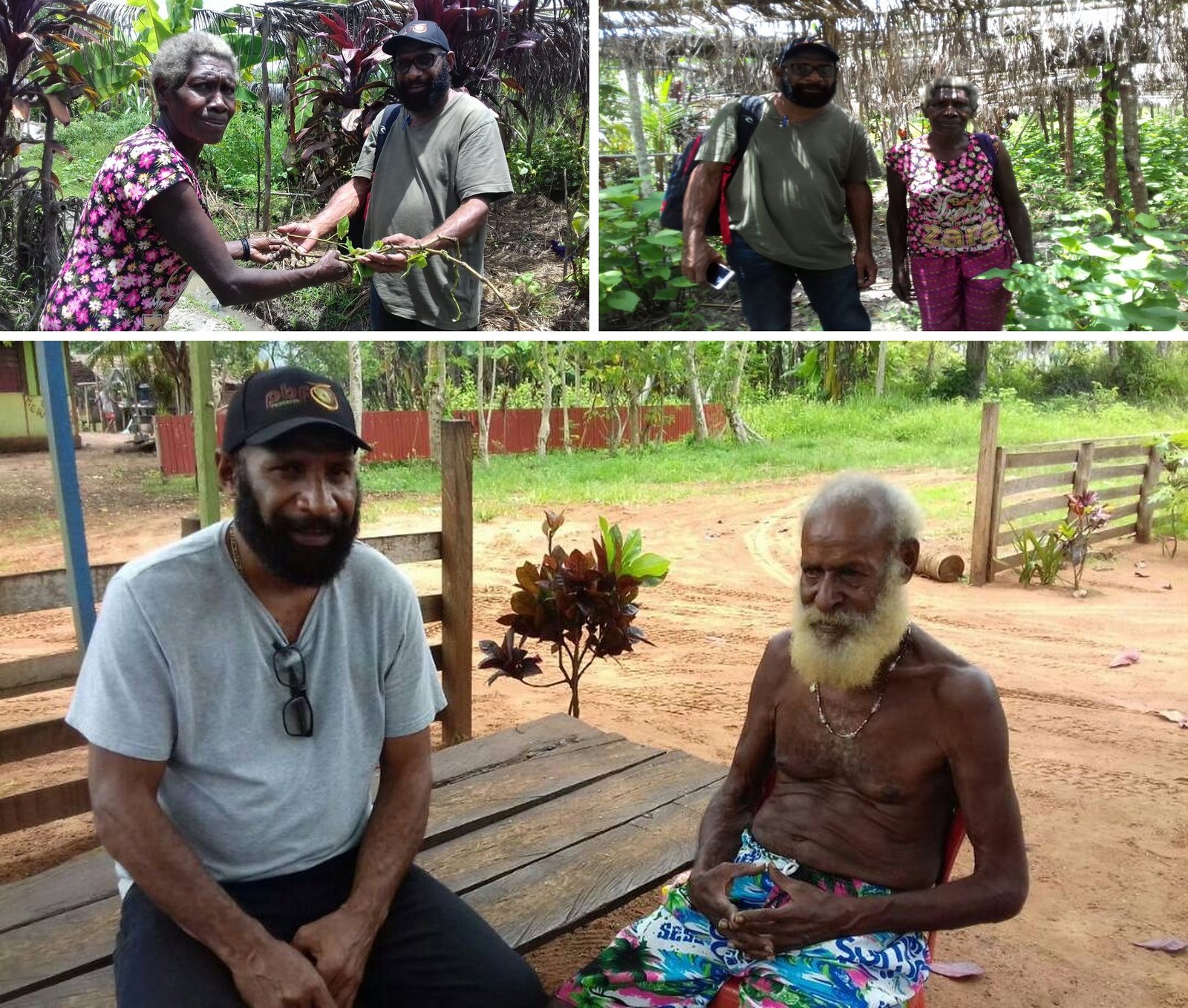
Marind informants interviewed at Merauke, in interviews communicated to the author on July 19 and 26, 2018, described wati as a clonally propagated, sacred plant kept for customary and ritual use rather than daily drinking. They did not present one variety as superior to another, and the collector concludes that the noble and two-day distinction is an external construct rather than an indigenous one (Sanday, 2018; Figure 1).
3.3. A revived trade
On the Madang coast, kava is again a commercial crop. In 1987 it was “cultivated in a few isolated areas for consumption and also as a cash crop, in Sipaia Village for example, where it is grown and sold to Fijians living in Lae” (Lebot & Lévesque, 1989, p. 266), and the National Agricultural Research Institute later named Madang Short the most successfully produced and enjoyed variety (Dom, 2007).
Fiji imported 21 tonnes of kava from Papua New Guinea in 2017 and 529.1 tonnes in 2025, worth FJD 18.7 million: 64% of Fiji’s kava imports that year by volume and 45% by value (Ministry of Agriculture, Waterways and Sugar, 2026, Sections 3.1 and 5; Fiji Agriculture Statistics Online Data Library, 2026). By the author’s trade information, that trade is Isa-type kava, Madang Short and Madang Tall, now commonly drunk in Fiji and blended into Fijian kava to fortify the beverage. The author knows of no reports of ill effects directly attributed to positively identified Isa cultivar, an unsystematic trade observation. A survey of kava on the Fijian market found two samples coded 254631, which is the same code of Kali ISA and of the Madang chips: A rhizome from a market root bundle that the authors singled out as not favorable for human consumption, and a commercial powder they judged possibly to contain non-noble material, the origin of neither was established (Pasinszki & Devi, 2024).
4. Isa in Hawai‘i
4.1. Introduction and chemical record
Isa and Iwi were brought from Madang to Hawai‘i in the mid-1980s, propagated at the Lyon Arboretum and planted at the National Tropical Botanical Garden’s Hāna site (Johnston & Rogers, 2006, p. 58, Table 6.1). The first study of Hawaiian cultivars found that Isa, “originally from Papua New Guinea”, had a morphotype of its own and was the accession most distant from the Hawaiian cultivars in AFLP fingerprints, with 117 distinctive bands where the Hawaiian cultivars were all but identical (Lebot et al., 1999, Tables 1, 2 and 6). The Isa and Iwi accessions later genotyped by Vandenbroucke et al. (2015) came from a nursery in Hilo.
Table 4 compiles the analytical record of Isa and Iwi. The 1987 Usino root sample is 254631. In the 2007 survey, Madang Short roots returned four codes at three sites, three of them kavain-led (425613 and 425163 at Madang, 421563 at Keravat), and Madang Tall two (245163 at Lae, 421563 at Keravat) (Dom, 2007). The six Madang chip plants of 2018 all returned 256431. In Hawai‘i the name Isa carries seven codes from 1999 onward (Lebot et al., 1999, Tables 2 and 5; Johnston & Rogers, 2006, Table 3.2; Bittenbender, 2011, slide 33; FratiniVergano, 2015, Annex 6.6.5; Wang et al., 2015), every one led by dihydrokavain; what changes is the order of the kavalactones below it. These records differ in plant part, age, island, laboratory and method, and some may be of different clones carried under one name.
Flavokavains were measured in Hawaiian Isa only by the 2015 ACP-EU project, in three Oahu samples. The project lists Isa as two-day kava, yet all three met both Harmonized limits on an A + B basis, with flavokavains A and B at 2.9–4.4% of kavalactones, unlike every other two-day root and chip sample it analyzed (11.3–35.5%). Flavokavain C was not measured. For Ha-27, at 4.38%, it would breach the ratio limit if it reached 14.2% of A + B, inside the 2.4–15.2% seen in this study’s certificates, so Ha-27’s compliance on A + B + C cannot be established (Supplementary File S5).
Iwi has a thinner record: 256431 at 29.62% total kavalactones in 1987 (Lebot & Lévesque, 1989, Table 8 and Appendix 1), and 254631 at 8.58% here, the code of the 1987 Isa sample. Roots of the Hawaiian cultivar Hiwa, assayed in the same job, returned 462351, the code Lebot et al. (1999, Table 2) printed for Hiwa.
| Line | Source | Origin; part; age | Total KL % | Chemotype | FK/KL % | K/FKB |
|---|---|---|---|---|---|---|
| Isa | Lebot & Lévesque (1989, Table 8 and Appendix 1) | Usino, Madang Province; roots, collected 1987 | 9.97 | 254631 | — | — |
| Isa type | Dom (2007, Tables 3 and 4; Supplementary Table S8) | Madang Short; Lae, Madang and Keravat, Papua New Guinea; roots; published 2007 | — | 245163 (Lae, Madang); 425613 and 425163 (Madang); 421563 (Keravat) | — | — |
| Isa type | Dom (2007, Tables 3 and 4; Supplementary Table S8) | Madang Tall; Lae and Keravat, Papua New Guinea; roots; published 2007 | — | 245163 (Lae); 421563 (Keravat) | — | — |
| Isa | Lebot et al. (1999, Tables 2 and 5); also printed by FratiniVergano (2015), from Johnston & Rogers (2006) | Alia Point Nursery, Hawai‘i Island; lateral roots, 2 years | 10.8 | 246531 | — | — |
| Isa | FratiniVergano (2015), Ha-26 | Oahu; roots, 2 years | 7.39 | 243651 | 3.65 | 7.23 |
| Isa | FratiniVergano (2015), Ha-11 | Oahu; root and chip powder | 8.19 | 256431 | 2.93 | 7.88 |
| Isa | FratiniVergano (2015), GS-132 | Hawai‘i Island; root and chip powder | 15.16 | 256431 | — | — |
| Isa | FratiniVergano (2015), Ha-27 | Oahu; unpeeled chips, 2 years | 2.74 | 253641 | 4.38 | 6.80 |
| Isa | Johnston & Rogers (2006, Table 3.2) | One-year root; stump | — | 245631; 254631 | — | — |
| Isa | Bittenbender (2011, slide 33) | University of Hawai‘i field trial (cultivar, light, fertilization and pruning); part not stated | — | 245613 | — | — |
| Isa | Wang et al. (2015) | Waimanalo, Oahu; freeze-dried beverages of 3.4-year roots and rhizomes | — | 254631 (both beverages); 245631 (acetone extract of root beverage) | — | — |
| Isa | This study (J19-0904-C, 2019) | Madang; peeled chips of six plants, harvested July 2018 | 4.18–23.1 | 256431 (all six) | 2.59–3.25 | 6.28–8.96 |
| Isa | This study (J24-0520-E, 2024; comparator) | Pa‘auilo, Hawai‘i Island; part not recorded | 4.05 | 254631 | 2.49 | 8.87 |
| Iwi | Lebot & Lévesque (1989, Table 8 and Appendix 1) | Madang; roots, collected 1987 | 29.62 | 256431 | — | — |
| Iwi | This study (J18-1228-D, 2019) | Roots | 8.58 | 254631 | — | — |
FratiniVergano (2015) values are percent of dry matter, with flavokavains A and B only; K/FKB is 100 divided by the printed FKB/K × 100. Codes are as given in each source, except the Iwi sample and the Pa‘auilo Isa lot of this study, computed from their certificates; the 1989 totals are from the survey’s Appendix 1. The annex profiles are tabulated in Supplementary Table S5.
4.2. Cultivation and use
The introductions were intended to widen the narrow genetic base of Hawaiian ‘awa. By the author’s account, Isa was favored by growers for its vigor, disease resistance, yield and potency, and it became one of the most widely grown cultivars of the Hawaiian kava trade of the 1990s. It was exported for the manufacture of nutraceutical kava products and was commonly served in Hawaiian ‘awa bars as a stronger kava than the Hawaiian cultivars, with no ill effects reported to the author’s knowledge. These statements are the author’s trade observations, not measured outcomes.
4.3. Why the code varies: Chemotype and place
Chemotype is held to be largely under genetic control and, on average, stable within a clone (Lebot & Lévesque, 1996b). The designed test of place, age and organ by Siméoni and Lebot (2002) found that “for a given cultivar, chemotype is stable across locations” and that it appears stable after about two years of growth, and Devi and Pasinszki (2025) found the environmental influence on the kavalactone profile to be about a third (32%) within Taveuni, Qamea and Rabi. Any reading of the Isa record has to start from those results.
Table 5 lists cases in which one named cultivar, or one morphotype, returned more than one code, with what each case held constant and what it varied besides place. Most vary plant part, age, laboratory or the plant itself, and plant parts differ in kavalactone distribution (Jaiswal et al., 2020). The Vila case, eight clones planted on the same day at one site, shows codes changing with place held constant: That is the baseline any effect of place must exceed.
| Cultivar or morphotype; source | What was compared | Held constant | Also varied | Result |
|---|---|---|---|---|
| Papua New Guinea and Hawai‘i | ||||
| Four local names for what the survey treated as one cultivar (Isa, Iwi, Sipaia, Ayou), Papua New Guinea; Lebot & Lévesque (1989, Table 8 and p. 273) | Five root samples at four localities, 1987 | Laboratory, method, plant part | Named cultivar; plants not genotyped | Five codes, all beginning 25: variation within a morphotype, not within a clone |
| Madang Short, Papua New Guinea; Dom (2007); Supplementary Table S8 | Roots at Lae, Madang and Keravat | Laboratory, method, plant part | Plant age and handling not reported | Four codes: 245163, 425613, 425163 and 421563 |
| Isa, Hawai‘i; Table 4 | All published records | — | Laboratory, method, plant part, age | Seven codes, all led by dihydrokavain |
| Alia #3, Hawai‘i; Lebot et al. (1999, Tables 2 and 6) | Seven root samples at three sites | Laboratory, method; fingerprints all but identical | Plant age not reported | Five codes, two of them from clones of one accession |
| Wa‘a Wa‘a, Hawai‘i; Lebot et al. (1999, Table 2); this study (Section 4.4) | A root sample at Alia Point Nursery, 1999, and a Puna sample, 2020 | — | Laboratory, method, place, age; plant part not recorded in 2020 | 241365 in 1999 and 256431 in 2020, both led by dihydrokavain |
| Hiwa, California; this study (Supplementary Table S1) | Roots, lateral roots, crown roots and peeled stump, 2019 | Place, laboratory | Plant part; harvest date | 462351, 462531, 642531 and 264531; the crown-root and stump codes turn on gaps of 0.7–3.3% |
| Vanuatu and Samoa | ||||
| Vila, a two-day cultivar; Lebot & Lévesque (1989, Tables 1, 3 and 4) | Eight clones planted on the same day and harvested at two years | Place, age, laboratory, method | The individual plant | Three codes: 256431, 265431 and 246531 |
| Tudey, a two-day cultivar; Lebot & Lévesque (1989, Tables 1, 3 and 4) | Four plants | Laboratory, method | Age, 13 to 28 months | Four codes: 426135, 421635, 256431 and 423615 |
| Ava lea, Samoa; Lebot & Lévesque (1989, Table 7); Lebot et al. (1999) | Three Samoan localities in 1987, and Hawai‘i in 1999 | — | Laboratory, method, age | Three codes in Samoa, led by dihydrokavain, methysticin and kavain; 463251 in Hawai‘i |
| Fiji | ||||
| Matakaro and Matakaro balavu; Lebot & Lévesque (1989, Table 6 and Appendix 1) | Five roots at four localities on three islands, 1987 | Laboratory, method, plant part | Probably one cultivar under two names | Five codes, led in turn by dihydrokavain, kavain and methysticin |
| Named noble cultivars; Devi & Pasinszki (2025); Pasinszki, Devi & Krebsz (2025) | 184 roots on six islands | Laboratory, method, plant part | Farm, drying, age (reported); clone identity rests on names | Positions below kavain differ by island (Supplementary Table S9) |
—, nothing held constant beyond the name. Cultivar identity rests on the names in use in every case; no case was genotyped.
The Fijian surveys are the strongest case, because one laboratory measured named noble cultivars on one plant part, roots, on six islands with one HPLC method: 88 plants on Taveuni, Qamea and Rabi (Devi & Pasinszki, 2025) and 110 on Rotuma, Kadavu and Vanua Levu (Pasinszki, Devi & Krebsz, 2025). Across the 184 root profiles of named noble cultivars printed in their tables, location explained 32% of the variance in methysticin relative to kavain and 32% of that in yangonin, against 23% and 5% for cultivar; with drying method and plant age added, location still explained 27% and 28%, and drying and age 1–3% each (Supplementary Section S6.6 and File S5). Kavain stayed first in every noble root. The codes by island are given in Supplementary Table S9. The authors found kavalactone profiles “more characteristic of the region than of kava cultivars” (Pasinszki, Devi & Krebsz, 2025, Sections 3.4 and 4), and the contrast with the “small” environmental influence found by Devi and Pasinszki (2025) is largely one of scale: Within Taveuni, Qamea and Rabi the differences are small, and the larger contrasts lie between that area and Rotuma. Siméoni and Lebot (2002) asked whether the code as a whole held across locations; the Fijian differences lie below the leading kavalactone but are present nonetheless. This is an observational association, consistent with an environmental influence.
In Hawai’I, kava opening with 256 grew on Oahu in 1987. Kava was then no longer cultivated in Hawai‘i, and the 1987 survey collected seven Oahu roots as local cultivars without vernacular names, Oahu 236–239 at the Lyon Arboretum and Oahu 240–242 in a private garden (Lebot & Lévesque, 1989, p. 264, Table 7 and Appendix 1). Six were dihydrokavain-led, and three opened 256, as the 1987 Iwi sample and the Madang Isa chips do: Oahu 241 (256143), Oahu 242 (256134) and Oahu 238, printed as 256143, although its printed proportions give 256413 (Supplementary File S5). In Oahu 241 and 242, kavain is fifth or last, below desmethoxyyangonin, whereas the Papuan Isa and Iwi records place it third or fourth. In Oahu 238 it is fourth, tied within 10% with desmethoxyyangonin. The survey placed all six dihydrokavain-led Oahu roots in its chemotype E, with cultivars from Vanuatu, including the two-day Vila, Tudey and Palisi, and from Tonga, Wallis, the Marquesas and Pohnpei, a chemotype it described as producing “a very pronounced physiological effect”, and it related Oahu 241, from the private garden, to Omoa, a cultivar of the Marquesas (Lebot & Lévesque, 1989, Table 9 and pp. 273–274). Oahu 236–239 grew at the arboretum where Isa and Iwi were propagated after their introduction, and whether any of these roots was Papuan cannot now be established. In the 1999 study, 42 of 44 Hawaiian root samples were kavain-led. The exceptions were Isa, whose fingerprint is distinct from every Hawaiian cultivar, and Wa‘a Wa‘a, a Hawaiian cultivar with a dihydrokavain-rich code (241365) and the fingerprint of the kavain-led Hawaiian cultivars (Lebot et al., 1999, Tables 2 and 6). At least some Hawaiian kava cultivars were therefore dihydrokavain-led and were not Isa, and a dihydrokavain-led code in a Hawaiian sample does not by itself identify it as a tudei-type variety. What sets Isa apart from the Hawaiian cultivars is its fingerprint and morphotype, not its code, and some of the Hawaiian historical records under its name may be of other clones.
Taken together, these cases show that a name can carry more than one code, usually with the lead held and the positions below it moving. For Isa, a swap of the second and third positions moves the code between 254 and 245; the Harmonized standard’s noble chemotype criterion admits the opening 24 but not 25, so that swap decides whether an Isa record meets it, and Kali ISA’s 254631 does not (Kava Coalition, 2025, Section 3.2). The Isa record crosses laboratories, methods and plant parts, so it cannot say how much of its variation is due to place. It also cannot be accepted for one purpose and set aside for another. The 2015 ACP-EU project, commissioned to advise the regional Codex standard, listed Isa as two-day kava, and its own four Hawaiian Isa samples, analyzed by one laboratory, returned three codes: 243651 in roots, 256431 in two root-and-chip powders and 253641 in unpeeled chips (Table 4). If these and the other Hawaiian records are taken as accurately reported and correctly identified, as their use in advising a standard requires, then Isa did not hold one code in Hawai‘i, and a code that a cultivar does not keep cannot by itself place it in a class. If they are not accurately reported then they cannot support the two-day listing either. Either way, the Hawaiian record does not establish Isa as two-day kava. Only the Fijian data hold laboratory, method and plant part constant, and they point to an environmental influence on the secondary and tertiary positions that is consistent with, but does not establish, a cause.
4.4. Wa‘a Wa‘a beside Isa
Wa‘a Wa‘a was collected by John Fowler at Hawaiian Beaches, in the Puna district of Hawai‘i Island, and planted in a collection in December 1995, where it was recorded as “a deep green ‘awa with very long internodes, growing upright to 16 feet and more”; the collection record adds that it “could be Koa‘e” (Winter, 2004, Appendix 2). Koa‘e was described in 1930 as a fast-growing ‘awa whose stem bark carries long white stripes, perhaps growing at Mt. Ka‘ala, O‘ahu (Cox, 1930, cited in Winter, 2004, pp. 85–86). In 1999 a root sample of Wa‘a Wa‘a was coded 241365 at 7.5% kavalactones, and its AFLP fingerprint matched the kavain-led Hawaiian cultivars (Lebot et al., 1999, Tables 2 and 6; Section 4.3).
Two Hawaiian-grown samples were assayed by the same laboratory as the study material (Table 1; Supplementary items 29 and 30). The Puna Wa‘a Wa‘a sample of 2020 returned 256431 at 12.3% kavalactones, the code of the Madang Isa chips and of Munana (Tables 2 and 4), with methysticin 29% above kavain (2.19% against 1.70%), well outside the 10% tie convention. Its flavokavains were 0.262%, 2.1% of kavalactones, and kavain was 14.5 times flavokavain B. The Pa‘auilo Isa, assayed in 2024, returned 254631 at 4.05%, with kavain and methysticin within 3% of each other, a tie under the same convention (25(46)31); its flavokavains were 2.5% of kavalactones, and kavain was 8.9 times flavokavain B. Both met the two Harmonized flavokavain limits. Wa‘a Wa‘a now carries two codes, 241365 in 1999 and 256431 in 2020, both led by dihydrokavain (Table 5).
The codes differ in the place of methysticin and kavain, but the overall compositions overlap. Wa‘a Wa‘a lies 5.5–11.2 percentage points (mean 8.3) from the seven Kali ISA root and raw-material assays, within the spread of the Madang Isa chips, which lie 2.3–11.7 points from it, and 4.5 points from Munana; the Pa‘auilo Isa lies 3.3–8.2 points (mean 5.4) from the same seven assays, and the two Hawaiian samples lie 7.2 points apart. Both are 22–43 points from the kavain-led and wild-type material of Table 7 (Supplementary File S5). Wa‘a Wa‘a’s 2020 code opens 256, as did Oahu 241 and 242, the two 1987 roots from a private garden rather than the arboretum (Section 4.3), and with the collection record’s suggestion that it may be Koa‘e it is consistent with a native Hawaiian dihydrokavain-led cultivar rather than an introduction; since neither plant has been genotyped, that remains a hypothesis. As in 1999, Hawaiian kava can carry an Isa-type composition without being Isa.
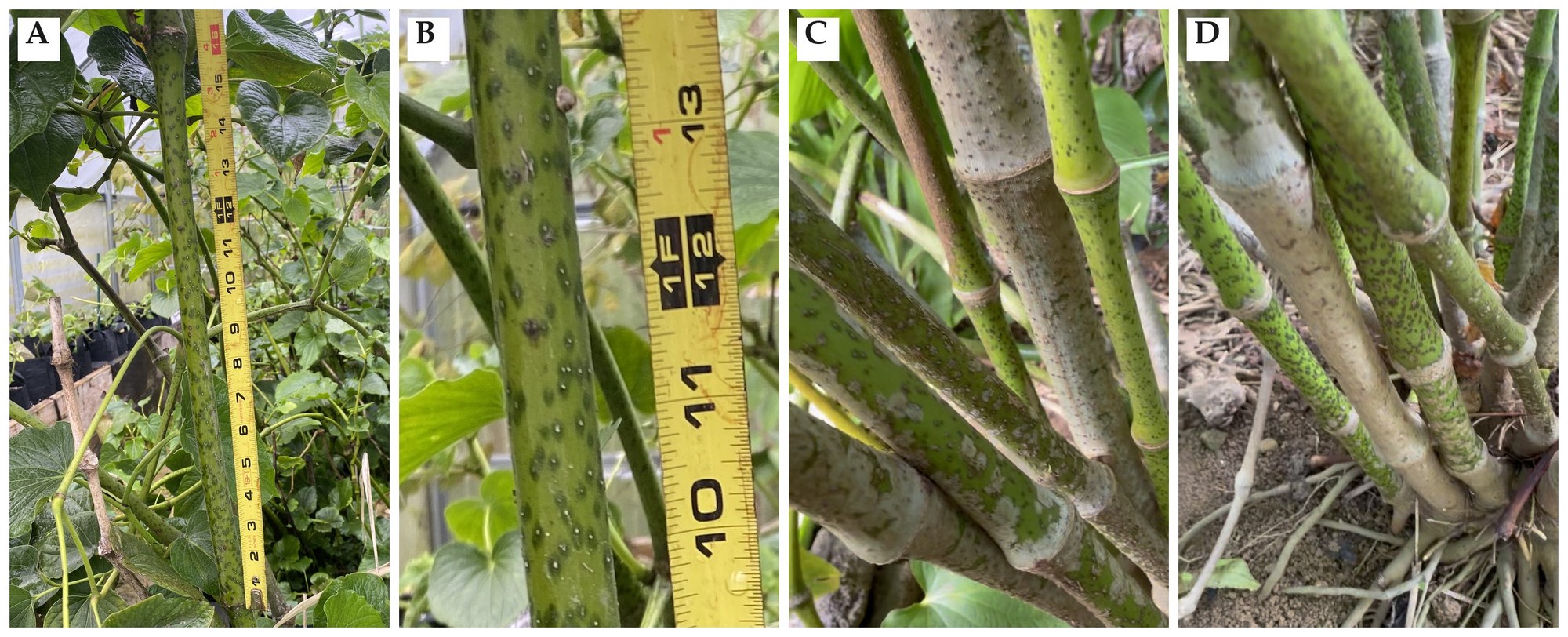
What separates the two is the plant. Isa is the only one of the 16 morphotypes described in 1999 to be scored as pubescent, and its pubescence placed it in a subclade of its own in the later morphological study of the Alia collection (Lebot et al., 1999, Table 1; Winter, 2004, p. 147). By the author’s observation (Figure 2), Isa stems stay green into maturity and carry raised, dark green lenticels, each with a white center, whereas mature Wa‘a Wa‘a stems take on a thick, pale blue-grey to white bark that Isa does not develop, and its young green stems carry dark lenticels without the white center. The Isa planting from which the Kali ISA line was taken was recorded on video at Pu‘u‘ala Kava Farm in 2013 (Root of Happiness, 2013; Section 5.1).
5. Kali ISA on the mainland
5.1. Selection and development
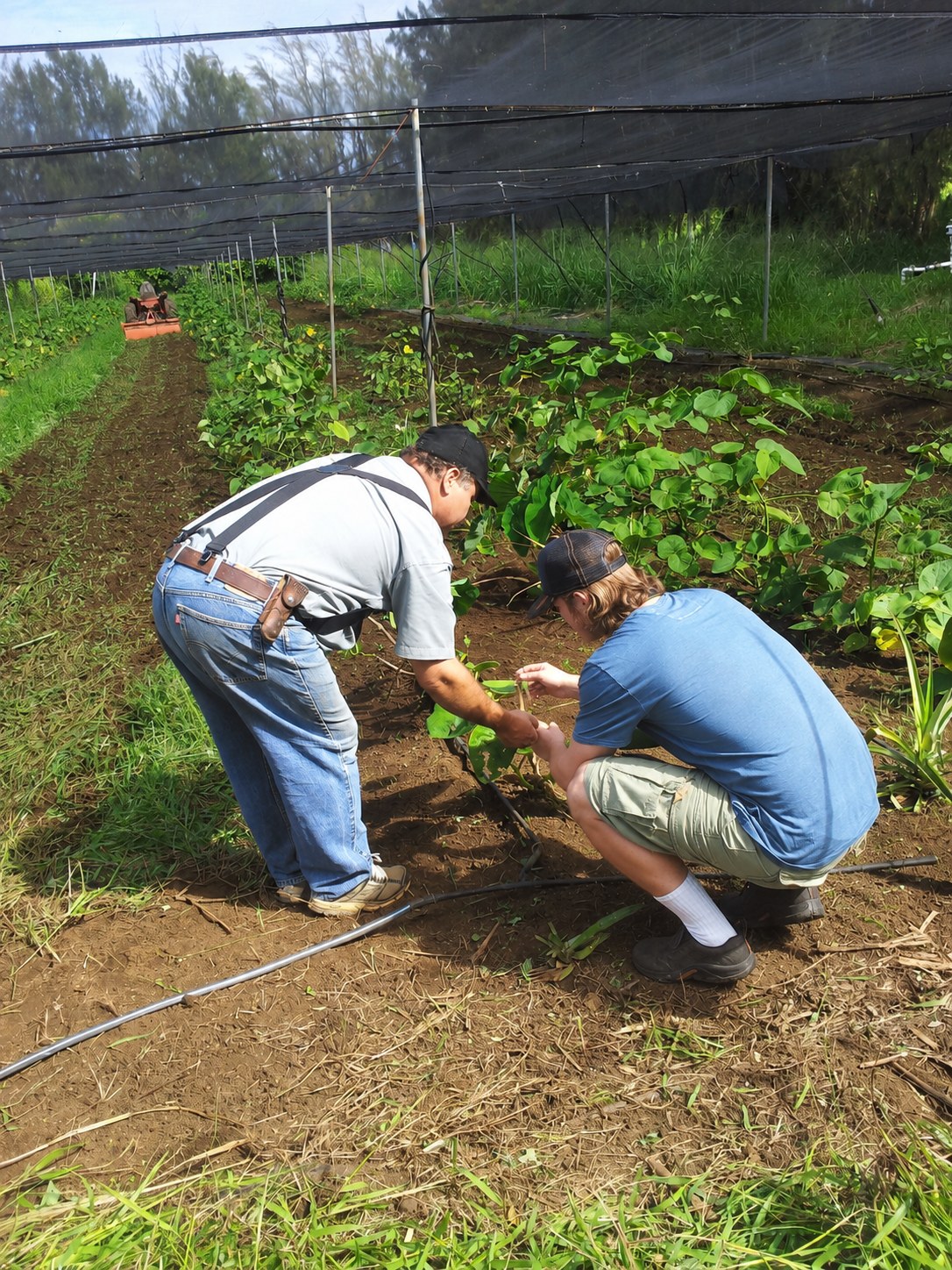
The history of the line is the author’s own account, corroborated where the genetic literature records the same route (Section 4.1). Beginning in 2008, the author traveled to Hawai‘i at least twice a year to study kava cultivation with growers, including Zach Gibson of Pu‘u‘ala Kava Farm on the Hāmākua Coast, and in 2013 acquired from that farm, among other cultivars, the Isa planting material from which the line descends (Root of Happiness, n.d.). A video recorded at the farm that year shows the author with the Isa planting, beside the Hawaiian cultivars Nēnē and Mahakea (Root of Happiness, 2013). In 2012 the author studied the variation between the cultivars at the farm with Gibson (Figure 3), and that comparison led to the choice of the sub-type of Isa that Gibson was growing.
Selection began in California in 2015, with cold and heat tolerance as the criteria rather than potency or chemotype. The most cold-tolerant individuals were placed in tissue culture, and the first plants grown out in 2017 retained the cold tolerance. Acclimation and re-culturing followed, and the author’s propagation records count 46 cycles of re-culturing by October 2026; Supplementary Figure S1 shows the propagation stages. Selection here means the choice of propagules from a sterile clone. No change of genotype is proposed, since in a clone propagated through tissue culture heritable change could arise only from somaclonal or epigenetic variation (Larkin & Scowcroft, 1981), and none was tested.
Plants of the line grown by Matthew Masifilo of Kavafied in Sarasota, Florida, in unamended Myakka sandy soil carrying concrete rubble and in full sun, were reported by the company to have survived a week-long cold event reaching 29 °F (Kali Kava, 2023), an observation of one event, without station temperature records, rather than a demonstrated gain in cold tolerance over the parent. By the author’s account, Kali ISA plantings at Sarasota have survived the winter outdoors without protection since 2022, and the line is grown at the Sacramento greenhouse and on commercial farms in Florida.
5.2. Assay results
Kali ISA was characterized in ten assays of beverage material: seven of lateral roots and raw material, from six lots harvested between 2023 and September 2025 at Sarasota and Boca Raton, Florida, and Sacramento, California, and three of peeled chips, assayed over 33 months from October 2023 to July 2026 (Table 6). Every root and raw-material assay was led by dihydrokavain and coded 254631, or differed from it only by a tie within 10%; potency varied about threefold with growing conditions, and flavokavains stayed below 3.6% of kavalactones. Six of the seven, and all three chip samples, met both Harmonized flavokavain limits.
| Lot or harvest | Grown | Part | Total KL | Chemotype | Total FK | FK/KL % | K/FKB | Both limits met |
|---|---|---|---|---|---|---|---|---|
| Lateral roots and raw material | ||||||||
| Sarasota lot, Oct 2023 | Florida | Lateral roots | 19.9 | 254631 | 0.697 | 3.50 | 6.22 | No |
| Boca Raton lot, Oct 2023 | Florida | Lateral roots and chips | 8.95 | 254631 | 0.320 | 3.58 | 6.69 | Yes |
| Harvest Jan 1, 2024 | Sacramento | Lateral roots | 7.00 | 254631 | 0.170 | 2.43 | 8.98 | Yes |
| Harvest May 1, 2024 | Sacramento | Lateral roots | 8.10 | 254631 | 0.138 | 1.70 | 12.86 | Yes |
| Harvest Jul 7, 2024 | Sacramento | Lateral roots | 6.38 | 254631 | 0.141 | 2.21 | 10.29 | Yes |
| September 2025 lot, Oct 2025 | Sacramento | Raw material | 14.2 | 254631 | 0.253 | 1.78 | 18.06 | Yes |
| September 2025 lot, Jul 2026 | Sacramento | Raw material | 14.3 | 254631 | 0.354 | 2.48 | 11.65 | Yes |
| September 2025 lot, mean of the two bags | Sacramento | Raw material | 14.2 | 254631 | 0.303 | 2.13 | 14.16 | Yes |
| Peeled chips, 2024 harvests | ||||||||
| Harvest Jan 1, 2024 | Sacramento | Chips | 2.37 | 254631 | 0.0624 | 2.63 | 8.95 | Yes |
| Harvest May 1, 2024 | Sacramento | Chips | 3.35 | 256431 | 0.0850 | 2.54 | 9.60 | Yes |
| Harvest Jul 7, 2024 | Sacramento | Chips | 2.34 | 256431 | 0.0876 | 3.74 | 5.56 | Yes |
| Summary | ||||||||
| Seven root and raw-material assays | 6.38–19.9 | 254631 (7) | 0.138–0.697 | 1.70–3.58 (mean 2.5) | 6.22–18.06 | 6 of 7 | ||
| Six lots, lot KI-R as one | 6.38–19.9 | 254631 (6) | 0.138–0.697 | 1.70–3.58 (mean 2.6) | 6.22–14.16 | 5 of 6 | ||
| Three peeled-chip assays | 2.34–3.35 | 254631 (1); 256431 (2) | 0.0624–0.0876 | 2.54–3.74 (mean 3.0) | 5.56–9.60 | 3 of 3 | ||
Sacramento, American Kava Association research greenhouse. The September 2025 rows are two assays of one homogenized lot, from two bags nine months apart, and their mean, which is the lot value in the six-lot summary. The Boca Raton lot is lateral roots and chips as they came out of the ground and is counted with the roots. Stems are excluded. Individual kavalactone values are given in Supplementary Table S1.
5.3. Composition beside Madang cultivated kava
Read code by code, Kali ISA returned 254631 in all seven root and raw-material assays, but that count overstates how fixed the code is. In three assays two kavalactones differ by less than 1%, inside the method’s repeatability: dihydromethysticin exceeds kavain by 0.6% in the Boca Raton lot, and kavain exceeds methysticin by 0.8% in the May 2024 harvest and by 0.9% in the second bag of lot KI-R. With ties bracketed, the seven read 254631 in four, 25(46)31 in two and 2(546)31 in one. The same knife-edge separates the materials compared: Madang Tall lateral roots code 245631 rather than 254631 on a 0.4% gap, and the Koniak lot 254631 rather than 256431 on a 0.3% gap.
Relative composition is the better comparison (Table 7). The seven Kali ISA assays differed among themselves by 1.7–9.4 points (mean 5.4) and lay 2.1–9.4 points (mean 5.4) from Madang Short and Madang Tall lateral roots, no further than their own spread, and 3.5–6.9 points (mean 4.9) from the Iwi roots. Kali Hiwa, a different cultivar grown in the same greenhouse, lay 18.3–26.5 points away, the kavain-led Fijian Waka 18.2–25.1, Palima 20.9–23.8 and Rai Coast Pink 39.1–43.4. On composition, Kali ISA is consistent with the cultivated kava of the Madang coast and distinct from the kavain-led and wild-type material assayed beside it.
| Material (assays) | Codes, ties within 10% bracketed (number of assays) | Spread within the material, points | Distance from Kali ISA roots, points |
|---|---|---|---|
| Kali ISA | |||
| Lateral roots and raw material (7) | 254631 (4); 25(46)31 (2); 2(546)31 | 1.7–9.4 (mean 5.4) | — |
| Peeled chips (3) | 25(46)31; 256431; 25(64)31 | 4.1–7.4 (mean 6.1) | 9.1–20.8 (mean 14.3) |
| Madang cultivated kava and Merauke | |||
| Madang Short and Madang Tall, lateral roots (2) | 2(45)631 (2) | 4.2 | 2.1–9.4 (mean 5.4) |
| Iwi, roots (1) | 25(46)31 | — | 3.5–6.9 (mean 4.9) |
| Munana, lateral roots (1) | 256431 | — | 3.5–12.2 (mean 8.9) |
| Madang Short and Madang Tall, peeled chips (2) | 254631 (2) | 3.0 | 3.3–11.6 (mean 6.7) |
| Isa peeled chips, six Madang plants (6) | 256(43)1 (2); (25)6(43)1 (2); 256431 (2) | 1.0–13.1 (mean 6.3) | 4.1–15.6 (mean 10.9) |
| Kavain-led and wild-type material | |||
| Kali Hiwa, same greenhouse, raw material (3) | 4(632)51 (2); 4(63)251 | 2.0–3.7 (mean 2.8) | 18.3–26.5 (mean 22.8) |
| Fijian Waka, lateral roots (1) | 46(32)51 | — | 18.2–25.1 (mean 22.2) |
| Palima, lateral roots (1) | (12)5634 | — | 20.9–23.8 (mean 22.0) |
| Rai Coast Pink, lateral roots (1) | 15(36)24 | — | 39.1–43.4 (mean 41.1) |
Each kavalactone is expressed as a percentage of the six; distances are Euclidean distances between profiles, in percentage points, as range (mean) over all pairs. Two kavalactones are bracketed when their difference is less than 10% of their mean (Devi & Pasinszki, 2025). The composition of every profile is in Supplementary Table S4, and the full distance matrix, as formulas, in File S5.
Plant part matters as much as provenance: Madang lateral roots lie 7.1–9.8 points (mean 8.1) from their own peeled chips, and the six Madang Isa chip plants, all coded 256431, spread over 1.0–13.1 points (mean 6.3). The mainland record is also one laboratory, one method and almost all lateral roots and raw material, whereas the Hawaiian records span laboratories, methods and parts (Table 4). The data therefore show consistent composition across seven assays in one laboratory, as close to Madang-grown roots as to one another, rather than a line more stable than its parent.
Potency followed the growing conditions. Greenhouse lateral roots harvested at 21.5–27.7 months held 6.38–8.10% total kavalactones, and lot KI-R, at 18 months, 14.2–14.3%, with one plant per harvest date. Siméoni and Lebot (2002) found kavalactone content still rising in the first 18 months of growth and chemotype appearing stable after about two years; the Kali ISA material was harvested at or near that age, and the Madang plants at five years or more. This study does not separate the contributions of genotype, selection, cultivation, plant age, harvest timing, storage and processing to any difference between Kali ISA and Madang-grown material.
5.4. Flavokavains in context
In lateral roots and raw material, Kali ISA carried flavokavains at 1.70–3.58% of kavalactones, a mean of 2.5% over seven assays and 2.6% over six lots: 0.61 of the mean for Madang lateral roots and the Koniak lot (4.15%), and 0.51 for the Sacramento material alone. That comparison crosses plant age, storage and handling, the Kali ISA lots being 18–28 months old and the Madang plants at least five years.
The like-for-like comparison is peeled chips of Isa from each place, assayed by the same laboratory. Kali ISA chips ran at 2.54–3.74% (mean 2.97%) and the six Madang Isa chip plants at 2.59–3.25% (mean 2.95%), with kavain at 5.56–9.60 times flavokavain B (mean 8.03) against 6.28–8.96 (mean 7.83). In chips, the line and its Papuan parent do not differ, although they were measured by different generations of the laboratory’s method and the Madang chips were stored about 13 months before submission. Table 8 sets both comparisons beside published HPLC values for kava of known class: Kali ISA overlaps the upper part of the noble range and lies far below two-day kava.
| Material | Range | Mean or median |
|---|---|---|
| This study, one laboratory | ||
| Kali ISA, lateral roots and raw material (7) | 1.70–3.58 | Mean 2.5 |
| Kali ISA, Sacramento greenhouse only (5) | 1.70–2.48 | Mean 2.1 |
| Madang lateral roots and the Koniak lot (3) | 3.65–4.84 | Mean 4.2 |
| Kali ISA, peeled chips (3) | 2.54–3.74 | Mean 2.97 |
| Isa peeled chips, six Madang plants (6) | 2.59–3.25 | Mean 2.95 |
| Rai Coast Pink, wild-collected (2) | 5.41–6.35 | — |
| Kali Hiwa, Sacramento greenhouse, raw material (3) | 1.25–2.19 | Mean 1.8 |
| Fijian Waka, lateral roots (1) | 1.63 | — |
| Hiwa, California, 2019: lateral roots, crown roots and peeled stump (3) | 1.79–3.68 | — |
| Published HPLC values, roots | ||
| Noble cultivars, 2015 ACP-EU project (46) | 0.50–2.70 | Median 1.10 |
| Noble cultivars, four Fijian islands (32) | 0.67–1.80 | Median 1.00 |
| Two-day cultivars, 2015 ACP-EU project (5) | 11.3–35.5 | Median 12.3 |
| The same without Tahu, listed as noble in the Solomon Islands (4) | 12.1–35.5 | Median 19.6 |
| Unclassified cultivar judged non-noble, Rabi, Fiji (10) | 8.3–10.4 | — |
| Standard | ||
| Harmonized ratio limit | Below 5 | — |
Numbers of assays or roots are in parentheses. The 2015 values count flavokavains A and B only, the others A, B and C; counted on A and B alone, the seven Kali ISA assays read 1.66–3.57%. The 2015 and Fijian values come from other laboratories and are derived in Supplementary File S5. The 2019 Hiwa and Madang Isa chip assays used the laboratory’s earlier methods, on an as-is basis.
Lot variability is observed in the second bag of lot KI-R, assayed nine months after the first, and carried 43% more flavokavain B, moving FK/KL from 1.78% to 2.48% and K/FKB from 18.06 to 11.65 while its code and total kavalactones held. Whether this reflects heterogeneity within the lot, storage or analytical variation was not tested, and the lot is reported as the mean of the two bags (2.13%; 14.16).
Hiwa, a kavain-led Hawaiian cultivar, gives a check from two settings. Grown beside Kali ISA, Kali Hiwa read 1.25–2.19%, and 1.25% and 1.88% against 1.78% and 2.48% for Kali ISA in the two jobs they shared; grown on a California plot and assayed in 2019, Hiwa read 1.79% in crown roots, 2.86% in peeled stump and 3.68% in lateral roots, above every Kali ISA root and raw-material assay (Supplementary Section S6.7). Between the two settings, which also differ in year, method generation, basis and plant part, Hiwa’s ratio moved further than the gap between the two cultivars grown side by side.
The one Kali ISA assay to exceed a Harmonized limit was the Sarasota lot. It met the ratio limit, at 3.5%, but at 19.9% total kavalactones, the most potent lot recorded for the line, it exceeded the absolute limit at 0.697% w/w. However, material of that composition would stay below 0.4% w/w at any kavalactone content up to 11.4%.
On a second measure, K/FKB, Kali ISA lies between the two-day and noble roots of the 2015 project: 6.22–14.16 by lot (6.22–18.06 by assay), against a two-day median of 2.24 and a noble range of 15.7–83.3 (median 53.6). Only the first bag of lot KI-R exceeds the lowest noble root, Nene Ha-20 (15.7), which the 2015 report treats as an outlier; the next-lowest is 29.1. The ratio reads low partly because kavain is third in this chemotype: it made up 15.6–18.1% of the kavalactones in Kali ISA against a median of 27.1% in the 2015 noble roots, while the kavain-led Kali Hiwa, grown beside it, read 32.60–46.75, inside the noble range. Why the two measures disagree is taken up in the companion paper (Blythe, in preparation).
Place may move the flavokavain ratio as much within one named cultivar: measured by one laboratory, the Fijian noble cultivar Matakaro balavu carried 0.57 times as much flavokavain per unit of kavalactone on Kadavu as on Rotuma (Pasinszki, Devi & Krebsz, 2025, Tables 2, 3 and 7, recomputed; Supplementary File S5), a difference of the order of the root difference between Kali ISA and Madang-grown material.
5.5. How it is drunk
Kava of the Isa type is a beverage kava in practice: it has been drunk on the Madang coast since the first records, is grown today for the Fijian market, where it is drunk and blended into Fijian kava, and was commonly served in Hawaiian ‘awa bars as a stronger alternative to Hawaiian ‘awa; it is also served in mainland American kava bars (Sections 3.2, 3.3 and 4.2). The author knows of no widespread reports of kava hangovers or undesirable effects from it, an unsystematic trade observation rather than a measured outcome.
How Kali ISA is prepared matters. Stems of the January and July 2024 harvests, assayed alongside the study material but not counted among its 28 assays, carried the most flavokavain B relative to kavain of any Kali ISA material, with K/FKB of 3.48 and 1.47 against 5.56–18.06 in lateral roots, chips and raw material. Separating lateral roots from stump and stem, peeling the chips and excluding stems and peelings keeps the material richest in flavokavain B out of the beverage.
Prepared this way, Kali ISA is in the author’s experience milder to drink than Papuan-grown Isa-type kava and without the after-effects attributed to two-day kava. That is an observation, not an outcome measured in this study.
5.6. Characterization of Kali ISA
Kali ISA is one line selected in 2015 from Hawaiian Isa, a Madang cultivar, for cold and heat tolerance, and then tissue-cultured. Six lots harvested from 2023 to September 2025 at Sarasota and Boca Raton in subtropical Florida and in a Sacramento greenhouse, and assayed by one laboratory from October 2023 to July 2026, gave:
- Identity: Piper methysticum root, by HPTLC, for the mother-plant stock (lot KI-R).
- Composition: dihydrokavain-led in every assay; coded 254631 in all seven root and raw-material assays, or 254631 in four and a tied variant in three with ties within 10% bracketed; no further from Madang-grown lateral roots than from one another, and far from the kavain-led and wild-type material assayed beside it.
- Total kavalactones: 6.38–8.10% in greenhouse lateral roots at 21.5–27.7 months, 14.2–14.3% in raw material from the mother stock at 18 months, 19.9% in field-grown Sarasota roots, and 2.34–3.35% in peeled chips.
- Flavokavains: 1.70–3.58% of kavalactones in roots and raw material, 0.61 of the mean for Madang root material from older plants; 2.54–3.74% in peeled chips, the same as Madang Isa chips. Six of seven root and raw-material assays, and all three chip samples, met both Harmonized limits.
- Hardiness: by the author’s account, plantings at Sarasota have survived the winter outdoors, unprotected, since 2022.
On the mainland, the line has kept the composition of Madang cultivated kava; its flavokavain ratio was lower than in the older Madang roots and the same in peeled chips. The Hawaiian codes of its parent cultivar vary, but those records cross laboratories, methods and plant parts and cannot be compared with this one on equal terms.
Where it sits. Four things are kept apart here. Composition was measured, as above. Compliance with the two Harmonized flavokavain limits was measured, and six of seven root and raw-material assays met both; the same standard’s noble chemotype criterion, a code beginning 42 or 24, is not met by 254631. Tolerability was not measured. By the measures used here, Kali ISA fits neither class: its K/FKB (6.22–14.16) lies below every 2015 noble root (15.7–83.3) and its code outside the Harmonized noble criterion, while its flavokavains lie far below two-day kava; formal classification under a named framework is taken up in the companion paper. Genetically, Kali ISA descends, by the author’s account, from Hawaiian grown Isa, an accession genotyped as distinct from the noble, two-day and wild groups sampled in Vanuatu and Polynesia (Vandenbroucke et al., 2015; Lebot et al., 2024); the line itself has not been genotyped. Its FK/KL overlaps noble HPLC values: five of seven root and raw-material assays fall inside the range of the 2015 noble roots (0.50–2.70%), and it reaches the top of the Fijian noble range (0.67–1.80%), far below two-day roots (11.3–35.5%). Its K/FKB lies between the two-day values and the noble range. Its code is not an identity test: 254631 was also found in two samples on the Fijian market whose origin was not established (Pasinszki & Devi, 2024). Its root code, 254631, and the 256431 of two of its chip samples are those of the Isa and Iwi samples that the 1987 survey placed in its chemotype F (Section 3.1.1). The Codex regional standard admits only noble varieties, confirmed by morphology, as raw material (Codex Alimentarius Commission, 2020, Section 3.1), and meeting the Harmonized flavokavain limits is neither that standard nor noble status.
How it has been classed. Isa has been placed with the two-day cultivars on accessions of the Vanuatu germplasm collection on Santo (Lebot, Do & Legendre, 2014) and by the 2015 project commissioned to advise the regional Codex standard, although that project’s own Hawaiian Isa samples met both Harmonized flavokavain limits on an A + B basis, unlike every other two-day root and chip sample it analyzed (Section 4.1); the Santo accessions and the Kali ISA mother stock have not been genotyped against each other.
6. Limitations
Each named Papuan variety is represented by one lot per plant part, the 2024 harvest series by one plant per date, and the two Hawaiian comparators by single samples whose plant part is not recorded. No sample was genetically authenticated: cultivar identity rests on the growers’ and the author’s identification, supported for the Madang material by photographs, and for Palima and Munana on the names given at collection.
The root flavokavain comparison crosses plant age (18–28 months against five years or more) and storage, and the two bags of lot KI-R differed by 43% in flavokavain B; the peeled-chip comparison shows no difference. The lower root ratio of Kali ISA therefore cannot be assigned to selection, plant age, place or handling. A side-by-side planting of Kali ISA and unselected Isa, of the same age and harvested and handled together, would separate them.
The HPTLC identification covers lot KI-R only, and the current certificates state no basis for their results. Comparisons with the historical and reference records cross laboratories and methods, and the 2015 values count flavokavains A and B only. The Fijian variance partition is observational. The Kali ISA history, plant ages and several harvest dates rest on the author’s records and the growers’ accounts.
Tolerability and two-day effects were not measured. Statements on how Isa-type kava is grown and drunk in Hawai‘i, Fiji and on the mainland, and on the absence of reported ill effects, are the author’s unsystematic trade observations from serving Madang Isa and Kali ISA at kava bars over 15 years.
7. Conclusions
Kava on the Madang coast has a long record of regular use. Miklouho-Maclay, who lived at Astrolabe Bay in 1871–1872, reported in 1874 that it was drunk by adult men at every feast and, in villages that grew much of it, in ordinary times, and that it was highly prized. In every assay here its cultivated kava was led by dihydrokavain, at 14–16% kavalactones in lateral roots with moderate flavokavains, but the chemotype record of Isa across other surveys is unclear. The 1987 survey coded Isa 254631, while the 2007 National Agricultural Research Institute survey gave Madang Short four codes at three sites, three of them kavain-led (425613, 425163 and 421563). Papua New Guinea now supplies a Fijian market that imported 529.1 tonnes of Papuan kava in 2025 and by the author’s trade observation, this Isa-type kava is drunk in Fiji and blended into Fijian kava for local sale and export, without reported incident.
In Hawai‘i, Isa’s published chemotype codes number seven, and the 2015 ACP-EU project that listed it as two-day kava recorded three of them in its own four Isa samples. Taken as reported, Isa did not hold one code there, and a code it does not keep cannot by itself class it. Across six Fijian islands, location explained 32% of the variance in methysticin and in yangonin relative to kavain in named noble cultivars, consistent with an environmental influence that the designed study of Siméoni and Lebot (2002) did not find.
On the mainland, seven root and raw-material assays of six Kali ISA lots, from three settings in two states, returned 254631 or ties with it within 10%, and lay as close to Madang lateral roots in relative composition as to one another. Its root flavokavains were 0.61 of the Madang mean, in younger plants, and matched Madang Isa in peeled chips. Descended from an accession genotyped as distinct from noble, two-day and wild kava, noble by neither its code nor its K/FKB, and far below two-day flavokavain levels, Kali ISA fits neither class, and whether it warrants beverage-grade status is taken up in the companion paper.
Supplementary Materials
Supplementary Data: Analytical Certificates, comprising S1, the index of certificates; S2, the consolidated data table (Table S1), repeatability (Table S2), raw-material equivalents (Table S3), relative composition (Table S4) and supplementary notes; S3, the certificates as issued, including the three Kali Hiwa comparator assays (item 23), the Fijian Waka comparator (item 24), the HPTLC identification (item 25) and the four 2019 Hiwa comparator certificates (item 26); S4, reference data from FratiniVergano (2015), transcribed into Tables S5–S7, with the 2015 root samples behind the HPLC reference values in Table S6; S6, supplementary text giving in full the material condensed in this paper, with the 2007 Papua New Guinea survey (Table S8) and the Fijian codes by island (Table S9); S7, added in version 2.0, the Wa‘a Wa‘a and Pa‘auilo Isa comparator certificates (items 29 and 30); and Supplementary Figure S1, propagation photographs. Supplementary File S5: derived-value workbook (.xlsx), with the certificate values and every derived code and ratio as formulas, the relative-composition matrix behind Table 7, the 2015 HPLC reference values, the transcribed Fijian kavalactone data behind Section 4.3 with the variance partition, the recomputed Fijian flavokavain values used in Section 5.4, and the Hawaiian records discussed in Section 4.3. The accepted manuscript, the Supplementary Data and Supplementary File S5 are deposited on Zenodo: https://doi.org/10.5281/zenodo.24330977.
Author Contributions
Conceptualization, data curation, formal analysis, investigation, writing—original draft preparation, and writing—review and editing, T.B. The author is responsible for the manuscript and its underlying data.
Funding
No external funding was received for the preparation of this paper. The Merauke material analyzed in Section 3.1 was contributed by John Sanday of Melanesian Trustee Services Limited, who declined payment for the shipment and asked to be cited; he had no role in the analysis, the interpretation or the decision to publish. The laboratory analyses were commissioned and paid for by Root of Happiness, a company co-founded by the author, except the Boca Raton lot, which was submitted by Nakava, LLC.
Institutional Review Board Statement
The field observations in Section 3.2 derive from interviews with Marind chiefs and community members conducted by John Sanday of Melanesian Trustee Services Limited and communicated to the author on July 19 and 26, 2018. They are relayed as personal communication and were not conducted under institutional review. Verbal consent was obtained from the community and from each interviewee.
Informed Consent Statement
Verbal consent was obtained from the individuals shown in the photographs in Figure 1.
Data Availability Statement
The Flora Research Laboratories certificates underlying this paper are reproduced in the Supplementary Data, and the derived-value workbook is provided as Supplementary File S5. The harvest record for the 2024 series is available from the corresponding author.
Use of Generative Artificial Intelligence
An AI assistant was used to extract values from the laboratory certificates, compute the derived chemotype codes and ratios reported here, and draft, revise and condense the manuscript into journal-article form in response to Computational Manuscript Review and the author’s own revisions. Every derived figure was computed from the certificate values rather than estimated; the source certificates, the underlying data and the conclusions are the author’s, and the author reviewed every change. The final revisions, versions 1.8 and 1.9, were prepared with the AI system used for the journal’s Computational Manuscript Review. Version 2.0, which adds Section 4.4 and Figures 2 and 3 and revises the Abstract and Sections 4.3, 5.6, 6 and 7, was prepared with an AI assistant in the same way.
Acknowledgments
The author thanks John Sanday, Executive Chairman of Melanesian Trustee Services Limited, Port Moresby, who located wati in Indonesian Papua, traveled to Merauke, interviewed Marind chiefs and community members on the cultural use of the plant, and arranged for the Palima and Munana samples to be collected and shipped for analysis; the staff of Flora Research Laboratories, Grants Pass, Oregon, for the analytical work across eight years of jobs; the growers and kava bar teams who pulled, separated and recorded the 2024 harvest material; and the grower in Madang Province who supplied and identified the Madang Short, Madang Tall and Rai Coast Pink material.
Conflicts of Interest
The author is a co-founder of Root of Happiness and of Kali Kava and has a direct commercial interest in Kali ISA, which this paper compares with other material on flavokavain ratios. Root of Happiness commissioned and paid for the laboratory analyses, except the Boca Raton lot, which was submitted by Nakava, LLC. The Madang Short, Madang Tall and Rai Coast Pink material was purchased through a grower and exporter in Madang Province who wishes to remain anonymous. The author founded the American Kava Association in 2014. The Association publishes this paper in its Technical White Paper series and publishes The Journal of American Kava, to which the paper is submitted; it has adopted the Harmonized Multinational Kava Standards (2025) against which Sections 3.1 and 5.4 test the samples. The Association has also adopted an ISA Grade category, which shares its name with Kali ISA and would benefit the author commercially; it is examined in a companion paper and is not applied here. The author is also a founding member of the Kava Coalition, through which the Harmonized standard was published, and a co-founder and owner of KavaLytics, an analytical company that has used a beverage-grade assessment of kava since before the Kali ISA line was developed. The author holds an editorial role at The Journal of American Kava, together with Travis Lowin and Jeffrey Bowman. This manuscript was handled by Travis Lowin as editor; he is also the author’s business partner as a co-owner of Root of Happiness. All analyses were performed by an independent laboratory, Flora Research Laboratories, which had no role in the design of this study or the interpretation of its results, and every certificate underlying the tables is reproduced in the Supplementary Data. The finding most exposed to these interests, that Kali ISA root and raw material has lower flavokavain ratios than the Papua New Guinea root material assayed under the same method, rests on single lots of that material from older plants, whose provenance is given in Section 2.1; the like-for-like comparison of peeled chips shows no difference (Section 5.4), and readers should weight the conclusions concerning Kali ISA accordingly. No external commercial funding influenced the design, data collection, interpretation or publication of the results.
Editorial process
The author is the journal's Editor-in-Chief and founded the American Kava Association, which publishes it. This manuscript was handled by Travis Lowin as editor, who is also the author's business partner as a co-owner of Root of Happiness (see Conflicts of Interest). Before acceptance it underwent Computational Manuscript Review (CMR; see editorial policies) of version 1.6, was revised by the author, and was accepted on the editor's decision. Corrections, if any, are issued as dated notices linked from this page; the version of record is not amended silently.
References
American Kava Association. (n.d.). Quality standards: the American Kava Certification Mark. Retrieved October 30, 2026, from https://www.americankavaassociation.org/
Bittenbender, H. C. (2011). Kava: the drink of peace [Lecture slides, beverage crops course, fall 2011]. College of Tropical Agriculture and Human Resources, University of Hawai‘i at Mānoa. https://www.ctahr.hawaii.edu/deFrankJ/Streaming%20Media/Windows_Media/hcb_BEVERAGE_CLASS_F2011/text_f2011/pdf_slideshows_f2011/kava01_11112011_%20lecture.pdf
Blythe, T. (in preparation). ISA Grade: chemotype codes, flavokavains and a third category for kava. American Kava Association Technical White Paper No. 29.
Blythe, T., & Bowman, J. (2026). Standardized preparation and extraction efficiency of traditional aqueous kava beverages. The Journal of American Kava, 1, 005. https://journalofamericankava.org/articles/alu-shaker-extraction
Blythe, T., Bowman, J., & Masifilo, M. (2026). Quantitative mass-balance determination of kavalactone transfer, partitioning, and chemotype behavior in American-grown kava (Piper methysticum) beverages. The Journal of American Kava, 1, 002. https://journalofamericankava.org/articles/kavalactone-mass-balance
British Herbal Medicine Association. (1996). British Herbal Pharmacopoeia 1996. British Herbal Medicine Association.
Brunton, R. (1990). The abandoned narcotic: Kava and cultural instability in Melanesia (Cambridge Studies in Social and Cultural Anthropology 69). Cambridge University Press. https://doi.org/10.1017/CBO9780511557958
Codex Alimentarius Commission. (2020). Regional standard for kava products for use as a beverage when mixed with water (CXS 336R-2020). FAO/WHO. https://www.fao.org/fao-who-codexalimentarius/committees/codex-regions/ccnaswp/reg-stan/en/
Devi, D. D., & Pasinszki, T. (2025). Kavalactone content and profile of kava cultivated on Taveuni, Qamea, and Rabi Islands of Fiji. Agriculture, 15(5), 478. https://doi.org/10.3390/agriculture15050478
Dom, M. (2007). Assessment of kavalactones in kava, Piper methysticum Forst. f., cultivars of Papua New Guinea. The Papua New Guinea Journal of Agriculture, Forestry and Fisheries, 50(1–2), 9–14. https://doi.org/10.67387/pngjaff.v50i1-2.1425
Fiji Agriculture Statistics Online Data Library. (2026). Trade data: kava imports by country of origin, Papua New Guinea, 2013–2025 [Data set and dashboard]. Hosted by the World Food Programme. Retrieved November 2, 2026, from https://analytics.wfp.org/t/Public/views/FijiAgricultureStatisticsOnlineDataLibrary/Trade_Data
FratiniVergano – European Lawyers. (2015). Scientific and legal assistance for the development of a quality and safety standard for kava production and trade in the Pacific region: Final report (ACP-EU TBT Programme, REG/FED/022-667, Project code 042/14; Annex 6, Analytical results from the variety screening project). African, Caribbean and Pacific Group of States.
Haddon, A. C. (1916). Kava-drinking in New Guinea. Man, 16, 145–152.
Institute for Nutraceutical Advancement. (2000). Kavalactone assay by HPLC, INA Method 101.002.
Jaiswal, Y. S., Yerke, A. M., Bagley, M. C., Ekelöf, M., Weber, D., Haddad, D., Fodor, A., Muddiman, D. C., & Williams, L. L. (2020). 3D imaging and metabolomic profiling reveal higher neuroactive kavalactone contents in lateral roots and crown root peels of Piper methysticum (kava). GigaScience, 9(9), giaa096. https://doi.org/10.1093/gigascience/giaa096
Johnston, E., & Rogers, H. (Eds.). (2006). Hawaiian ‘awa: Views of an ethnobotanical treasure. Association for Hawaiian ‘Awa. http://www.awadevelopment.org/wp-content/uploads/2014/01/awabook-web-part-2-of-2.pdf
Kali Kava. (2023, October 11). Kali-Isa™ breaks new record in Sarasota, FL USA: 19.9% kavalactones! https://kalikava.com/blogs/blog/kali-isa%E2%84%A2-breaks-new-record-in-sarasota-fl-19-9-kavalactones
Kameubun, K. M. B. (2014). Indigenous knowledge, morphological variation and genetic diversity of kava (Piper methysticum Forst.) in Merauke, Papua, Indonesia. Doctoral dissertation, Georg-August-Universität Göttingen, Göttingen, Germany. https://ediss.uni-goettingen.de/handle/11858/00-1735-0000-0022-5EB7-4
Kava Coalition. (2025). Harmonized Multinational Kava Standards (2025) (Version 1.1). https://www.kavacoalition.org/kava-industry-standards
Larkin, P. J., & Scowcroft, W. R. (1981). Somaclonal variation: A novel source of variability from cell cultures for plant improvement. Theoretical and Applied Genetics, 60(4), 197–214. https://doi.org/10.1007/BF02342540
Lasme, P., Davrieux, F., Montet, D., & Lebot, V. (2008). Quantification of kavalactones and determination of kava (Piper methysticum) chemotypes using near-infrared reflectance spectroscopy for quality control in Vanuatu. Journal of Agricultural and Food Chemistry, 56(13), 4976–4981. https://doi.org/10.1021/jf800439g
Lebot, V. (1997). An overview of kava production in the Pacific Islands: what we do know and what we don't know. Journal of South Pacific Agriculture, 4(1/2), 55–62.
Lebot, V., Aradhya, M. K., & Manshardt, R. M. (1991). Geographic survey of genetic variation in kava (Piper methysticum Forst. f. and P. wichmannii C. DC.). Pacific Science, 45(2), 169–185.
Lebot, V., Do, T. K. T., & Legendre, L. (2014). Detection of flavokavins (A, B, C) in cultivars of kava (Piper methysticum) using high performance thin layer chromatography (HPTLC). Food Chemistry, 151, 554–560. https://doi.org/10.1016/j.foodchem.2013.11.120
Lebot, V., Johnston, E., Zheng, Q. Y., McKern, D., & McKenna, D. J. (1999). Morphological, phytochemical, and genetic variation in Hawaiian cultivars of ‘awa (kava, Piper methysticum, Piperaceae). Economic Botany, 53(4), 407–418. https://doi.org/10.1007/BF02866720
Lebot, V., Labouisse, J.-P., Rivallan, R., Kaoh, J., & Davrieux, F. (2024). Use of SSR markers and FTIR chemometrics to assess the nobility of kava cultivars from the Pacific. Food Control, 164, 110598. https://doi.org/10.1016/j.foodcont.2024.110598
Lebot, V., & Lévesque, J. (1989). The origin and distribution of kava (Piper methysticum Forst. f., Piperaceae): a phytochemical approach. Allertonia, 5(2), 223–281.
Lebot, V., & Lévesque, J. (1996a). Evidence for conspecificity of Piper methysticum Forst. f. and Piper wichmannii C. DC. Biochemical Systematics and Ecology, 24(7/8), 775–782. https://doi.org/10.1016/S0305-1978(96)00048-8
Lebot, V., & Lévesque, J. (1996b). Genetic control of kavalactone chemotypes in Piper methysticum cultivars. Phytochemistry, 43(2), 397–403. https://doi.org/10.1016/0031-9422(96)00209-9
Lebot, V., Michalet, S., & Legendre, L. (2019). Kavalactones and flavokavins profiles contribute to quality assessment of kava (Piper methysticum G. Forst.), the traditional beverage of the Pacific. Beverages, 5(2), 34. https://doi.org/10.3390/beverages5020034
Lebot, V., & Siméoni, P. (2004). Is the quality of kava (Piper methysticum Forst. f.) responsible for different geographical patterns? Ethnobotany Research & Applications, 2, 19–28. https://doi.org/10.17348/era.2.0.19-28
Liu, Y., Lund, J. A., Murch, S. J., & Brown, P. N. (2018). Single-lab validation for determination of kavalactones and flavokavains in Piper methysticum (kava). Planta Medica, 84(16), 1213–1218. https://doi.org/10.1055/a-0637-2400
Miklouho-Maclay, N. N. (1874). Об употреблении напитка кеу папуасами в Новой Гвинее [On the use of the drink keu by the Papuans of New Guinea]. Известия Императорского Русского географического общества [Proceedings of the Imperial Russian Geographical Society], 10(2), 83–86.
Ministry of Agriculture, Waterways and Sugar. (2026). Fiji kava (yaqona) trade performance report (2013–2025). Government of Fiji. Trade data from the Fiji Bureau of Statistics, International Merchandise Trade Statistics. Not published online.
Pasinszki, T., & Devi, D. D. (2024). The kavalactone content and profile of Fiji kava sold on the local market. Beverages, 10(1), 4. https://doi.org/10.3390/beverages10010004
Pasinszki, T., Devi, D. D., & Krebsz, M. (2025). Bioactive compound profile and nutrition values of kava (Piper methysticum) cultivated in Fiji. Horticulturae, 11(12), 1456. https://doi.org/10.3390/horticulturae11121456
Republic of Vanuatu. (2002). Kava Act No. 7 of 2002. Port Vila, Vanuatu. https://faolex.fao.org/docs/pdf/van38473.pdf
Root of Happiness. (n.d.). About us. Retrieved October 30, 2026, from https://rootofhappinesskava.com/pages/about-us
Root of Happiness. (2013, March 19). Hawaiian kava farm – Isa versus noble varieties [Video]. YouTube. https://www.youtube.com/watch?v=vLpWKrnQnsA
Sanday, J. (2018). Field observations from Merauke, South Papua: interviews with Marind chiefs and community members on the cultural use of wati. Personal communication to T. Blythe, 19 and 26 July 2018. Melanesian Trustee Services Limited, Port Moresby, Papua New Guinea.
Siméoni, P., & Lebot, V. (2002). Identification of factors determining kavalactone content and chemotype in kava (Piper methysticum Forst. f.). Biochemical Systematics and Ecology, 30(5), 413–424. https://doi.org/10.1016/S0305-1978(01)00093-X
Solomon Islands Government. (2022). Solomon Islands kava quality standard 2022. Government of the Solomon Islands. https://phamaplus.com.au/wp-content/uploads/2025/04/Solomon_Islands_Kava_Standard_2022-e-copy.pdf
Suharno, Tanjung, R. H. R., Sufaati, S., & Agustini, V. (2016). Wati (Piper methysticum) medicinal plant: the ethnobiological and ethnomedicinal values of the Marind tribe in Merauke, Papua, Indonesia. Biodiversitas, 17(2), 814–822. https://doi.org/10.13057/biodiv/d170259
Vandenbroucke, H., Mournet, P., Malapa, R., Glaszmann, J.-C., Chaïr, H., & Lebot, V. (2015). Comparative analysis of genetic variation in kava (Piper methysticum) assessed by SSR and DArT reveals zygotic foundation and clonal diversification. Genome, 58(1), 1–11. https://doi.org/10.1139/gen-2014-0166
Wang, J., Qu, W., Bittenbender, H. C., & Li, Q. X. (2015). Kavalactone content and chemotype of kava beverages prepared from roots and rhizomes of Isa and Mahakea varieties and extraction efficiency of kavalactones using different solvents. Journal of Food Science and Technology, 52(2), 1164–1169. https://doi.org/10.1007/s13197-013-1047-2
Winter, K. (2004). Hawaiian ‘awa, Piper methysticum: A study in ethnobotany [Master’s thesis, University of Hawai‘i]. https://www.awadevelopment.org/wp-content/uploads/2014/01/kw-awa-thesis.pdf
How to cite
Blythe, T. From Madang to the mainland: Papuan kava chemotypes, the Hawaiian Isa record, and the development of Kali ISA. J. Am. Kava 2026, 2, 026. https://journalofamericankava.org/articles/madang-to-mainland