
Monograph
The Organoleptic Spectrum of Kava: From Aversion to Appreciation in Comparative Beverage History
Historical sensory description, comparative beverage normalization and a proposed seven-family flavor framework for Piper methysticum
- 1 American Kava Association; Root of Happiness Kava, Las Vegas, Nevada, USA
- 2 LaRose Agroforestry (Consulting), Baltimore, Maryland, USA
- 3 American Kava Association; Nakava LLC, Boca Raton, Florida, USA
Correspondence: Tyler Blythe, admin@americankavaassociation.org · ORCID: Tyler Blythe 0009-0006-7884-0650; Jeffrey Bowman 0009-0004-1269-6559
- DOI
- Pending Crossref registration
- Preprint
- 10.5281/zenodo.22839874 · AKA Technical White Paper No. 9
- Received
- 19 September 2026
- Accepted
- 28 October 2026
- Published
- 28 October 2026
- Volume
- Volume 2 (2026)
- Article
- 009
- Article type
- Monograph
- Review
- Computational Manuscript Review (CMR) · Editorially accepted
- Handling editor
- Tyler Blythe, Editor-in-Chief (also an author)
- License
- CC BY 4.0 · © 2026 The Author(s)
Abstract
Kava (Piper methysticum) is a longstanding Oceanian root beverage whose sensory properties receive less systematic attention than its pharmacology and toxicology. This review examines primary historical accounts, contemporary sensory descriptions, and processing evidence to situate kava alongside established foods and beverages. Historical objections to kava resemble early reactions to coffee and cacao, showing that initial aversion and effect-motivated consumption are not distinctive to kava. More importantly, earthy, woody, nutty, spicy, piney, herbal, and floral descriptors associated with kava overlap with notes praised in highly rated coffees and recognized in chocolate and tea sensory vocabularies. This overlap supports investigating kava’s flavor as a source of appreciation, not merely an obstacle tolerated for physiological effects. Processing provides a second comparison: cocoa pressing and particle-size reduction illustrate how composition and texture can be modified, while CO₂ extraction offers a functional, not mechanically identical, counterpart for separating kava constituents from bulk root solids. Published characterization indicates that a characteristic kavalactone profile can be retained. Decaffeinated and instant coffee further demonstrate that selective extraction and extensive transformation do not themselves extinguish beverage-food identity. The paper proposes coordinated flavor, mouthfeel and oral-sensation, and defect wheels, a separate temporal record, and a prospective consumer sensory protocol. Published sensory and chemical studies inform the discussion, but the purpose is descriptive and food-centered: to support appreciation of kava for its flavor, not to establish the molecular cause of each descriptor or define the beverage by its physiological effects. The frameworks await panel validation, and beverage compositional evidence remains incomplete. Together, these comparisons support evaluating kava as a potentially appreciable, distinctive beverage through sensory research and product-specific characterization.
Keywords: Piper methysticum; kava beverage; sensory evaluation; flavor lexicon; bitterness and astringency; chemesthesis; consumer motivation; botanical beverages; non-alcoholic social beverages; comparative beverage history
Overview
Kava is described in the scientific literature almost exclusively in pharmacological, toxicological and regulatory terms. Yet millions of people across the Pacific and in the United States, consume it daily as a traditional herbal beverage. This paper examines kava as a beverage food with a describable sensory structure and a documented history of outsider aversion. Coffee and chocolate provide historical and technological comparisons, while ginger provides a contrasting case of established culinary and medicinal use.
The paper assembles the primary-source record of outsider sensory descriptions of the traditionally prepared aqueous kava beverage and compares it with the reception and processing of coffee, chocolate, and ginger. A central finding is that modern processing of raw kava and extensive processing in the form of CO2 extraction, can improve palatability and acceptance without, by itself, removing a product from the food category. Cocoa pressing and the manufacture of decaffeinated and instant coffee demonstrate continuity of familiar food identity through substantial physical and chemical transformation; coffee extracts also retain explicit regulatory recognition (European Parliament and Council, 1999). These precedents inform the discussion of processed kava products as they pertain to food regulations. The paper also proposes a seven-family flavor wheel to give producers, kava bars, and researchers a shared vocabulary for describing the beverage.
The purpose of the proposed wheels is to support evaluation and appreciation of kava as a food beverage for its flavor, aroma, texture, and oral sensations. Its relaxing effects are secondary to this sensory purpose, not the defining criterion of the framework. Published chemical studies supply supporting context and plausible explanations, not a molecular assignment for every descriptor. The consumer sensory panel is presented as a prospective protocol; this paper reports no results from that study.
1. Introduction
Kava (Piper methysticum) has been consumed as a prepared aqueous beverage for centuries across Oceania and, more recently, in global markets where it is increasingly positioned alongside other traditional drinks rather than exclusively as a dietary supplement or potential medicine. In Indigenous Pacific societies kava has long functioned as a social, ceremonial, and refreshing beverage, embedded in daily and ritual life and evaluated according to preparation quality, cultivar, mouthfeel, bitterness, aroma, and aftertaste. Contemporary consumption extends beyond kava bars and cafes to private homes. A U.S. survey using a non-probability online sample of 2,000 respondents reported an estimated past-year kava-use prevalence of 10.7 percent, approximately one in nine adults; among surveyed kava users, 59.4 percent reported consumption at home (Mamallapalli et al., 2025). These figures concern kava products across forms, not exclusively traditional aqueous beverages.
The term beverage food is used here in both an ordinary culinary sense and a defined legal sense. The Federal Food, Drug, and Cosmetic Act includes “articles used for food or drink for man or other animals” within its definition of food (21 U.S.C. § 321(f)). It also expressly recognizes processed food, including food subjected to cooking, freezing, dehydration, or milling (§ 321(gg)). Beverage use is therefore relevant to food identity, and substantial processing is not a categorical disqualification. Classification as food is nevertheless distinct from authorization of a particular ingredient or formulation: the comparison developed here does not establish GRAS status, safety, or lawful marketing for every kava product.
The modern scientific literature has not kept pace with those realities. Research on kava remains dominated by toxicological, pharmacological, and regulatory perspectives, while sensory perception, consumer motivation, and flavor-driven use are largely absent. Early European accounts of coffee, chocolate, and ginger likewise described unfamiliar flavors in repellent or medicinal terms. Culinary integration, cultural reframing, and later systematic sensory evaluation displaced those dismissals. These accounts are read here as culturally situated responses to a beverage, not neutral measurements of its taste.
Kava has not undergone a comparable scientific transition. Unlike coffee, chocolate, or ginger-based beverages, each supported by an extensive food-science literature on taste chemistry, sensory profiling, and consumer segmentation, kava remains underexamined as a beverage consumed for flavor, texture, and ritual enjoyment. The absence of structured sensory and consumer-motivation data has reinforced a reductive narrative that positions kava primarily as an effect-driven substance rather than as a complex botanical drink with distinctive organoleptic and compositional properties.
A food-science framework provides a corrective. Established methodologies such as trained sensory panels, descriptive analysis, hedonic testing, and compositional characterization allow a beverage to be evaluated without presuming pharmacological intent. Applied to kava, these tools allow its bitterness, astringency, aroma, and mouthfeel to be characterized empirically, and its consumption motivations to be situated within broader patterns of beverage choice and cultural practice.
1.1 Objectives
— Assemble the primary-source record of outsider sensory description of kava from the 1770s to the end of the twentieth century, and identify the recurrent descriptor set within it.
— Compare that record with the early European reception of coffee, chocolate, and ginger beverages, using digitized primary texts and stating the transmission path for every quotation.
— Identify which processing comparisons are mechanistically informative for kava, and examine how substantial sensory and compositional transformation can coexist with continued food identity.
— Propose a structured sensory framework for kava comprising a seven-family flavor wheel, a five-domain mouthfeel and oral-sensation wheel, and a separate seven-family defect wheel, with temporal attributes recorded alongside them and reproducibility to be tested.
— Establish what is known, inherited, and unknown about the composition of kava root material and of the strained beverage, and state the gaps explicitly.
— Specify a consumer sensory protocol capable of testing the framework, for subsequent execution and separate reporting.
2. Scope and evidentiary framework
This paper is a review and a framework proposal centered on the sensory description and appreciation of kava as a food beverage. Its principal contribution is the proposed flavor wheel, supported by separate mouthfeel, oral-sensation, and defect vocabularies. Historical and processing comparisons serve that purpose; the paper is not an investigation of pharmacological efficacy or a molecular explanation of every sensory descriptor. No new laboratory experiments or sensory panels were conducted for it. Published research and previously collected analytical evidence, including an unpublished 2022 Veda Scientific report commissioned by Root of Happiness (Las Vegas, NV), are discussed as supporting context. Sensory observations, analytical findings, and proposed chemical explanations remain distinct. It draws on three classes of material, and it treats them differently.
— Primary historical texts are cited from the edition actually consulted, with the transmission path stated. Direct quotation is used only where the wording was read in a digitized text or in a scholarly transcription that was itself read.
— Peer-reviewed food science and sensory physiology is used for mechanism: What makes coffee bitter, why cacao astringency is a separate channel from cacao bitterness, and why ginger pungency belongs to a different sensory system than either.
— Practitioner knowledge from commercial preparation, kava-bar service, and cultivar handling is used for the sensory framework and preparation account, and is identified as such. It is presented in the authors’ voice and is offered as structured experience rather than as measurement.
2.1 Interpreting historical beverage descriptions
Historical sensory accounts are evidence about observers as much as about beverages. Four cautions govern their use here.
— The describer’s reference set is not neutral. An eighteenth-century European naturalist evaluating a turbid, astringent, luke-warm root suspension had no beverage category in which to place it. The nearest available comparisons were pepper, soap-suds, and muddy water, and those comparisons appear in the record.
— Preparation was frequently the object of the disgust, not flavor. The chew-and-strain method that dominates early accounts provoked reactions that were then transferred to the drink. Where an observer describes the process rather than the taste, this paper says so.
— Polemic is not description. Missionary and temperance writing had an argumentative purpose, and its sensory vocabulary was recruited to that purpose. The same is true of the anti-coffee broadsides of the 1660s and 1670s, which supply the densest cluster of negative adjectives in the coffee corpus precisely while consumption was rising.
— Absence of praise is not evidence of unpalatability. The absence of flavor praise in a travel, medical or polemical account does not establish that drinkers found the beverage unpleasant. Favorable evaluations also occur, as Rauwolf’s coffee account in Section 4.1 illustrates; both praise and aversion must be read in their documentary context.
2.2 Limitations of early outsider sensory description
Early European accounts documented traditional preparation methods, which sometimes raised concerns about sanitation. One traditional method involved chewing the root to create a pulp, which was then mixed with water or coconut liquid. This chew-and-strain preparation was recognized by early European observers for its similarity to the South American preparation of a saliva and corn mush crude alcoholic drink called chicha, and it is at least plausible that a pre-existing framework for interpreting masticatory fermentation shaped how kava was received. Hope and Storey have examined the possible connection directly (Hope & Storey, 2010). Chewing was believed by practitioners to improve the drink; to outside observers, particularly where a communal vessel was involved, it read as unhygienic, and several described kava as an unsanitary drink on that basis alone.
Historical narratives therefore establish context and reception patterns, not sensory measurements. No descriptor in the proposed framework rests on a historical account alone.
3. Historical descriptions of kava in outsider accounts
The outsider record of kava sensory description falls into three phases with distinct purposes, with a fourth documentary stream running alongside them: Exploratory natural history from the 1770s to about 1800, missionary and temperance writing through the nineteenth century, and ethnographic and ethnobotanical fieldwork through the twentieth. The vocabulary narrows and stabilizes across all three, and the object of the described aversion shifts from preparation toward flavor and texture. The fourth stream is the commercial and newspaper print of the British and American consumer market between the 1880s and the 1960s.
3.1 Eighteenth-century voyage accounts
The most detailed early European accounts of kava, also written as ava or kava-kava, come from Captain James Cook’s second voyage of 1772 to 1775, through the naturalists Johann Reinhold Forster and, especially, his son Georg Forster, who accompanied him aboard the Resolution.
Georg Forster gave one of the most influential descriptions in A Voyage Round the World (1777). He addressed the preparation and the drink in explicitly repelled terms:
"[Kava] is made in the most disgustful manner that can be imagined, from the juice contained in the roots of a species of pepper-tree. This root is cut small, and the pieces chewed by several people, who spit the macerated mass into a bowl, where some water (milk) of coconuts is poured upon it. … They swallow this nauseous stuff as fast as possible; and some old topers value themselves on being able to empty a great number of bowls."
Georg Forster, A Voyage Round the World, 1777.
The passage is about method more than flavor. “Disgustful” and “nauseous” are applied to the preparation process, while the sensory qualities of the drink itself are not described at all. This distinction is critical to understanding how kava began to lose its status as a beverage consumed for its flavor, rather than being understood primarily through its effects. Later writers effectively converted a reaction to the preparation process into negative evidence about the beverage’s taste, and these passages in turn became standard citations for kava’s supposed unpalatability.
Johann Reinhold Forster, in Observations Made during a Voyage Round the World (1778), concentrated on botany, ethnobotanical use, and the drink’s relaxing effects, noting a resemblance to opium at heavy doses as Cook also recorded. He described the drink’s appearance and cultural role but offered little on flavor beyond the association with pepper. Both Forsters observed kava principally in Tonga, Tahiti, and the New Hebrides, now Vanuatu. Their accounts, and those that followed them, generally record the flavor as unappealing or neutral at best, earthy and mildly pungent or pepper-like, while emphasizing the numbing and relaxing effects over any gustatory appeal.
William Bligh, HMS Bounty, 1787 to 1789
Bligh, who had sailed with Cook on the third voyage, noted kava in Tonga and elsewhere, describing its ceremonial use, social role, and preparation, and recording the relaxing effects. He found the chewing method unappealing. His accounts reinforced the plant’s social importance without adding flavor detail beyond the established earthy and pepper-like profile.
Jacques Julien Houtou de La Billardière, d’Entrecasteaux expedition, 1791 to 1794
The naturalist of the French expedition sent in search of La Pérouse produced the most sensorily direct pre-1800 account. In Voyage in Search of La Pérouse, published in French in 1798 and in English translation in 1800, he described joining a group at Tongatapu in 1793. The relevant passage is in Volume II, Chapter XII:
"It was not long before we fell in with a company of the islanders, who were preparing to drink kava. They invited us to sit down by them, and we remained all the time they were preparing their beverage. They give the same name to the species of pepper tree, which constitutes its chief ingredient, and the long, fleshy, and very tender roots of which are often more than four inches thick. These they first cleaned with the greatest care. They then chewed them, so as to reduce them to a kind of paste, of which they formed balls, nearly four inches in circumference. As fast as these balls were made, they were put into a large wooden vessel; and when the bottom was covered with them, standing about four inches distant from each other, they filled up the vessel with water. The liquor was then shaken, and served out in cups to all the guests. Some drank out of cocoa-nut shells, others made themselves cups on the occasion from the leaves of the plantain tree."
"The large roots, with which the kava was made, had, in the direction of their length, very slender woody fibres, which subsided to the bottom of the liquor. These fibres, the person who served it out, collected in one of his hands, and used as a sponge, to fill the cups."
"We were invited to take a share of this beverage; but our seeing it prepared was sufficient to make us decline the civil offer. The chaplain of our ship, however, had the courage to swallow a bumper of it. For my part, as I was desirous also of tasting the flavour of the root, I preferred chewing a bit of it myself, and found it acrid and stimulant. Each of the company afterwards ate some yams, fresh roasted under the embers, and plaintains; no doubt to take off the heat, which the stomach must feel from this intoxicating liquor."
La Billardière, Voyage in Search of La Pérouse, Volume 2, Chapter 12, English edition 1800.
Four things in this passage should be read separately. The refusal is explicitly attributed to having watched the preparation, not to having tasted the drink. The only first-hand sensory judgment in the passage, acrid and stimulant, is of the raw root, chewed deliberately, and not of the diluted beverage. The chaplain’s courage in swallowing a full cup is the author’s framing of a social act, not a report of taste. And the passage contains the earliest clear description of the particulate behaviour that still defines the drink: Slender woody fibres subsiding to the bottom, gathered by hand and used as a sponge. The suspension is described before the flavor is.
La Billardière’s acrid and stimulant is also the first outsider description that maps onto a mechanism rather than an aesthetic. Acridity and oral stimulation are consistent with the genus, Piper, and with the trigeminal component of kava’s oral sensations.
Other pre-1800 mentions
Brief or indirect references appear in logs from vessels passing through Fiji and Tongan waters in the 1790s, but they lack the depth of the accounts above. No detailed account survives from La Pérouse himself, whose 1785 to 1788 expedition ended before full publication, although survivors’ notes mention kava branches as ceremonial offerings in Samoa.
These post-Cook sources generally echo the Forsters, focusing on the preparation, the milky and earthy appearance, the relaxing or intoxicating effects, and the ceremonial importance, rather than on flavor, which is recorded as neutral, peppery, or off-putting. From the early nineteenth century the register changes, as missionaries arrive and the criticism becomes moral rather than aesthetic.
3.2 Nineteenth-century missionary and temperance accounts
Nineteenth-century missionary accounts generally portrayed kava, known as ava, awa, or yaqona across the region, as unhygienic and morally corrupting, and tied it to practices the writers regarded as pagan. The writers were predominantly Protestant evangelists of the London Missionary Society, the American Board of Commissioners for Foreign Missions, and the Wesleyan Methodists. Their accounts emphasize revulsion at the chew-and-strain method, effects framed as producing idleness or barbarity, and the drink’s role in non-Christian ceremony. The practical result was suppression: Prohibitions, chiefly edicts, and temperance campaigns across Polynesia and Melanesia.
For a sensory history, this body of writing has a specific and limited value. It is argumentative rather than descriptive, and its adjectives were selected to support a conclusion. It is quoted here as evidence of a reception pattern, not as evidence about the beverage.
William Ellis, London Missionary Society, Society Islands and Hawaii, 1817 to 1830
Ellis’s Polynesian Researches (1829) is among the most detailed and influential missionary texts on Pacific custom. He described the preparation as offensive to Europeans:
"The mode of preparing the ava is extremely disgusting to Europeans… The root is cut into small pieces, chewed by several persons, and the fragments thrown into a wooden bowl… Water is then poured upon it, and the whole strained through a quantity of hibiscus fibres."
Ellis, Polynesian Researches, 1829, Volume 1, pp. 185–186.
His account of effects conflates kava with distilled spirits and, on any modern reading, describes something kava does not do:
"Sometimes [they were] engaged for several days together, drinking the spirit as it issued from the still, sinking into a state of indescribable wretchedness and often practicing the most ferocious barbarities. Under the unrestraining influence of their intoxicating draught, in their appearance and actions, they resembled demons more than human beings."
Ellis, Polynesian Researches, 1829, Volume 1, p. 187.
The passage refers to a still and to spirits, which places it outside kava preparation entirely; it is cited here because it was read at the time as a kava passage and contributed to suppression campaigns in Tahiti and the surrounding islands. Ellis also noted the shift toward pounded rather than chewed preparation under missionary pressure, while continuing to condemn the practice.
One passage in Ellis is genuinely sensory, and it is a report of what a drinker did rather than of what the writer thought. Describing an evening meal in the house of Miomioi, a Hawaiian chief, Ellis records that "a man stood by his side with a calabash of fresh water, and the moment he had swallowed the intoxicating dose, he seized the calabash, and drank a hearty draught of water, to remove the unpleasant taste and the burning effect of the ava" (Ellis, Polynesian Researches, reprinted New York, 1833, Volume 4, p. 278). This is a behavioural observation of a chaser, and it identifies two attributes, an unpleasant lingering taste and a burning effect, that are consistent with astringency and with chemesthetic stimulation respectively.
Hiram Bingham, American Board of Commissioners for Foreign Missions, Hawaii, 1820 to 1840
Bingham, who led the first ABCFM mission to Hawaii, treated awa as one element of an intemperance problem alongside introduced alcohol and tobacco. In A Residence of Twenty-One Years in the Sandwich Islands (1847) he wrote of the chief Boki as "at times like one stupefied with alcohol, tobacco, and ‘awa" (p. 228), and argued that "Intemperance among men without intelligence, and destitute of attachment to the charities and privileges of well-regulated society is as stubborn a foe as any species of idolatry" (p. 415). His sensory content is negligible; his object was suppression, and Hawaiian chiefs enacted restrictions on intoxicants including awa during the 1820s to 1840s, with uneven enforcement.
Joseph Waterhouse and the Wesleyan mission, Fiji, 1850s to 1860s
Waterhouse, writing in The King and People of Fiji (1866), described yaqona as promoting drunkenness and as integral to what he called temple-worship, complaining that "kava drunkenness had become fearfully prevalent" (p. 362) and treating communal drinking as debasing and unhygienic (pp. 77, 404). The Wesleyan blue-ribbon temperance campaigns of the later nineteenth century followed from this position. Colonial administrators subsequently questioned the bans; Basil Thomson noted that they made native life dull and risked driving converts toward Catholic missions, which were more tolerant of kava.
The most useful nineteenth-century sensory line
The most informative nineteenth-century description of kava’s flavor comes from the materia medica tradition rather than the mission field, and it is more useful than any of the missionary accounts because its purpose was description rather than persuasion. It appears in the article on kava in the ninth edition of the Encyclopædia Britannica, published in 1882, which compiles reports from the Pharmaceutical Journal, the Comptes Rendus, the Journal de Pharmacie for 1860 and 1862, Seemann’s Flora Vitiensis, and the surgeon Collie’s observations as printed in Beechey’s Voyage of the Blossom:
"By this means a muddy-looking liquid resembling café au lait in appearance, or of a greenish hue if made from the leaves, is left in the bowl, a quantity of fæcula remaining suspended in the fluid. … The taste of the liquid is at first sweet and then pungent and acrid."
"Kava," Encyclopædia Britannica, 9th ed., Vol. XIV, p. 18 (1882). Transcription: https://en.wikisource.org/wiki/Encyclop%C3%A6dia_Britannica,_Ninth_Edition/Kava
Three things make this the most valuable outsider sensory line of the century. It is the first description with temporal structure, reporting an initial sweet impression followed by pungency and acridity rather than a single verdict. It distinguishes root-made from leaf-made liquid by colour, and it names the café-au-lait appearance that later writers reduced to "muddy." And it states plainly that starch, the fæcula, remains suspended in the fluid rather than dissolved in it, which is the earliest located outsider recognition that the beverage is a suspension. The distinction between suspension and solution is central to kava’s sensory character, and it was on the record in the pharmaceutical literature by 1882.
The article is used here as evidence of historical sensory description, not as an endorsement of the chemical explanations attached to that description.1
Regional pattern of prohibition
— Tonga. Under Wesleyan influence, King George Tupou I restricted kava ceremony in the mid-nineteenth century. Missionaries criticized the preparation as repulsive and linked the practice to idleness.
— Cook Islands. London Missionary Society influence produced outright prohibition, kava being treated as incompatible with Christian practice.
— Samoa and the Cook Islands. John Williams, in A Narrative of Missionary Enterprises in the South Sea Islands (1837), described the preparation in terms of the saliva and masticated material ejected into the bowl, and advocated prohibition (pp. 120–122).
— Hawaii. During the awa disturbances of 1873 to 1874, the Mormon missionary Frederick A. Mitchell declared awa forbidden under the Word of Wisdom and ordered crops uprooted and burned, which provoked resistance. No sensory description survives from him; the objection was doctrinal.
— Catholic practice. French Marist missionaries in Samoa and Fiji were markedly more tolerant, and in places treated kava as a non-alcoholic alternative to wine, which is a direct contrast to the Protestant position.
A near-contemporary observer recorded the internal debate bluntly. Churchill dismissed the sanitation objection as coming from "earnest but stupid men who had consecrated uniformly dull lives to the amelioration of the happy pagans of the island world," while conceding that some heavy drinkers dispensed with the precautions. Deihl also reports that some heavy drinkers in Samoa reused kava after leaving it “to ferment for a day or two.” He separately notes the addition of polo, a small pungent pepper, to give kava a strong burning taste (Deihl, 1932, p. 62). Such holding introduces deterioration as a possible influence on flavor. Masking sourness is a possible interpretation of the pepper addition, but the account neither states that motive nor establishes that pepper was added specifically to the held kava.
That last detail is the earliest documented instance of deliberate flavor modification of kava by its drinkers. It is evidence against the reading that Pacific drinkers were indifferent to sensory character, and evidence for the reading that intensity was sometimes sought rather than tolerated.
3.3 Twentieth-century ethnography and ethnobotany
The twentieth century shifted the register from condemnation to documentation. Influenced by cultural relativism and the fieldwork methods associated with Boas and Malinowski, researchers described kava’s place in Pacific social structure, ritual, and daily life. Flavor descriptions remained unflattering by Western standards, but they became more specific, and the aversion is increasingly presented as the observer’s rather than as the beverage’s property.
A recurring methodological weakness runs through this literature. Sensory descriptions are almost always incidental, appearing as a single adjective pair inside an account of social structure. None was produced under controlled conditions, none records cultivar, preparation ratio, service temperature, or time from preparation, and several circulate in the secondary literature in condensed or misattributed form. They should be read as a converging vocabulary rather than as a set of independent measurements.
Early to mid-century
— Margaret Mead, Samoa, 1920s. Coming of Age in Samoa (1928) describes preparation by women, chewing roots into a paste, straining through hibiscus fibre, and serving in coconut shells, as an ordinary part of daily social life. Mead recorded mild effects that fostered relaxation without aggression, contrasting implicitly with alcohol, and characterized the flavor as bitter and astringent while treating it as culturally unremarkable.
— Felix Keesing, Samoa and the wider South Pacific, 1930s to 1950s. In The South Seas in the Modern World (1941) and later work, Keesing analyzed kava’s function in political and social hierarchy, where serving order encoded chiefly status and kinship. He characterized the taste as acrid and peppery with a lingering numbness, and treated the sensory profile as secondary to the ceremonial function. He also noted the post-missionary shift toward pounded preparation in Christian communities.
— Raymond Firth, Tikopia, 1920s to 1930s. We, the Tikopia (1936) treats kava as essential to chiefly authority and to libations offered to ancestors. Firth described the beverage as bitter and unpalatable to outsiders while vital to communal bonding, emphasized its non-disruptive relaxation in contrast to alcohol, and recorded outsider aversion to the texture rather than to the taste.
— Margaret Titcomb, Hawaii, 1948. "Kava in Hawaii" (Journal of the Polynesian Society 57: 105–171) is the most substantial single treatment of Hawaiian ‘awa, cataloguing fourteen varieties in traditional use and their ritual and medicinal applications. Titcomb also made the sharpest linguistic observation in the ethnographic record on this subject: noting that most Polynesian foods were suave and non-acid and that no other drink except medicinal ones carried any bitterness, she concluded that "it may be that the exact translation of ‘awa, the adjective, is not bitter as we understand the word" (p. 118).
— Marshall Sahlins, Fiji, 1950s to 1960s. Moala (1962) analyzes kava as a medium of reciprocity and hierarchy, describing sessions in which a bitter and muddy flavor was accepted for the sake of the social benefit, and contrasting kava’s effects with those of imported alcohol.
— Elizabeth Bott Spillius, Tonga, 1950s. Working with Queen Sālote and publishing in 1982, Bott Spillius documented the hierarchical etiquette of the royal taumafa kava. She characterized the taste as earthy and slightly bitter with a numbing aftertaste, and valued the relaxing effect above the sensory appeal. Her account is also one of the few to record gender dynamics in preparation and participation.
— Clellan S. Ford, cross-cultural synthesis, 1967. In "Ethnographical Aspects of Kava," Ford synthesized mid-century observation from Fiji and Samoa and produced the single most-quoted sensory analogy in the literature, likening the taste to "the smell of a cedar lead pencil when it is sharpened." He recorded the hygienic shift from chewing to pounding and described kava’s effect as producing pleasant changes in behaviour, which countered the earlier narcotic framing.
Ford’s pencil analogy deserves attention as a piece of descriptive craft rather than as a criticism. It is cross-modal, invoking smell to describe taste; it names a specific woody-resinous character rather than a hedonic verdict; and it is immediately recognizable to anyone who has drunk kava. It is closer to a modern sensory descriptor than anything produced in the preceding two centuries.
Late century: ethnobotany and cultivar awareness
— Ron Brunton, Melanesia, 1989. The Abandoned Narcotic examined the decline of kava use in parts of Melanesia. Brunton described the flavor as astringent and peppery, and concentrated on cultural-instability explanations for voluntary abandonment.
— Vincent Lebot and Pierre Cabalion, Vanuatu and Fiji, 1988. Kavas of Vanuatu catalogued a large number of cultivars and formalized the distinction between noble cultivars, described as milder and more pleasant, and tudei types, described as harsher. They characterized traditional brews as chalky and numbing, and documented the shift to dried and pounded preparation after the missionary period. This is the point at which cultivar becomes an explicit variable in sensory description.
— Lamont Lindstrom, Vanuatu, 1980s to 2000s. Contributions to Kava: The Pacific Drug (Lebot, Merlin & Lindstrom, 1992) documented nakamals as social institutions, described the taste as muddy and peppery, and emphasized the political and social functions of consumption.
— Chris Kilham, 1996. Kava: Medicine Hunting in Paradise likened kava to kvass as one of only two drinks that taste as unpleasant as they look, describing it as earthy and bitter, like muddy water with a pepper kick, while advocating its anxiolytic value and documenting traditional use in Fiji and Vanuatu.
What the century changed
By the end of the twentieth century, outsider description of kava had moved from the starkly negative and often exaggerated language of the eighteenth and nineteenth centuries, nauseous, disgustful, filthy, muddy water, soap-suds, toward characterizations that were more specific and more neutral: Distinct, earthy, bitter, peppery, numbing, and an acquired taste that was unremarkable within kava-drinking societies.
Three factors drove that change. Extended fieldwork produced cultural relativism in place of moral evaluation. Scientific interest in kavalactone pharmacology drew attention away from sensory judgment altogether. And cultivar distinctions gave writers a way to attribute harshness to specific material rather than to the beverage category, so that noble cultivars could be described as smoother and milder while tudei types absorbed the negative descriptors.
That third development is the most consequential for this paper, because it converts a fixed judgment into a variable. Once flavor is attributed to cultivar, root fraction, freshness, drying method, preparation, or extraction method, it becomes a subject for measurement rather than for opinion.
Online tasting records document flavor becoming an explicit point of comparison among named kava products. By 2010, Douglas LaRose, writing as Kavasseur, described Hawaiian Hiwa as having a “smooth, creamy texture and an almost buttery finish” and Malekula Magic from Vanuatu as having a “slightly sweet flavor” with an “almost almond-like aftertaste” (LaRose, 2010). These contemporary reviews document differentiated sensory appreciation, rather than establishing when cultivar selection or processing improvements began. Export regulation and proposals for quality standardization placed increasing emphasis on cultivar identity and raw-material quality. Vanuatu’s Kava Act of 2002 generally restricted exports to organically cultivated noble kava harvested at least five years after planting, subject to specified exceptions for two-day and medicinal kava (Republic of Vanuatu, 2002, §6). Separately, Teschke and Lebot (2011) proposed more consistent quality controls, including analysis of kavalactone content and composition and limits on residual moisture.
Later standards and production manuals specified these controls directly. Vanuatu’s National Quality Standard for Kava Export specifies noble varieties, a minimum five-year harvest age for export, peeled rhizomes and basal stems, unpeeled roots, and product-specific moisture limits (PHAMA, Pacific Community, & Vanuatu Kava Industry Association, 2016, §§2–3). The Fiji Kava Quality Manual recommends harvesting generally at three years or older, peeling the rhizome or lewena, and drying to 12% moisture or less (PHAMA, Pacific Community, & University of the South Pacific, n.d., pp. 61–62). Samoa’s published Food (’Ava) Regulations 2018 text likewise specifies noble varieties, peeled rhizomes, exclusion of leaves and peelings, and moisture limits for dried and powdered material (Samoa, 2018, §§2, 7). Peeling requirements are therefore plant-part-specific rather than a universal requirement to peel lateral roots. Chemical criteria also differ across sources: the Fiji manual emphasizes the relative abundance of kavain, dihydrokavain and methysticin, and explicitly labels its Appendix 1 varietal chemotypes as preliminary results requiring further analysis (PHAMA, Pacific Community, & University of the South Pacific, n.d., pp. 10, 74).
The Kava Coalition’s Harmonized Multinational Kava Standards (2025) extend this approach through a voluntary industry framework. They specify noble-cultivar rhizomes and lateral roots, require rhizome peeling and exclusion of stems, leaves and peelings, and set limits on combined flavokavains A, B and C alongside chromatographic identity and compositional testing (Kava Coalition, 2025, §§3.2, 6–7). As voluntary guidelines they do not carry the force of law or replace national requirements (Kava Coalition, 2025, §1.5). Such provisions define sourcing, handling and compositional specifications; they do not themselves demonstrate a particular flavor profile or validate a sensory descriptor.
Two qualifications attach to that account and should be carried through the rest of this paper. The first is that the direction of change was commercial and regulatory rather than corrective. Pacific growers have selected cultivars, judged maturity, and appraised preparations against their own quality criteria for as long as kava has been cultivated, and have continued to adapt those practices throughout the period described here. The measures above narrowed and standardized an export category rather than repairing a deficient tradition. The second concerns the noble and non-noble distinction, which recurs throughout what follows. It is a cultivar and chemotype classification adopted for export regulation, and it is not used in this paper as a proxy for safe and unsafe. Non-noble and tudei-type cultivars are grown deliberately in the Pacific for particular occasions and effects, and the claims made here about noble and non-noble material are claims about flavor and about reproducibility of description, not about the effects of the beverage.
The effect the above standardization measures was to change what the descriptor set is describing. Much of the historical vocabulary of muddiness, mustiness, and harshness refers to material properties that modern sanitary post-harvest processing was specifically designed to remove. Applying eighteenth-century descriptors to a modern processed, peeled, promptly dried, single-cultivar noble root or an extensively processed CO2 extract is a category error. The converse error should be stated with equal force. Peeled, promptly dried, single-cultivar noble root or extract therefrom is not the normative form of kava against which other preparations are to be judged. It is one well-characterized material among many, and its prominence in this paper reflects only that it is the material most often described in export-market commerce and the easiest to specify reproducibly for panel work. Fresh-root preparations, unpeeled and whole-fraction practice, mixed-cultivar lots, and the regionally distinct methods of Fiji, Vanuatu, Tonga, Samoa, Micronesia, Hawaii and Florida, each produce coherent sensory profiles of their own. Descriptors developed on one material transfer to another only as far as the material does, and where they fail to transfer the deficiency lies with the descriptor set.
3.4 American commercial and journalistic descriptions, 1887–1965
Alongside the voyage, missionary, and ethnographic literatures runs a fourth documentary stream that has not previously been read for sensory content. Between the 1880s and the 1960s kava was advertised, retailed, and reported on in English-language commercial and newspaper print addressed to British and American consumers, and that print describes the taste of the drink to people who might buy it. Several of the documents in this subsection were located through the archival survey of California kava commerce published as a book by the American Kava Association (Blythe, 2026), and each is cited here to its own original publication, from the original scan or photograph in every case. Their evidentiary standing differs from that of the exploratory, missionary, and ethnographic accounts in two ways. Advertising copy is a seller’s claim about a product and is not observation, and the newspaper items are lay report rather than trained description. What they do establish is how kava’s flavor was characterized in the American market before any of the modern regulatory or sensory frameworks existed, and one of them carries the earliest located American statement of kava’s taste in explicitly adverse terms.
The seller-side descriptions are uniformly favourable and correspondingly weak as evidence. A full-column advertisement placed by John Arthur and Co. of London in the “Daily News” of 5 January 1887 sets its subheadings as “A NATIONAL DRINK,” “A ROYAL BEVERAGE,” and “A HEALTH STIMULANT,” and states that “the active principle of this agreeable and splendid beverage is prepared from the root of the PIPER METHYSTICUM, a species of pepper” (John Arthur and Co., 1887). The word that matters is agreeable, and it is doing commercial rather than descriptive work.
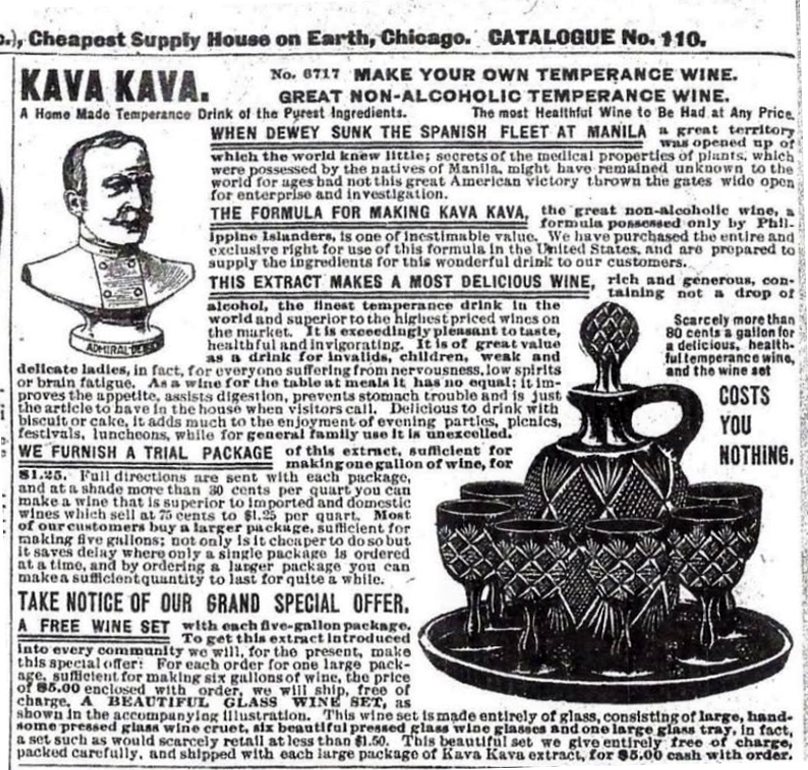
By the autumn of 1900 the same claim was being made by the largest retailer in the United States, and in food terms. Sears, Roebuck and Co. offered kava in Catalogue No. 110 as item No. 6717 under the heading “KAVA KAVA. A Home Made Temperance Drink of the Purest Ingredients.” The copy states that “THIS EXTRACT MAKES A MOST DELICIOUS WINE, rich and generous, containing not a drop of alcohol, the finest temperance drink in the world and superior to the highest priced wines on the market”; that “It is exceedingly pleasant to taste, healthful and invigorating”; that “As a wine for the table at meals it has no equal”; and that it is “Delicious to drink with biscuit or cake,” adding “much to the enjoyment of evening parties, picnics, festivals, luncheons, while for general family use it is unexcelled” (Sears, Roebuck & Co., 1900). Two features are worth separating from the salesmanship. The first is the sensory claim itself, pleasant to taste, which is the reverse of the adverse exploratory, missionary, and ethnographic accounts. The second is the eating context: the drink is placed at the table at meals and beside baked goods, which is a food position rather than a medicinal or ceremonial one, and it bears directly on the question of kava’s place among foods and beverages. The page also attributes the formula to “Philippine Islanders,” which is geographically wrong, and no openly viewable digital scan of the volume exists; Exhibit 2 is a photograph of the physical catalogue page, the volume being identified as the Fall 1900 Consumers Guide by Library of Congress record LCCN 71129093, and the claims on the page are treated here as market language rather than as findings.
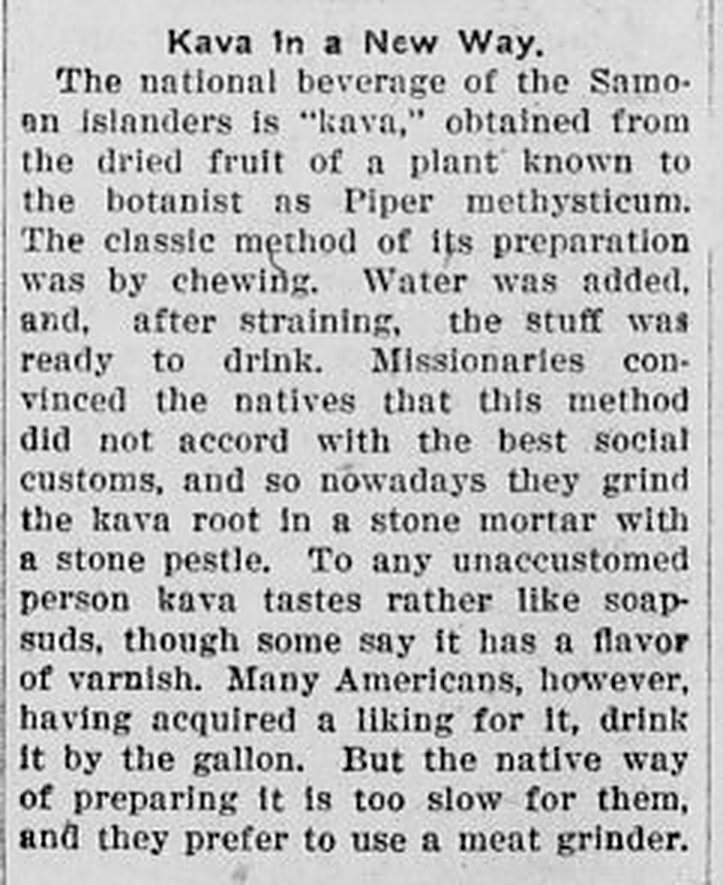
The following newspaper item shifts the evidence from promotional promises to a published account of reception: It places adverse flavor descriptions beside a report of acquired liking. It is not a controlled tasting record, and neither firsthand observation nor the accuracy of its consumption claims is established. On 6 November 1920 the Sausalito News, a weekly published across the Golden Gate from San Francisco, ran a short item headed “Kava in a New Way.” The item is short enough to give in full, and is transcribed here from the clipping reproduced whole as Exhibit 1:
Kava in a New Way. The national beverage of the Samoan islanders is “kava,” obtained from the dried fruit of a plant known to the botanist as Piper methysticum. The classic method of its preparation was by chewing. Water was added, and, after straining, the stuff was ready to drink. Missionaries convinced the natives that this method did not accord with the best social customs, and so nowadays they grind the kava root in a stone mortar with a stone pestle. To any unaccustomed person kava tastes rather like soapsuds, though some say it has a flavor of varnish. Many Americans, however, having acquired a liking for it, drink it by the gallon. But the native way of preparing it is too slow for them, and they prefer to use a meat grinder.
“Kava in a New Way,” Sausalito News (Sausalito, California), November 6, 1920, p. 10. California Digital Newspaper Collection, University of California, Riverside, item SN19201106.2.82, https://cdnc.ucr.edu/?a=d&d=SN19201106.2.82. Transcribed from the scan of the item held in that collection and reproduced as Exhibit 1.
Two details in the full text bear noting before the descriptors. The item calls kava “the national beverage of the Samoan islanders,” placing it in the beverage category in American lay print in 1920. It also attributes the abandonment of chewing to missionary pressure on social custom, rather than presenting evidence of a hygiene intervention.
The closing sentences introduce two distinctive descriptors: soapsuds, a tactile and visual comparison, and varnish, which may describe a solvent-like off-odor rather than a legitimate piney or resinous note. In our quality-control experience, inadequately dried kava sealed in airtight packaging can develop petrol-like or solvent-like odors even without visible mold. Such material belongs on the fermented/solvent defect wheel, not automatically in the piney/resinous flavor family. The historical word alone cannot establish the condition or cause. The item also describes aversion followed by acquired liking, and its record of meat-grinder preparation has a present-day counterpart: mechanical grinding of fresh root is standard practice at many Port Vila kava bars in the authors’ experience. The 1920 account documents an early use of the method, not its invention.
The item misstates the plant part, calling it dried fruit while also referring to the root. Its cultivar, preparation ratio, peeling status and drying history are not recoverable. The descriptors therefore attest historical vocabulary, not measurements of a characterized beverage.
The same stream carries the opposite verdict, and the way that verdict travels is more informative than the verdict itself. Ford’s chapter on the ethnography of kava in the 1967 National Institute of Mental Health symposium volume opens by recalling what he and his wife had read before their 1935 fieldwork in Fiji, and quotes an encyclopedia article at length: “The resulting liquid, which has a muddy or café-au-lait appearance or is of a greenish hue if made from leaves, is now ready for consumption. The taste of the liquid is at first sweet, and then pungent and acrid” (Ford, 1967, pp. 162–163). Ford’s own reference list identifies his source as the anonymous article “Kava (Cava or Ava)” at volume 13, page 299 of the 1944 Encyclopaedia Britannica (“Kava (cava or ava),” 1944). The sentence also appears in the ninth edition of 1882, and its wording is unaltered across sixty-two years of reprinting. The consequence is the reverse of what the repetition suggests. The sweet-then-pungent description has one source and not three; its appearances in 1882, in 1944, and in a 1967 volume addressed to pharmacologists are a single textual line, and the caution about the compilation’s evidentiary limits extends to the whole of its afterlife. What the 1967 reproduction does establish is that the sweet descriptor, and not the adverse ones, was the description a scientific audience was being given as late as the 1960s.
Set beside the 1920 newspaper item the divergence is stark. One line of text reports an initial sweetness, and a lay writer of the same market reports soapsuds and varnish. Nothing in the record resolves it. Neither description attaches to a cultivar, a root-to-water ratio, a peeling or drying history, or a second observer, and the two are separated by thirty-eight years and by the difference between a compiler working from other people’s reports and a journalist reporting what drinkers said. The range itself is the finding. A vocabulary that runs from sweet at one end to soapsuds and varnish at the other, applied to material of unknown identity and unknown handling, is what the proposed standardized panel exists to replace.
The pattern in the Sausalito item recurs in American popular print of the following decade. Harry L. Foster’s travel account “A Vagabond in Fiji”, published in New York in 1927 and quoted by Ford, describes kava as “a brownish murky fluid, slightly pungent and acrid”, states that it “is usually obnoxious to the novice”, and then reports that “Europeans in the islands often acquire a taste for it, and business men frequently keep it in the office for an occasional swig with their customers” (Foster, 1927, quoted in Ford, 1967, p. 164). The descriptors add nothing new to Table 1, but the sequence links novice aversion with acquired liking and routine social use. The quotation is verified in Ford’s reproduction; Foster’s original volume was not independently consulted.
The last item in this stream is the only first-person description located in the mainstream American press between 1920 and the modern period, and it is the mildest. In October 1965 the President and Mrs. Johnson were offered ’ava at a Samoan reception; the New York Times report of 19 October, quoted in full by Pfeiffer, Murphree, and Goldstein in the same 1967 symposium volume, preserves both the reporter’s characterization and the drinker’s. The First Lady “sipped the bitter juice from a coconut cup”, and “later Mrs. Johnson said the drink tasted a little like the milk of coconuts—watered down—with a slightly medicinal taste” (New York Times, October 19, 1965, quoted in Pfeiffer et al., 1967, p. 155). Three features are worth separating. The account is neither adverse nor promotional, which distinguishes it from everything else in this subsection. Its comparators are food comparators, diluted coconut milk with a medicinal note appended rather than leading, which places it nearest the nutty/roasted family and the mild end of the bitter/medicinal family, while also illustrating the relevance of dilution. And it separates the reporter’s word from the drinker’s: Bitter is the journalist’s, and it does not appear in what she is reported to have said. That separation illustrates why a reporter’s sensory vocabulary should not be mistaken for the drinker’s own assessment. The limits are equally plain. This is one ceremonial sip of an uncharacterized preparation, described by a drinker with no prior exposure, and the descriptors enter Table 1 as vocabulary on the same terms as the rest of the set.
Two further documents of the period place kava in the food category explicitly rather than by implication. The Hawaiian historian Samuel M. Kamakau, in an 1869 account of kava cultivation quoted in the Hawai’i Department of Health’s 2024 ’awa determination, wrote that “kava was one of the choice foods of the planter” (Hawai’i Department of Health, 2024). And the 1898 King’s American Dispensatory, the standard American Eclectic reference of the period, carries a full monograph on “Piper Methysticum — Kava-Kava” in the same volume, and in the same descriptive terms, as its monographs on tea, coffee, Roman and German chamomile, peppermint, and ginger (Felter & Lloyd, 1898). That volume is the source of the ginger monograph used here as a negative control. The inference is the authors’: nineteenth-century American pharmacy drew no boundary between a beverage plant and a medicinal one, so kava’s presence on that shelf establishes that the plant and its preparation were known to American readers, not that it was consumed as a food. The Sears page and the Kamakau passage that follows are what carry the food position.
A separate Kamakau passage records olfactory pleasure rather than acceptance for effect alone. Describing Hana, Maui, in 1866, he wrote, in the account reproduced by Titcomb, that “Heaps of awa delighted the nostrils of the dear, first born chiefs” (Kamakau, quoted in Titcomb, 1948, p. 119). The passage concerns the aroma of the material, not a standardized beverage tasting. It nevertheless preserves an explicitly favorable Hawaiian description of ‘awa aroma alongside the outsider vocabulary of aversion and supports treating olfactory pleasure as a distinct part of the historical record.
3.5 The recurrent descriptor set
Across two and a half centuries of outsider accounts, a small and stable vocabulary recurs. Table 1 arranges it by sensory channel and records the earliest located outsider attestation for each, together with the corresponding flavor family in the proposed framework. The table is a summary of the historical record; it is not a claim that the historical writers were measuring what the modern descriptor names.
| Historical descriptor | Sensory channel | Earliest located outsider attestation | Flavor family |
|---|---|---|---|
| Peppery, acrid, stimulant, biting | Chemesthetic and gustatory | La Billardière 1793, on the chewed raw root | Spicy / peppery |
| Bitter | Gustatory (TAS2R) | Mead 1928; earlier only as generalized unpleasantness | Bitter / medicinal |
| Astringent, drying, chalky | Tactile / mouthfeel | Mead 1928; Felter & Lloyd 1898 ("astringent"); Buck via Titcomb 1948 ("astringent rather than bitter"); Lebot & Cabalion 1988 ("chalky") | Mouthfeel layer |
| Numbing, tingling | Chemesthetic | Felter & Lloyd 1898 (“acrid, benumbing sensation”); Keesing 1941; Emerson, Buck, and Churchill via Titcomb 1948 | Mouthfeel and temporal overlay |
| Earthy, muddy, muddy water | Gustatory and olfactory | Forster 1777 (appearance); Sahlins 1962 (taste) | Earthy / woody |
| Woody, cedar-pencil, resinous | Olfactory / retro-nasal | Ford 1967 | Earthy / woody and piney / resinous |
| Café-au-lait, milky, opaque | Visual | Forster 1777; Britannica 9th ed. 1882 | Visual and particulate cues |
| Burning effect requiring a water chaser | Chemesthetic, temporal | Ellis, on Miomioi, 1820s | Temporal / chemesthetic overlay |
| Initially sweet, then pungent | Temporal, gustatory | Britannica 9th ed. 1882 (materia medica compilation) | Temporal / chemesthetic overlay |
| Slimy, thick, fibres subsiding | Tactile and visual | La Billardière 1793; Firth 1936 | Mouthfeel layer |
| Soapy, like soapsuds | Tactile and visual | Tregear 1891 (“mild and soapy”); Felter & Lloyd 1898 (“soap-suds and tannin”); “Kava in a New Way,” 1920 | Mouthfeel layer; not in the Appendix A lexicon |
| Varnish, solvent-like | Olfactory / retro-nasal | “Kava in a New Way,” 1920 | Possible fermented / solvent defect; condition unknown |
| Coconut milk, watered down, faintly medicinal | Gustatory and olfactory | New York Times 1965, quoted in Pfeiffer et al. 1967 | Nutty / coconut and the mild end of bitter / medicinal |
Two features of the set are worth stating. First, it is dominated by texture and chemesthesis rather than by taste in the narrow sense. Of the thirteen recurrent descriptor groups, six are wholly or partly tactile or chemesthetic, four are wholly or partly olfactory or retro-nasal, three are wholly or partly visual, and only two are unambiguously gustatory; the categories overlap because several of the descriptors carry more than one channel. Any account of kava’s reception that treats bitterness as the central obstacle is reading the record selectively. Second, bitterness enters the outsider vocabulary surprisingly late. The eighteenth-century accounts describe acridity and pungency, which are Piper-consistent trigeminal properties while explicit bitterness attributions become common only in the twentieth century, once observers were drinking prepared beverages rather than chewing roots.
A semantic caution belongs with that second point. Titcomb, working on Hawaiian ‘awa, observed that most Polynesian foods were suave and non-acid and that no drink other than a medicinal one carried any bitterness at all, and concluded that the adjective ‘awa may not mean "bitter as we understand the word" (Titcomb, 1948, p. 118). The inference is the authors’, not Titcomb’s: If the indigenous term denotes a category for which English has no close equivalent, then part of the apparent agreement between historical and modern descriptor sets may be an artifact of translation into the narrow gustatory sense of "bitter." This is a further reason to treat the historical vocabulary as converging usage rather than as measurement.
Titcomb’s caution does not eliminate bitterness from the historical record. On the same page, she preserves Hawaiian accounts describing “peculiar bitterness” and “sour, and very bitter” sensations during root chewing, together with a feeling of oral thickness or diminished perception of subsequently eaten food (Titcomb, 1948, p. 118). These accounts concern root chewing and its oral effects, not a standardized beverage assessment. They support distinguishing preparation, sensory modality, and the breadth of translated terms rather than treating bitterness as either the sole defining quality or an exclusively outsider attribution.
In our preparation and quality-control experience, properly processed, freshly prepared kava is not sour; marked sourness is treated as a deterioration defect. It occurs in prepared beverage left standing, improperly dried root, and fresh root held too long before preparation. Microbial activity is a plausible contributor, but identifying yeast or another cause requires testing. Titcomb records chewed root wrapped in moss or banana leaves for later preparation, while stating that the Hawaiian beverage itself was not made ahead and kept (Titcomb, 1948, p. 116). Together with Deihl’s account of prolonged holding, this makes deterioration a relevant interpretation of historical sourness where handling delays are documented, although it cannot retrospectively diagnose every sample.
The linguistic discussion requires a botanical distinction. Pacific kava (Piper methysticum) is not the New Zealand plant kawakawa, called Macropiper excelsum by Wilson. Wilson discusses both plants and the Māori word kawa; the gloss “bitter; sour; unpleasant to the taste” is a dictionary sense of that word, not a sensory measurement of kawakawa. She reports that Tregear separated this taste sense from plant and ritual entries because “the taste of the kava root (when made into a beverage) is not acrid, but mild and soapy” (Tregear, 1891, p. 139, quoted in Wilson, 1996, pp. 483–485). The passage does not establish that Māori kawakawa tastes sour. The Williams dictionaries kept the senses separate until their merger in the fifth edition of 1917 (Wilson, 1996, p. 485). Soapy language also appears in the 1898 dispensatory and the 1920 newspaper. These are distinct textual attestations, not proof of independent tasting or identical preparations.
Wilson also proposes how the bitterness gloss acquired its currency. She observes that kawa was assigned as the Maori equivalent for all fifty-one occurrences of derivatives of “bitter” in the translation of the Bible into Maori, and suggests that bitter serves in English as the most tractable member of a general category of the unpalatable, so that as a gloss for kawa it carries that generic sense rather than the gustatory one; she offers the generic sense of sweet, meaning delectable, as the parallel case for Maori reka (Wilson, 1996, p. 486, n. 4). This is a philological suggestion and not a measurement, and it is carried here as such. Its weight comes from convergence: Wilson reaches by way of translation history the conclusion Titcomb reached by way of Polynesian food categories, and between them they shift the burden of argument. An author who wants “bitter” in the historical record read as a specific receptor-mediated taste quality, rather than as a general term for the unpalatable, should now have to argue for that reading rather than assume it.
Wilson’s third observation concerns sensory salience rather than vocabulary. Reviewing written descriptions left by novice kava drinkers and root chewers, she notes that Emerson, Buck, and Churchill each mention a numbing of the tongue as a more immediately noticeable feature than the taste itself, and that Buck describes the taste as “astringent rather than bitter” (Wilson, 1996, p. 485, and Titcomb, 1948, pp. 117–118). That is the ordering Table 1 shows in aggregate, chemesthesis and texture ahead of taste in the narrow sense, stated by individual observers one at a time and in print half a century before any descriptive panel was run on the beverage. Two limits apply. The originals of Emerson, Buck, and Churchill were not consulted here; the attributions are Wilson’s and Titcomb’s, and the corresponding cells of Table 1 are annotated to that effect. And salience in a written recollection is not a measured intensity: These writers record the sensation they thought worth reporting first, which is why the proposed study specifies a time-course task rather than relying on recalled impressions.
Mary Kawena Pukui’s contribution makes the distinction more explicit: Titcomb attributes to her the observation that numbing is the strongest characteristic of the ‘awa taste (Titcomb, 1948, p. 118). This is an attributed Hawaiian assessment of sensory salience, not a measured ranking of intensities. Alongside the accounts above, it supports recording numbing separately from bitterness and astringency, without establishing a universal sequence or duration of oral sensations.
One mechanistic note attaches to the numbing reports, and it is an analogy rather than an explanation. Wilson’s subject is the New Zealand relative kawakawa, whose leaves and wood carry a series of lignans and myristicin, the latter related to eugenol, the mild antiseptic used as a dental analgesic; kawakawa leaves were chewed for toothache and the ripe fruit and roots boiled for the same purpose (Wilson, 1996, p. 485, citing Brooker, Cambie, and Cooper, 1987, pp. 77–78). The inference is the authors’: a numbing constituent in a related Piper is a parallel case and not an account of kavalactone-mediated oral anaesthesia, and the two should not be conflated. What it does support is the general proposition that oral anaesthesia is a recurrent property of the genus and was recognized as such by users of more than one species.
Modern documents make preparation controls explicit. Vanuatu’s export quality manual was published in May 2013, its national export quality standard in 2016, and the Fiji Kava Standard in 2017 (PHAMA, 2013; PHAMA, Pacific Community, & Vanuatu Kava Industry Association, 2016; Fiji Ministry of Agriculture, 2017). The 2016 and 2017 standards both distinguish unpeeled roots from peeled stumps or rhizomes and basal stems. These dates identify published specifications, not the origins of washing, peeling or drying. Historical descriptions rarely document equivalent sample details, so their handling status should not be assumed.
4. Comparative beverage histories
Coffee, chocolate, and ginger are the standard comparisons invoked when kava’s reception is discussed. This section tests those comparisons against primary texts rather than against received summaries, and reaches a differentiated conclusion: Coffee supplies the rhetorical template, chocolate supplies the mechanism, ginger supplies a control that disconfirms the simplest version of the argument, kava’s own congeners in the genus Piper supply a second control showing that the descriptor set itself is compatible with unrestricted food status, and Sichuan pepper supplies a third in which oral numbing is the property the ingredient is bought for.
A note on quotation practice. Nearly every famous early beverage quotation in circulation reaches the reader through a chain of intermediaries: A later edition, a nineteenth-century translation, an early twentieth-century trade history with a promotional interest, and optical character recognition of a scanned page. Each quotation below is attributed to the specific text consulted, and where the chain introduces doubt about exact wording, the doubt is stated.
4.1 Coffee
Early European descriptions of coffee were not uniformly repellent. Sedgewick places them within encounters with Ottoman drinking practices, where unfamiliar appearance, preparation and cultural association could accompany sensory judgment (Sedgewick, 2020, pp. 15–17). Leonhard Rauwolf, describing Aleppo during his 1573 journey, called coffee a “very good drink” although “almost as black as ink,” and described small, hot sips shared in company (Rauwolf, quoted in Ukers, 1922, ch. 4, pp. 25–26; English rendering consulted, not a new translation of the German original). The favorable wording sits beside a medicinal claim rather than providing a detailed flavor appraisal. It nevertheless prevents dark appearance from being read automatically as disgust: outsider accounts record different evaluations, not a single starting verdict.
An early English-language judgment states the contrary structure especially concisely. William Biddulph, travelling in the Levant around 1600, wrote that the drink was:
"…more holesome than toothsome."
William Biddulph, c. 1600, as quoted in Robinson, The Early History of Coffee Houses in England (1893). Consulted at https://archive.org/details/earlyhistoryofco00robi
Wholesome but not tasty. Efficacy conceded, palatability denied, in a single antithesis. The same structure recurs across the seventeenth-century record with different vocabulary.
George Sandys, describing coffee-house practice in the Ottoman empire, supplied the visual and gustatory comparison that later writers repeated:
"…they sit chatting most of the day; and sippe of a drinke called Coffa … in little China dishes, as hot as they can suffer it: blacke as soote, and tasting not much unlike it."
George Sandys, A Relation of a Journey, first published 1615; wording as printed in the 1673 edition.
Francis Bacon, in Sylva Sylvarum (1626), described the aroma with unusual precision and without hostility, distinguishing a strong smell from a pleasant one:
"They have in Turkey a Drinke called Coffa, made of a Berry of the same name, as Blacke as Soot, and of a Strong Sent, but not Aromaticall; which they take, beaten into Powder, in Water, as Hot as they can Drinke it."
Francis Bacon, Sylva Sylvarum, 1626.
Henry Blount, writing in 1636, gave the most moderate seventeenth-century verdict located, and named bitterness directly:
"…a little bitterish taste, which they take as hot as they can endure it."
Henry Blount, A Voyage into the Levant, 1636.
Commercial promotion could emphasize effects rather than sensory appeal. Pasqua Rosée’s handbill of about 1652, transcribed by Ukers, promotes coffee through purported health benefits and wakefulness rather than praise of its flavor (Ukers, 1922, ch. 28). It names dropsy, gout, scurvy, sore eyes, headache and consumption, and recommends the drink for people who must remain awake for business. This advertisement illustrates acceptance encouraged by perceived function, without requiring a claim that coffee tasted good.
The densest cluster of hostile description belongs to the polemical literature of the 1660s and 1670s, including the Women’s Petition Against Coffee of 1674, which called it a "little base, black, thick, nasty, bitter, stinking, nauseous puddle water." That was printed while consumption was rising sharply, which is the point: Hostile sensory rhetoric and expanding consumption coexisted, and the rhetoric did not predict the outcome.
Appreciation also developed around the occasion of drinking. John Houghton’s 1699 discourse states that “Coffeehouses make all sorts of people sociable” and links them with improvements in knowledge (Houghton, 1699, quoted in University of California, Irvine Libraries, n.d., p. 14; Sedgewick, 2020, pp. 18–19). This is testimony about the social setting, not evidence that every patron liked coffee or that the beverage itself caused sociability. Its relevance to aversion and appreciation is narrower: repeat encounters could be embedded in a valued gathering place while hostile descriptions remained in circulation. The corresponding question for kava is how preparation, sensory familiarity and the drinking occasion contribute separately to appreciation, rather than whether kava bars reproduce coffeehouse history.
Coffee also offers a counterpoint to the treatment of kava as an effect-driven substance rather than a beverage: its perceived functional benefits were used to reinforce its value as a drink independently of its nutritional contribution. A 1921 American advertisement promoted coffee as “An Aid to Factory Efficiency” (University of California, Irvine Libraries, n.d.). In Mitchell v. Greinetz (1956), a federal appeals court recognized coffee breaks as compensable time partly because they “promote more efficiency and result in a greater output.” These were arguments about perceived usefulness, not nourishment or flavor. The comparison highlights an asymmetry in how effects are interpreted: effects valued in the workplace became a positive argument for coffee consumption, whereas kava’s effect-driven use is often presented as a reason to distinguish it from ordinary beverages. An interest in a drink’s effects does not, by itself, negate its use as a beverage or food; sensory qualities, nutritional contribution, and perceived effects are distinct dimensions of evaluation.
The chemistry behind the historical complaint
Coffee bitterness is largely a process artifact, and this is the single most important corrective that modern flavor chemistry offers to the historical narrative. Caffeine, the compound that popular accounts blame, contributes only about 15 percent of perceived coffee bitterness. The dominant contributors are chlorogenic acid lactones and, at darker roasts, phenylindanes, which are generated during roasting rather than present in the green bean (Frank et al., 2007).
This means the historical obsession with roast degree, grind fineness, water temperature, and brewing method was not superstition. Those variables control the formation and extraction of the compounds that actually cause the bitterness being complained about. Seventeenth-century coffee, boiled from powder in water taken as hot as could be endured, was close to a worst case: high extraction of bitter degradation products with no filtration.
The practical trajectory of coffee’s domestication follows the chemistry rather than the sweetener. Roast control, grind control, filtration, and later espresso and pressure extraction changed which compounds reached the cup. Sugar and milk were adjuncts to that process, not the mechanism of it.
The historical record also shows preparation becoming a subject of consumer instruction. Sedgewick describes the 1930s American shift toward drip and vacuum coffeemakers, accompanied by industry advice about recipes and measured doses (Sedgewick, 2020, pp. 309–311). Sensory improvement and commercial incentives were intertwined: shorter brewing and recommended dosing also affected the quantity of coffee purchased. For kava, the useful comparison is that appreciation can involve changing and specifying the served preparation, not simply teaching consumers to endure an unchanged drink. It does not establish that a coffee brewing mechanism transfers to kava.
4.2 Chocolate
The chocolate record supplies the strongest single piece of evidence in this comparison, and it is not a fragment. Girolamo Benzoni, in La Historia del Mondo Nuovo (1565), described his own reception of cacao from initial disgust to eventual acceptance in one continuous passage:
"It seemed more a drink for pigs, than a drink for humanity. I was in this country for more than a year, and never wanted to taste it, and whenever I passed a settlement, some Indian would offer me a drink of it, and would be amazed when I would not accept, going away laughing. But then, as there was a shortage of wine, so as not to be always drinking water, I did like the others. The taste is somewhat bitter, it satisfies and refreshes the body, but does not inebriate, and it is the best and most expensive merchandise, according to the Indians of that country."
Girolamo Benzoni, La Historia del Mondo Nuovo; first published Venice, 1565, with an enlarged edition following. W. H. Smyth translation, Hakluyt Society, 1857. Transcription consulted at https://dcc.newberry.org/?p=14389. Coe and Coe (2013, p. 110) cite this passage from the 1575 edition of the work.
Every element of a modern acquired-taste account is present. There is an initial rejection expressed through an animal comparison. There is a documented duration of refusal, more than a year. There is a mechanism of first exposure that is not hedonic, a wine shortage rather than curiosity. There is social modelling, doing as the others did. There is persistence of the aversive attribute after acceptance, the taste remains somewhat bitter. And there is a positive functional appraisal in place of a hedonic one: It satisfies and refreshes without inebriating. Benzoni does not claim to have come to like the flavour. He claims to have come to value the drink.
That distinction is directly relevant to kava, where the observed adoption pattern among new consumers is frequently the same: The continued acknowledgement of an unfamiliar flavour alongside a favourable appraisal of what the drink does in a social setting.
Two further first-contact accounts extend the pattern, and the earlier of them predates Benzoni by nine years. The Anonymous Conqueror, whose description of Tenochtitlan was published at Venice in 1556, treats the drink’s texture as something a newcomer has to be taught to manage — in drinking it "one must open one’s mouth, because being foam one must give it room to subside, and go down bit by bit" — and pairs that instruction immediately with an efficacy claim, calling it "the healthiest thing, and the greatest sustenance of anything you could drink in the world" (Coe & Coe, 2013, p. 84). Gonzalo Fernández de Oviedo, who encountered chocolate during the Spanish campaign in Nicaragua, objected on visual grounds: taken with its customary achiote, the drink turned the drinkers’ mouths, lips and whiskers red, as though they had been drinking blood (Coe & Coe, 2013, pp. 110, 112).
Oviedo’s objection is worth separating from the others because it concerns neither taste nor texture but appearance, and it is the closest analogue in the chocolate corpus to the kava record’s muddy, milky and café-au-lait vocabulary. Coe and Coe characterize the general European reaction to chocolate as a reaction to a "strange, murky, sinister-looking beverage," which is a fair description of what the Forsters and La Billardière were looking at as well.
José de Acosta, in the Historia natural y moral de las Indias (1590, English translation 1604), located the aversion somewhere more specific than bitterness:
"The chiefe use of this cacao is in a drinke which they call Chocolate, whereof they make great account, foolishly and without reason; for it is loathsome to such as are not acquainted with it, having a skumme or froth that is very unpleasant to taste, if they be not very well conceited thereof."
José de Acosta, Historia natural y moral de las Indias, 1590; Edward Grimston translation, 1604. Quoted from the Hakluyt Society reprint of Grimston’s text, edited by Clements R. Markham, vol. I (Books I–IV), 1880, book IV, chap. xxii, p. 244. Page facsimile consulted at https://archive.org/details/naturalmoralhist60acosrich/page/n306
The object of the complaint is the skumme or froth, that is, the texture, and the phrase loathsome to such as are not acquainted with it makes the acquired-taste claim explicit: Unpleasantness is attributed to unfamiliarity, not to the substance.
Acosta’s complaint contrasts with the Nahua account in Book 10 of Sahagún’s Florentine Codex. Its description of the seller of fine chocolate, tlaquetzalli, includes deliberate aeration: the preparer “aerates it, filters it, strains it, pours it back and forth, aerates it; she makes it form a head, makes it foam” (Sahagún, 1961, Book 10, p. 93, translated by Anderson & Dibble). The froth objection therefore concerned a deliberately produced texture, not simply failed preparation. This offers a parallel to contrasting evaluations of the suspended particles that give kava its body.
The technical literature of the seventeenth century identifies process causes of bitterness with a clarity that anticipates modern practice. Antonio Colmenero de Ledesma, in the 1652 English translation by James Wadsworth, warned that over-drying the beans produces bitterness and that they must be prepared with care. He also noted that the moulded tablet form was adopted for palatability rather than for efficacy, made "onely to please the Pallats" (Colmenero de Ledesma, 1652, consulted at https://www.gutenberg.org/files/21271/21271-h/21271-h.htm). Johann Vesling, writing around 1638, recorded that sugar was added specifically "to correct the bitterness."
The two-channel structure set out in the next subsection is not only a modern reading of the material. It is stated in the primary literature. In a dialogue published in 1618 by Bartholomeo Marradón, the physician of the piece dismisses cacao in terms that separate the two sensations explicitly:
"an astringent and bitter taste … so disagreeable that one does not marvel that those who taste them have a horror of the beverage made of them."
Bartholomeo Marradón, 1618, quoted in Coe & Coe, 2013, p. 134.
Astringent and bitter are given as two attributes rather than one, three centuries before the receptor mechanisms behind them were described.
Why chocolate is the mechanistically informative case
Cacao presents a two-channel sensory obstacle rather than a single one. Bitterness arises from methylxanthines, principally theobromine with caffeine, together with bitter peptides and polyphenols. Astringency, a tactile sensation produced by the precipitation of salivary proteins, arises from flavan-3-ols and procyanidins and is perceived as drying, puckering, and mouth-coating. Bitterness and astringency are distinct percepts with distinct mechanisms, and reducing one does not reduce the other.
The interventions that made chocolate broadly palatable were correspondingly physical rather than gustatory:
Hydraulic pressing (Van Houten, 1828) separated cocoa butter from the solids, allowing fat content and therefore mouthfeel to be controlled independently of the solids that carry the bitterness and astringency. Untreated chocolate liquor contains about 53 percent cacao butter; the press brought this down to 27 or 28 percent, leaving a cake that could be pulverized into powder (Coe & Coe, 2013, pp. 234–235). The 1828 Dutch patent is conventionally credited to Coenraad Johannes van Houten; recent archival work attributes it to his father, Casparus van Houten Sr., and the firm rather than the individual is the safer attribution.
The moulded eating bar (Fry, 1847) changed the delivery matrix from a suspension in water to a fat-continuous solid, in which fat coats the palate and blunts astringency. The mechanism was a substitution of one continuous phase for another: Fry combined cocoa powder and sugar with melted cacao butter instead of with warm water, giving a less viscous paste that could be cast into a mould (Coe & Coe, 2013, p. 236).
Milk chocolate (Nestlé and Peter) added milk proteins and fat, which bind polyphenols and further reduce astringency. Coe and Coe date the first milk chocolate bar to 1879 (2013, pp. 246–247); 1875 is also widely given, for Peter’s earlier trials rather than for the marketed bar, and the two dates should not be used interchangeably.
Conching (Lindt, 1879) reduced particle size below the threshold of perceived grittiness and volatilized aversive volatiles, addressing texture and aroma simultaneously. Coe and Coe state the effect plainly: before Lindt, eating chocolate was usually coarse and gritty (2013, p. 248).
Alkalization, still called Dutch processing, is dated inconsistently in the literature, and the discrepancy is better stated than resolved by assertion. Coe and Coe treat it as part of the same 1828 innovation, recording that Van Houten treated the defatted cake with potassium or sodium carbonates in order "to cause this product to mix well with water" (2013, pp. 234–235); the Van Houten brand’s published corporate history dates a distinct alkalization patent to 1846. What is not in dispute is what the treatment does, and three of its four documented effects are physical rather than gustatory. Whymper’s 1921 manufacturing text records that treatment with potassium or sodium carbonates partially disintegrates the tissue of the kernel, so that the material is "capable of suspension in water or milk to a greater degree"; that slight saponification of the fat aids formation of an emulsion that resists settling; that free organic acids are neutralized, shifting the ratio of soluble to insoluble ash from roughly 46:54 to about 80:20; and that flavour and odour improve while the colour darkens. Alkalization was, in other words, a suspension-stability intervention that also reduced harshness, not a sweetening one.
The parallel with kava concerns both suspension control and fractionation. The cocoa press separated butter from a solid cake that could be milled into beverage powder, making composition and texture adjustable rather than fixed properties of the starting material (Whymper, 1921). Carbon dioxide extraction offers a corresponding process route for kava: Recover selected root constituents while leaving the bulk fibrous matrix behind, then formulate the recovered fraction for drinking (Gregg, 2003). The mechanisms differ, but the food-processing principle is shared: a botanical can be separated into useful fractions to improve preparation and product qualities without ceasing to be a product of that botanical. This is a central technological parallel, not merely an analogy between two acquired tastes.
One detail of the chocolate record makes that parallel concrete. For roughly three centuries the European chocolate drink required a dedicated vessel and a beater, because the solids would not stay up on their own. Coe and Coe note that the silver chocolatière’s "decline would only come when Van Houten invented his method for defatting cacao in the early 19th century; after that, the chocolate-pot, which had been necessary to stir and beat the heavy liquid, no longer was of use in making a palatable drink" (2013, p. 158). The apparatus existed because the beverage was an unstable suspension, and it became obsolete when a physical intervention changed that. Their summary of 1828 is that "the age-old, thick and foamy drink was dethroned" (2013, p. 235) — displaced rather than repaired, a distinction that also matters for kava processing. Coe and Coe also draw a distinction this paper has particular cause to underline: what Dutching improved was the powder’s "miscibility (not, as some believed, its solubility) in warm water" (2013, p. 234). The same conflation of a suspension with a solution recurs in the kava trade.
4.3 Negative controls: Ginger, the Piper congeners, and the numbing spices
Ginger provides a contrasting case rather than a third parallel history of outsider aversion. Its established place in European cookery and pharmacy allows the comparison to consider familiarity and perceived benefit alongside sensory intensity.
No early modern European text describing ginger as unpleasant was located. John Gerard’s Herball (1597) treats it as a valued warming drug, recording that it "heateth and drieth in the third degree" in the humoral scheme, with no aversive sensory note whatever. Ginger appears throughout medieval and early modern European cookery and pharmacy as a desirable spice.
That familiarity was medicinal as well as culinary. Gerard’s account presents ginger’s warming action as a virtue, illustrating how perceived physiological benefits could support the acceptance of a pungent food rather than disqualify it from food use (Gerard, 1597). More broadly, the association of diet with health is well documented in the Hippocratic tradition, although food and medicine were not treated as interchangeable categories (Cárdenas, 2013). Ginger therefore offers a historical contrast, not a controlled experiment isolating sensation from motivation: its customary use combined flavor, familiarity, and attributed benefits. The relevant parallel for kava is that interest in a plant’s effects can coexist with culinary use and appreciation.
The comparison can in fact be made within a single work. Cacao entered the Herball in Thomas Johnson’s revised edition of 1633, where it is described as a drink "of which, though bitter, they highly esteeme" and the fruit as "of an astringent and ungrateful taste" (Coe & Coe, 2013, p. 161). One botanical author, one text tradition, two unfamiliar botanicals, and opposite sensory verdicts: Aversive for cacao, unremarkable for ginger. The contrast cannot be explained by differing observers or differing conventions of description.
That absence is a substantive finding rather than a gap in the search. Ginger differs from coffee, cacao, and kava on three axes at once.
— Sensory mechanism. Ginger’s dominant sensation is pungency, transduced by the TRPV1 and TRPA1 ion channels on trigeminal afferents by gingerols and shogaols. It is a chemesthetic sensation, closer to warmth or irritation than to taste, and it is not mediated by TAS2R bitter taste receptors (Yin et al., 2019). Coffee, cacao, and kava bitterness are TAS2R-mediated. Ginger therefore belongs to Rozin’s chili-pepper model of benign masochism, in which mild aversive stimulation becomes pleasurable through learned safety, rather than to the bitter-stimulant model of learned liking.
— Prior familiarity. Ginger reached Europe overland via Arab and Venetian trade long before the seventeenth century and was already naturalized in use. Coffee, cacao, and kava were encountered as complete novelties, in unfamiliar preparations, from unfamiliar cultures.
— Chronology of beverage form. Ginger’s beverage forms are late. Ginger beer emerges in the mid-eighteenth century, and carbonated ginger ale is a nineteenth-century product; Henry Mayhew’s London Labour and the London Poor (1851) records street ginger-beer formulations in detail, and Joseph Priestley’s 1772 work on artificial carbonation, undertaken as an antiscorbutic project, supplied the enabling technology. There was no early modern ginger beverage to be aversive about.
Ginger is a useful contrast rather than an experimental control: its established culinary familiarity shows why sensory intensity alone does not explain rejection. Its history also distinguishes harm from a particular preparation from the identity of the plant as a food.
Ginger, cacao and coffee illustrate the distinction between a hazardous product and the food category to which it belongs. Table 2 places kava alongside these examples, comparing the reported hazards, their assessment and the implications for beverage or food use.
| Food or product | Incident or concern | Response or assessment | Food-use implications |
|---|---|---|---|
| Kava: liver-injury reports and German restrictions | Rare, sometimes severe liver injuries have been associated with kava products; clinical features suggest idiosyncratic or immunoallergic injury in some cases (LiverTox, 2018). | Schmidt’s historical estimate was <1 case per 50 million daily doses, with important reporting limitations (WHO, 2007). German courts overturned medicinal-product revocations in 2014–2015, favoring risk-reducing conditions over withdrawal (OVG NRW, 2015). | Medicinal-product rulings did not decide beverage-food status. Separately, Codex adopted a regional standard for noble-kava products used to prepare a beverage (Codex Alimentarius Commission, 2020). Later German proceedings are summarized below. |
| Ginger: Jamaica ginger (“Jake”), 1930 | A high-alcohol ginger extract was adulterated with tri-orthocresyl phosphate (TOCP), causing neurological illness in tens of thousands of people (Parascandola, 1995). | Investigators identified the toxic adulterant, rather than culinary ginger, as the cause (Parascandola, 1995). | Ginger remains listed as a spice generally recognized as safe for its intended use; the poisoning did not disqualify ginger as a food ingredient (21 C.F.R. § 182.10). |
| Cacao / chocolate: Salmonella, 2022 | A multinational outbreak was linked to contaminated chocolate products (European Centre for Disease Prevention and Control [ECDC], 2022). | Worldwide recalls and closure of the implicated factory targeted the affected products and production site (ECDC, 2022). | Chocolate remained a food category; the response addressed contaminated products, not cacao as a botanical food source (ECDC, 2022). |
| Cacao / chocolate: cadmium | Cadmium in cocoa products presents a contaminant-exposure concern, distinct from an acute outbreak (European Commission, n.d.). | European rules set maximum cadmium levels for specified cocoa and chocolate products (European Commission, n.d.). | The regulatory approach allows compliant products to remain foods while controlling contaminant levels (European Commission, n.d.). |
| Coffee: acrylamide controversy | Cancer-warning concerns arose over chemicals generated during roasting and brewing, including acrylamide (Office of Environmental Health Hazard Assessment [OEHHA], 2019). | California’s 2019 determination found no significant cancer risk from the covered chemicals inherent in roasting or brewing coffee (OEHHA, 2019). | Coffee continued as a beverage. The assessment did not remove its food identity or establish that it is free of every possible risk (OEHHA, 2019). |
| Caffeine: pure or highly concentrated products | Fatal poisonings have been associated with pure or highly concentrated caffeine products, not necessarily coffee beverages (U.S. Food and Drug Administration [FDA], n.d.). | FDA warnings and enforcement focused on dangerous concentrated formulations and dosing risks (FDA, n.d.). | The response distinguishes concentrated caffeine from ordinary brewed coffee; it does not disqualify coffee as a food beverage (FDA, n.d.). |
The examples differ in cause, severity and regulatory setting. Jamaica ginger tonic is not equivalent to culinary ginger, concentrated caffeine is not equivalent to brewed coffee, and German medicinal-product decisions are distinct from food regulation.
Schmidt’s 2003 assessment, summarized by WHO (2007), estimated fewer than 0.02 cases per million daily doses, equivalent to fewer than one case per 50 million days of use. This was a calculation from selected reported cases and sales-based exposure, not a prospective measurement of risk in individual drinkers or traditional beverage servings. WHO considered the published estimates unrealistically low because of incomplete reporting, while concluding that injury was likely uncommon or rare. LiverTox (2018) likewise describes a possible idiosyncratic or immunoallergic mechanism, meaning an unusual individual susceptibility rather than a uniform response among consumers. Kuchta, Schmidt and Nahrstedt (2015) additionally emphasized botanical identity and quality control in interpreting the disputed cases.
The German decisions illustrate the distinction between identifying a risk and deciding whether withdrawal is proportionate. In 2015, the Higher Administrative Court of North Rhine-Westphalia upheld the reversal of the medicinal-product revocations, finding that risks could be addressed through prescribing, dose and duration limits, liver monitoring and avoidance of alcohol and interacting medicines (OVG NRW, 2015). BfArM revoked authorizations again in 2019; a further Cologne ruling in June 2024 annulled the challenged revocation, and BfArM appealed that July (BfArM, 2019; FratiniVergano, 2024). These proceedings concerned particular medicines, not a blanket finding that kava is harmless or a determination of its status as food.
Ginger, cacao/chocolate and coffee retained their food identity despite serious hazards involving particular products, contaminants or constituents. Kava likewise requires assessment of the preparation, quality, exposure and susceptible consumer, rather than treating a safety controversy as a sensory judgment or an automatic disqualification of the botanical from beverage use. The comparison supports that distinction without assuming equal risks across these products.
The Piper congeners: A within-genus control
A second control is available, and it is tighter than ginger because it holds the botany constant. If the descriptor set were what kept a plant out of the food category, then kava’s two closest commercial relatives would be excluded along with it. They are not. Black pepper (Piper nigrum), and long pepper (Piper longum), are congeners of Piper methysticum, and the historical and modern sensory literatures describe them in the terms on which kava’s unsuitability as a food is usually asserted: Pungent, acrid, bitter, astringent, salivation-inducing, and numbing to the tongue.
The comparison can be made inside a single work, as it was for cacao and ginger above. The 1898 King’s American Dispensatory carries monographs on both species, written by the same authors under the same descriptive conventions. Of kava it states that “the taste is said to resemble soap-suds and tannin”; that “after chewing a little of it, a peculiar, acrid, benumbing sensation is imparted to the parts of the mouth with which the pulp comes in contact”; and that the root has “a pleasant, somewhat lilac odor, and a slightly pungent, bitter and astringent taste, which augments the salivary discharge” (Felter & Lloyd, 1898). Of black pepper the same volume states “odor aromatic; taste pungently spicy”; that internally administered “it excites in the mouth and fauces a burning sensation”; and that “pain and redness are the results of the local application of powdered pepper” (Felter & Lloyd, 1898). Pereira’s materia medica describes long pepper as having “a mild aromatic odour but a violent pungent taste”, its volatile oil as “colourless” with “a disagreeable odour and an acrid taste”, and reports most pharmacologists agreeing that it is “more acrid” than black pepper (Pereira, 1854). The kava monograph’s soap-suds is also a third attestation of that descriptor, standing between Tregear in 1891 and the Sausalito item of 1920, and it is recorded in Table 1 accordingly.
The modern literature is more precise and says the same thing. A 2025 review of the sensory and biological properties of the plants sold as pepper states that “long pepper presents similar sensorial characteristics to black pepper (Piper nigrum L.), with a pungent bitter taste that produces numbness on the tongue”, that piperine promotes “pronounced salivation and numbness sensations”, and that black pepper carries a “pungent fruity aroma with piney, citrusy, herbaceous, woody, earthy, and spicy notes” (Díaz-Guerrero et al., 2025). That last phrase names five of the seven proposed flavor families. Instrumental sensory work on peppercorns reports that they “elicit a pungent and tingling oral impression”, with piperine pungent at a threshold of 3.0 nmol/cm² and the isobutylamides producing “a long-lasting tingling sensation at higher concentrations” (Beltrán et al., 2017). Psychophysical work on the bitterness of pungent compounds reports that “capsaicin, piperine and ethanol elicit bitterness in addition to burning/stinging sensations”, with burning dominant and bitterness second in the rated order (Nolden et al., 2016), which is the channel ordering Table 1 shows for kava. And piperine is a TAS2R14 agonist as well as a TRPV1 agonist (Huang et al., 2022), so pepper engages both receptor-mediated bitterness and chemesthesis — the combination that is said to make kava a difficult beverage.
The category outcome is the opposite of kava’s. Black pepper appears by name in the federal list of spices and natural seasonings that are generally recognized as safe, as “Pepper, black — Piper nigrum L.” (Spices and Other Natural Seasonings and Flavorings, 21 C.F.R. § 182.10). Long pepper is not on that list, so the regulatory claim here is limited to P. nigrum; the sensory claim covers both. The inference is the authors’: A descriptor set of pungency, acridity, bitterness, astringency, induced salivation and tongue numbness is compatible with unrestricted food status, because a plant carrying every one of those descriptors sits in the GRAS spice list and in most domestic kitchens. Those sensory descriptors therefore cannot, by themselves, determine whether a substance is treated as a food; otherwise, the same reasoning used to exclude kava on the basis of acridity, bitterness or oral numbness would also exclude black pepper.
Sichuan pepper: Numbing as a sought property, outside the genus
A naming caution is required before the next comparator, because the two are routinely conflated. Long pepper, Piper longum, is a Piperaceae vine and a true congener of kava. Sichuan pepper, sold as hua jiao, is the dried fruit husk of Zanthoxylum species in the Rutaceae, the citrus family, and is not a Piper at all. The shared English name records culinary function rather than botany. Sichuan pepper is not merely a food that happens to be numbing. It is a food bought and served specifically for that its numbing properties.
The active principle is hydroxy-α-sanshool, an alkylamide that acts by inhibiting two-pore potassium channels rather than by the vanilloid route taken by capsaicin and gingerol. The compound was characterized in a study which opens by noting that “in contrast to the intense, burning pain associated with ’hot’ chili peppers of the Capsicum family, Szechuan peppers elicit a wholly unique sensation that is best described as a tingling paresthesia or numbing” (Bautista et al., 2008). Sanshool “induces numbing and robust tingling paresthesia in humans” by exciting light-touch afferents, so that the resulting sensation “more likely result[s] from tingling paresthesia rather than painful irritation” (Lennertz et al., 2010). Psychophysical work confirms the oral persistence and notes that alkylamides of this class “are used in ethnic cuisines to provide unique oral sensations during the consumption of meals” (Albin & Simons, 2010). The parallel with kava is not one of chemistry: Kavalactone-induced oral anaesthesia and sanshool-induced tingling are different mechanisms. The parallel is that a persistent, non-gustatory, trigeminally mediated oral sensation is the reason the ingredient is used.
Two further observations connect the sensory vocabulary with food use. First, the linguistic pattern this paper documents for kava recurs here in reverse. In Chinese usage the numbing sensation, má, has long been classed with the tastes, although “the spicy and numbing feelings caused by chilli pepper and Sichuan pepper, traditionally known as taste sense in China, shall belong to ’chemesthesis’” (Dong et al., 2018). A culture that valued the sensation lexicalized it as a taste of its own; the English-language record, lacking a category for it, filed kava’s equivalent sensation under bitterness, a merger illustrated by the accounts of Tregear and Titcomb. Second, Sichuan pepper is not named in the federal list of spices generally recognized as safe, which lists black, white, red and cayenne peppers but no Zanthoxylum (Spices and Other Natural Seasonings and Flavorings, 21 C.F.R. § 182.10). It is nonetheless sold in American grocery stores and used daily in American restaurant and home kitchens. Absence from that list therefore does automatically place a substance outside of the food category. The GRAS list should therefore be read as identifying substances that have been affirmatively recognized as safe for specified uses, not as defining the outer boundary of what substances qualify as food.
The regulatory history of Sichuan pepper is instructive for a different reason. Its importation into the United States was restricted from 1968 until 2005, and the stated ground was phytosanitary rather than sensory or toxicological: the tree belongs to the citrus family and the fruit was held capable of carrying citrus canker, a bacterial disease of citrus trees that is harmless to humans. Importation resumed once a heat treatment was approved, and the treatment itself attenuates the very property the spice is bought for, with one restaurateur estimating “about 10 percent less heat and tingling sensation in the mouth than untreated ones” (“Sichuan’s Signature Is Now Legal Again,” 2005). The inference is the authors’: For thirty-seven years an intensely numbing culinary spice was legally unavailable in the United States for reasons having nothing to do with how it tasted or what it did to the mouth, and its cuisine was reconstructed around the gap. Regulatory position and sensory character are separable variables, and treating a plant’s current regulatory position as though it followed from its flavour confuses the two.
Two disanalogies must be kept in view, and neither restores the descriptor argument. The peppers are consumed as condiments in milligram quantities and kava as a beverage in gram quantities, so intensity per serving differs by orders of magnitude; and black pepper’s chemesthetic effects are comparatively brief where kava’s oral anaesthesia persists for minutes, making duration a separate sensory variable. The second disanalogy is the weaker of the two, since sanshool tingling also persists for minutes and is valued for persisting. Both are arguments about dose and duration rather than about vocabulary, and both are testable by the proposed sensory protocol rather than by appeal to historical adjectives. Read together, the three controls in this section divide the work. Ginger isolates novelty: An intensely sensation-bearing plant can have an established culinary role. The Piper congeners provide a comparison for the descriptor set: Plants carrying kava’s exact descriptors, in the same genus, entered and remain in the food supply without one. Sichuan pepper isolates the single descriptor most often treated as disqualifying, since oral numbing is there the reason for purchase. What is left to explain kava’s position is neither intensity nor vocabulary but novelty, preparation, and the absence of a familiar culinary slot.
4.4 Mechanisms of learned liking
The historical pattern has a modern experimental literature behind it, and the mechanisms are separable.
— Bitterness is an innate aversive signal, and it is plastic. Bitter perception is a toxin-detection system; rejection of bitterness is present at birth. Yet many of the most widely consumed adult beverages are bitter, and the tolerance is acquired (Drewnowski & Gomez-Carneros, 2000).
— Mere repeated exposure increases liking. Repetition alone, without any consequence, raises hedonic ratings for initially disliked flavours (Stein et al., 2003). This is the weakest but most general mechanism, and it is what Benzoni’s year of daily availability supplied.
— Flavour-nutrient and flavour-consequence learning is stronger. When a flavour reliably predicts a valued post-ingestive outcome, liking for that flavour increases. Yeomans, Spetch and Rogers demonstrated the effect for caffeine: in moderate caffeine users tested after overnight abstinence, liking for a novel fruit tea rose significantly across four trials when the drink contained 100 milligrams of caffeine and fell significantly when it did not, and the effect was largest in participants who rated the drink as highly novel (Yeomans, Spetch & Rogers, 1998).
— Pairing with an already-liked taste transfers liking. Repeatedly pairing a bitter or novel flavour with sweetness raises liking for the flavour even after the sweetness is withdrawn (Zellner et al., 1983).
— Genetic variation modulates the starting point without determining the outcome. Variation in TAS2R receptor genotypes shifts initial bitter sensitivity and thereby the amount of learning required, but does not fix the endpoint (Masi et al., 2015).
The caffeine result requires an important qualification. Conditioning did not occur in participants who had already received caffeine earlier in the session, and the authors read their data as supporting a negative-reinforcement model: What was reinforcing was relief of a withdrawal state rather than a positively valued effect. Kava has no established withdrawal syndrome for a first-time or occasional consumer, so the caffeine finding should not be transferred to kava directly. What it establishes is that flavour-consequence learning operates on beverage flavours in humans and that novelty amplifies it. Whether kava’s acute effects reinforce its flavour is a separate question, and the proposed protocol is designed to test it rather than assume it.
For kava, this literature makes a specific prediction. The reinforcing post-ingestive outcome is present and is reported as pleasant; the exposure context is social and repeated; and the aversive attributes are bitterness plus astringency plus particulate texture. Flavour-consequence learning should therefore operate, and the rate-limiting factor should be the tactile channel, because astringency and grittiness are not reduced by learning to the same degree that bitterness is. The proposed study will test this prediction.
4.5 Five overlapping processes of beverage normalization
The coffee and cacao histories suggest five overlapping processes rather than a fixed chronological sequence. Table 3 places kava against that comparative framework. Coffeehouse sociability was already described in the seventeenth century, long before the twentieth-century sensory practices listed in the table; social drinking therefore need not follow technical refinement or formal grading (Sedgewick, 2020, pp. 17–19, 111–113). The numbered rows organize comparison, not a universal progression. The kava column is an assessment of the present state of the field, not a prediction.
| Process | Coffee | Chocolate | Kava |
|---|---|---|---|
| 1. Novel encounter described in repellent terms with efficacy conceded | Biddulph c. 1600, "more holesome than toothsome"; Sandys 1615, "blacke as soote" | Anonymous Conqueror 1556, foam "must be given room to subside"; Benzoni 1565, "more a drink for pigs"; Acosta 1590, "loathsome to such as are not acquainted with it" | Forster 1777, "disgustful," "nauseous"; La Billardière 1793, "acrid and stimulant" |
| 2. Medical framing substitutes for hedonic appeal | Rosée handbill c. 1652: disease list, no flavour claim | Colmenero 1631/1652: humoral and therapeutic argument | Anxiolytic and standardized-extract literature, 1990s onward |
| 3. Process intervention rather than sweetening solves the sensory obstacle | Roast, grind and filtration control; later pressure extraction | Pressing 1828; alkalization 1828 or 1846 (sources differ); bar 1847; milk 1879; conching 1879 | Post-harvest standards, fresh preparations and CO₂ extraction provide distinct process routes. CO₂ extraction separates recoverable constituents from bulk root solids, a functional parallel to cocoa pressing; a studied extract retained a similar kavalactone profile to noble root (Petersen et al., 2019). Comparative sensory validation remains needed. |
| 4. Descriptive vocabulary and quality grading emerge | SCA cupping protocol and flavour wheel | Cacao of Excellence and fine-flavour lexicons; earlier, adulteration analysis (Lancet 1850) driving the Food and Drug Act 1860 and the Adulteration of Food Act 1872 | Not yet established in the receiving market, though Pacific producing societies grade kava and long have. This paper proposes a starting framework |
| 5. Social ritual and category identity consolidate the beverage | Coffee house, then café and third wave | Chocolate house, then confectionery and craft bar | Nakamal, then kava bar; category identity still contested |
Kava has established preparation and extraction technologies corresponding to row 3, including a CO₂ route with published chemical characterization (Ashraf-Khorassani et al., 1999; Petersen et al., 2019). The remaining gap is not the absence of process intervention but the limited integration of processing, composition and shared sensory targets. A receiving-market vocabulary would allow these technologies to be compared and optimized for specified drinking qualities rather than yield alone. The proposed flavor framework addresses that gap.
One qualification belongs with row 4, and it applies to the comparative cases as much as to kava. What is absent is a shared descriptive vocabulary in the receiving market, not descriptive vocabulary as such. Mesoamerica graded chocolate before contact, and graded it by an attribute that was physical rather than gustatory: fine chocolate was tlaquetzalli, and inferior material was identified by the collapse of its foam (Coe & Coe, 2013, pp. 84–85). Pacific kava-drinking societies likewise distinguish cultivars, preparations and grades, and have done so for far longer than the trade now selling the material. Row 4 therefore concerns a receiving market acquiring a vocabulary it can hold in common with producers, rather than the invention of description. That is the sense in which this paper offers a starting framework.
4.6 Where kava sits on the chocolate timeline
The chocolate comparison identifies two complementary routes for kava: improve the handling and preparation of the root, and separate useful constituents from the bulk plant matrix. The first parallels cacao post-harvest practice; the second makes the cocoa press, rather than alkalization alone, the relevant industrial precedent.
Cacao’s aversive load was reduced before any recipe was written. Fermentation, which lowers the astringency of the bean, and roasting, which leaves the nib less astringent still, are operations on the raw material, and both were inherited practice long before anyone could say what they did (Coe & Coe, 2013, pp. 20–21). Pressing, alkalization, moulding, milk and conching all came later, and all acted on material that post-harvest handling had already made tractable. The industrial interventions of 1828 to 1879 are the visible part of the process refinement summarized in row 3. The invisible part is the centuries of post-harvest practice that preceded them.
Kava likewise has post-harvest controls that precede any finished-drink formulation. Vanuatu’s 2013 export manual specifies double peeling of rhizomes and basal stems; its 2016 national standard and Fiji’s 2017 standard explicitly distinguish these peeled fractions from unpeeled roots (PHAMA, 2013, pp. 22, 39; PHAMA, Pacific Community, & Vanuatu Kava Industry Association, 2016; Fiji Ministry of Agriculture, 2017, p. 5). Their publication dates document formal specifications, not the beginning of the practices.
For sensory work, anatomical fraction and documented handling matter more than country labels alone.
The proposed panel therefore records peeling status and anatomical fraction for every sample and uses matched lots for controlled comparisons. A country of origin is not a substitute for a processing record, and compliance with a written standard cannot be inferred for an unidentified historical sample.
The Vanuatu manual gives a safety rationale for removing outer layers, rather than reporting a sensory experiment (PHAMA, 2013, p. 22). In our preparation experience, cleaning and peeling affect bark-like character and the appearance of the drink. Matched comparisons of peeled and unpeeled rhizome from the same lots would quantify those effects separately from cultivar, age and drying history.
The historical vocabulary can consequently inform a lexicon, but cannot by itself predict the profile of a documented, promptly processed modern sample.
Fresh material is a different object
The authors’ operations have supplied fresh or fresh-frozen kava to the United States mainland market since 2017, and locally grown material is also available from American producers. Controlled validation of the proposed wheel across fresh and dried material remains absent from the evidence assembled here. The descriptive record includes practitioner observations of fresh material, but these must not be confused with a standardized panel. The fresh/green family is a particular candidate for material-state differences. The proposed study includes a fresh-frozen arm while identifying the controls needed to separate freshness from preparation method.
CO₂ extraction as a cocoa-press analogue
The cocoa press made a botanical matrix adjustable. A hydraulic force separated cocoa butter from presscake, and the cake could then be milled into cocoa powder (Whymper, 1921). CO₂ extraction provides a comparable process for kava by recovering a kavalactone-containing fraction without carrying forward the bulk root fibre. The fraction retained for a kava drink is the extract, whereas cocoa powder is made from the retained cake. Indeed both processes separate constituents so that a manufacturer can control the material reaching the cup. In that functional sense, CO₂ extraction is a cocoa-press analogue for kava: It permits product improvement through separation and formulation rather than requiring consumers to accept the entire starting matrix.
Pressure is important in both processes, but its role differs. A cocoa press mechanically expresses fat. In CO₂ extraction, pressurized carbon dioxide acts as a solvent that dissolves and transports extractable compounds; reducing pressure in a separator permits their recovery while the bulk insoluble biomass remains in the extraction vessel (Gregg, 2003). This is not simply squeezing the root. Ashraf-Khorassani et al. (1999) extracted most of the studied kavalactones with pure CO₂ at efficiencies greater than 90 percent relative to conventional organic-solvent extraction. A pure-CO₂ process can therefore recover a multi-kavalactone fraction without an added organic extraction solvent; CO₂ itself is still the extraction solvent.
Separating this fraction from coarse root solids provides a route to lower grit and sediment at a specified kavalactone loading. The authors have supplied CO₂-derived kava ingredients formulated for mixing with water since 2012 and regard them as a practical process development, not merely a sweetened disguise for the traditional drink. Extraction and water-compatible formulation are separate operations: a recovered extract is not automatically a true aqueous solution, and a finished beverage may be an emulsion or dispersion. These distinctions allow texture, dispersion stability and flavor to be adjusted independently; their sensory benefit should be measured in the finished formulation rather than inferred from the extraction label.
Compositional continuity and kava identity
Retention of a characteristic kavalactone profile is demonstrable rather than merely hypothetical. Petersen, Tang and Fields (2019) compared a supercritical CO₂ extract, KAVOA™, with noble kava root and reported similar kavalactone and flavokavain profiles, with lower flavokavain B relative to total kavalactones in the extract. Their findings support the possibility of substantial similarity in the measured kavalactone profile despite a change in concentration and physical form. They do not establish that every CO₂ process preserves every constituent: Cultivar, extraction conditions and fraction selection remain relevant.
A preparation can therefore remain kava while being a processed form of it, just as pressing and recombination create distinct cacao products without severing their botanical identity. The useful distinction is between preparation types within kava, not between kava and an unrelated substance simply because fibre has been removed. “CO₂-extracted kava beverage” identifies both continuity and process. Similarity should be specified for the properties measured, such as the relative proportions of the six major kavalactones; retaining that profile does not require retaining every insoluble root component or reproducing the traditional drink’s texture.
Selective fractionation extends the same principle to constituents a producer wishes to reduce. The AB-free patent family includes a process that separates an ethanolic kava extract into fractions using silica-gel chromatography; its kavalactone-containing Fraction B is described as free of flavokawains A and B (Xing et al., 2020). That example establishes a disclosed route to selective refinement, not flavokavain removal by CO₂ alone. A separate patent describes staged CO₂ extraction followed by solvent re-extraction, adsorption and crystallization, reporting low residual flavokawain A and B in the final material (Xiao et al., 2025). These patent disclosures show how targeted reduction can be designed into processing, but “CO₂ extract” alone is not an analytical specification for an AB-free product.
The cocoa-press comparison thus places CO₂ extraction near the centre of kava’s process-development history, not at its margins. It provides an established route for separating composition from bulk root texture while retaining a recognizable multi-kavalactone profile, with additional fractionation available where a different compositional target is intended. The proposed sensory framework should be tested across both traditional preparations and CO₂-derived beverages. Matched-source comparisons at equal total kavalactone concentration should assess aroma, bitterness, numbing, body, grit and sediment, while recording carriers, emulsifiers and sweeteners separately. The question is which processing choices improve the intended drinking qualities, not whether processing alone disqualifies the product from being kava.
Decaffeinated and instant coffee: Extensive processing without loss of food identity
Coffee provides an especially clear precedent because its familiar beverage identity belongs to a substantially transformed product, not to the intact fruit. Harvesting is followed by alternative processing routes: cherries may be dried whole and then hulled, or pulped and washed before the seeds are dried and their remaining coverings removed; honey processing retains some mucilage during drying (National Coffee Association, n.d.). Deliberate fermentation can add a further transformation. Experimental wet-processing methods have even fermented coffee with pineapple or ginger as sources of proteolytic enzymes before drying, hulling, roasting and grinding (Budiman et al., 2021). Such co-processing is not universal, but illustrates the latitude for intentional biochemical modification. Roasting to different degrees then develops different sensory profiles before grinding and brewing (Nestlé, n.d.). The resulting drink resembles neither the original cherry nor its unroasted seed.
Decaffeination adds selective extraction, generally at the green-bean stage before roasting. Commercial routes include organic solvents such as ethyl acetate and methylene chloride, as well as pressurized CO₂ (Vasquez, 2024). The Swiss Water process instead uses an aqueous green-coffee extract and carbon filtration to remove caffeine, followed by drying of the treated beans (Swiss Water, n.d.). The technically useful distinction is between organic-solvent extraction and water-based or CO₂-based processing, not between the presence and absence of any solvent: water and CO₂ also function as extraction media. Across these routes, a constituent strongly associated with coffee’s effects is deliberately reduced, yet the product remains decaffeinated coffee. CO₂-based processing is therefore already part of the manufacture of an established beverage, not a technology inherently opposed to food use (Vasquez, 2024).
Instant decaffeinated coffee takes the comparison further. After decaffeination and roasting, coffee is ground and extracted with water; the liquid extract is concentrated and dried to yield soluble material for later reconstitution. Freeze-drying is one route, and spray-drying another: the consumer receives neither the original fruit nor the intact seed, but a dried beverage extract (Vasquez, 2024; Nestlé, n.d.). This is not merely a matter of customary naming. European Directive 1999/4/EC expressly defines “coffee extract,” “soluble coffee” and “instant coffee” as products extracted from roasted beans with water, and provides for the designation “decaffeinated” when caffeine does not exceed 0.3 percent of coffee-based dry matter (European Parliament and Council, 1999, Article 2(b) and Annex 1). Selective constituent removal, separation from insoluble plant material, concentration and drying coexist with explicit recognition as a coffee food product.
The implication for kava is direct: CO₂ processing does not, in itself, negate food or beverage identity. Coffee demonstrates that neither extensive processing nor loss of resemblance to the harvested botanical is sufficient grounds for doing so. It also shows that food identity need not depend on preserving the original concentration of an effect-producing constituent. A CO₂-derived kava preparation can likewise be understood as a processed kava beverage ingredient rather than categorically excluded from food use because it is an extract. This comparison does not transfer coffee’s regulatory permissions to a particular kava formulation; suitability and compliance remain product-specific. It does remove processing intensity alone as a coherent objection to kava’s food worthiness.
5. Contemporary preparation and service
Contemporary kava preparation has evolved from traditional Pacific techniques into a spectrum of methods that balance cultural fidelity with practical demands in home and commercial settings. These variations shape the organoleptic profile directly, and specifically mouthfeel, bitterness intensity, particulate load, and the expression of the proposed flavor families, by modulating extraction mechanics, particle size, temperature, and material interactions. The descriptions in this section draw on the authors’ commercial preparation and kava-bar practice as well as on the published extraction work cited; where a figure is quoted it is from the published study named.
5.1 Hand-squeezing
Hand-mixing and hand-squeezing remain established approaches to aqueous kava preparation. In the authors’ Root of Happiness bar practice, one-half pound of dry root powder is extracted in a 150-micrometre straining bag using six US quarts of water in total, divided into two equal three-quart portions. Each portion begins at 38 degrees Celsius. The material is hand-mixed and squeezed for two minutes in the first portion, then the retained material is extracted and squeezed for two minutes in the second, fresh portion. The two liquid fractions are combined. Thus the recipe uses approximately 227 grams of powder per 5.68 litres of total added water, or 40 grams per litre, with four minutes of squeezing across two extractions. The ratio describes added water, not measured finished-beverage concentration or kavalactone dose. Grind, actual starting and ending water temperatures, and recovered volume should accompany the preparation record. The authors’ observations of differences in body, grit, bitterness, and numbing remain practitioner descriptions rather than effects isolated in a controlled comparison.
5.2 Straining materials as sensory variables
On Pohnpei, sakau preparation includes straining through the mucilaginous inner bark of sea hibiscus, Hibiscus tiliaceus. The authors describe the drink as glossy or viscous and sometimes vegetal-herbal. Matched preparations with and without the bark would help isolate its contributions to aroma, body, and sedimentation.
Coconut husk fibre is also described as a straining material in some Polynesian and Melanesian preparations. Any proposed contribution to nutty aroma, texture, or astringency requires comparison with the same root preparation strained through an alternative material; a phenolic mechanism is not established here.
The general point is that the strainer is not a neutral instrument. Its pore size determines particulate load, and its own composition can contribute mucilage, phenolics, and aroma to the finished drink.
5.3 Mechanical methods
The fresh-frozen preparation pathway follows the commercial blender method, a short warm-water extraction procedure described in Technical White Paper No. 2 (Blythe, Bowman, and Masifilo, 2026b). In that study, 454 grams of frozen homogenate was thawed at 23 degrees Celsius for approximately ten hours. Each of three extraction cycles used 1,250 millilitres of fresh filtered tap water at 38 degrees Celsius and pH 8, a Vitamix 5200 on high for 30 seconds, and a 150-micrometre nylon strainer hand-kneaded for approximately 40 seconds to an endpoint of about one drop per second. The study added 3,750 millilitres of water and recovered 4,000 millilitres of beverage, including water from the root. These are study-specific conditions and a measured yield, not a guaranteed yield for every cultivar or lot. The authors’ observations of creamy body and pronounced numbing are sensory descriptions, not demonstrated consequences of any single extraction variable.
The Alu Ball shaker standardized method offers an alternative, using controlled mechanical shaking for 60 seconds through a 70-micrometre Alu Ball screen. In our study of four varieties, mean kavalactone transfer was 77.8 percent after the first wash (Blythe & Bowman, 2026a). Standardized mechanics reduce an operator-dependent variable, but the study used single marc dry-weight determinations and did not establish between-run reproducibility. Finer filtration is expected to reduce grit; comparative sensory testing would be needed to quantify any improvement in mouthfeel or finish.
5.4 Service temperature
The authors observe temperature-associated differences in bitterness, aroma, body, and refreshment during service. Chilled samples may emphasize fresh or green impressions, while ambient or warm samples may emphasize nutty or rounded impressions. The proposed study tests these observations at chilled and ambient service temperatures within each preparation pathway, treating extraction and serving temperature as separate variables.
Across these methods, particulate load, particle size, and the surrounding beverage matrix are candidate contributors to body and persistence. Their relative sensory effects should be separated experimentally rather than assigning one primary driver across all preparations.
6. A sensory framework for kava
The flavor spectrum of kava encompasses taste, aroma, mouthfeel, and chemesthesis, which should not be collapsed into a single chemical explanation. Cultivar, root fraction, freshness, handling, and preparation are plausible sources of variation. Published analyses establish the presence of kavalactones and diverse volatiles, but do not assign every descriptor below to a compound or chemotype. The broad phytochemical review by Salehi et al. (2019) supplies Piper context, not validation of a kava flavor wheel. Regional profile differences reported in the authors’ practice are observations, not reliable origin classifiers: Cheung et al. (2022) found no grouping by purported geographic origin among the commercial powders they examined.
6.1 Construction and status of the wheel
Flavor wheels organize sensory attributes hierarchically to support profiling and comparison, as they do for coffee, cacao, tea, and wine. The authors constructed the wheel in Figure 1 from reported tasting notes, commercial cupping and service experience, and established sensory-lexicon conventions. Attributes are grouped by perceived similarity and practical descriptive use, not shared chemical origin. Historical descriptors contribute candidate language, but do not validate the groupings.
The flavor wheel remains an unvalidated descriptive framework: no panel has confirmed its seven-family structure. It encodes no preference; no family is a defect or target. The proposed companion mouthfeel and oral-sensation wheel (Figure 2) records attributes that cut across flavor families, while Figure 3 provides a separate defect-screening vocabulary. Temporal development and liking are recorded independently.
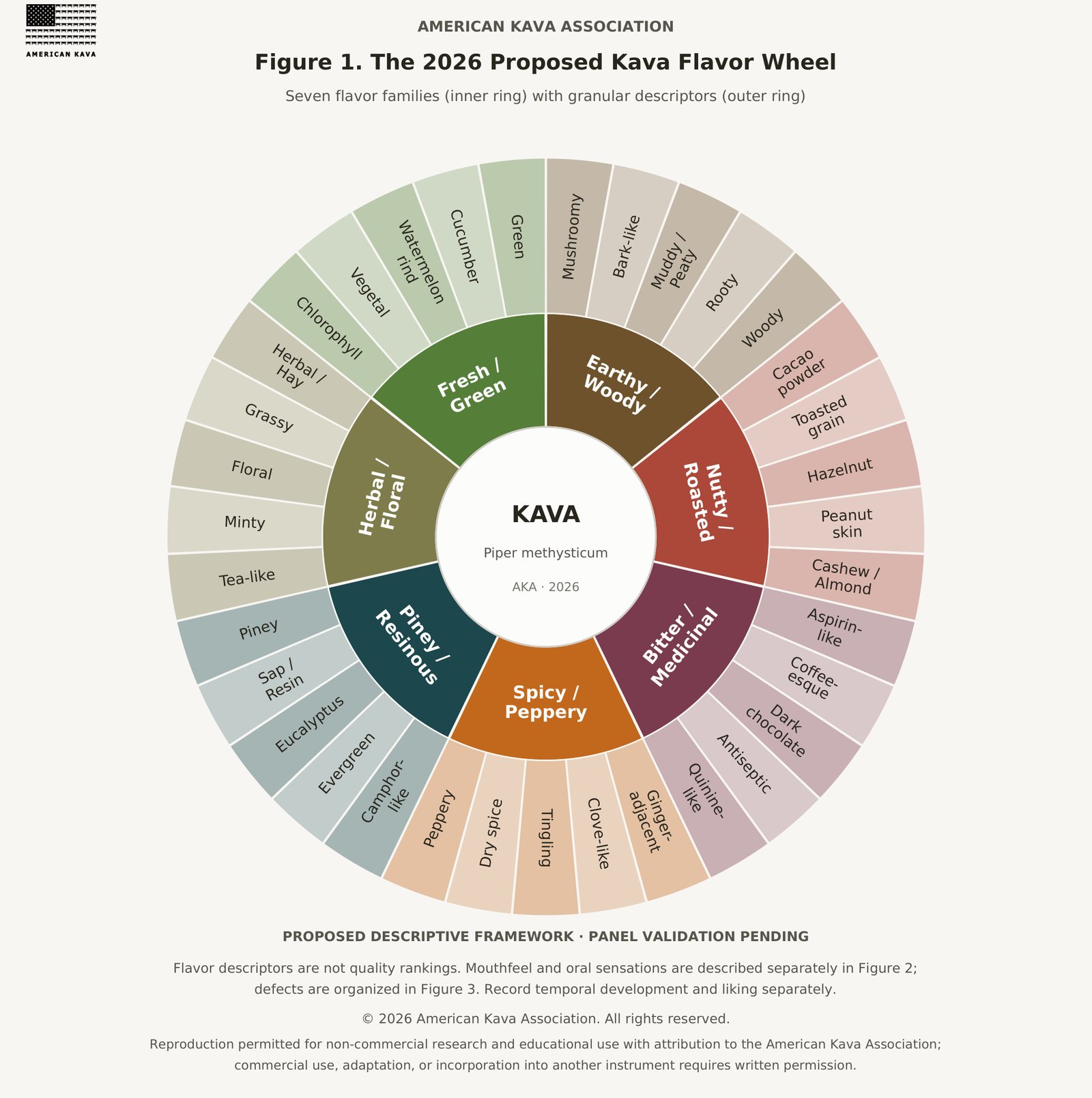
6.1.1 Published sensory findings and plausible chemical explanations
Cheung, Baker, Byrne, and Perrault (2022) supplied an analytical foundation for investigating kava aroma by characterizing volatiles in nine commercial root powders and corresponding water extracts using comprehensive two-dimensional gas chromatography. They tentatively identified 99 compounds across the sample types, with beta-caryophyllene prominent in powders and camphene prominent in water extracts. Their study did not include a sensory panel or establish which compounds produced particular perceived descriptors. Its contribution here is evidence of chemical diversity and preparation-dependent profiles, rather than validation of a flavor vocabulary.
Wang et al. (2025) added direct sensory evidence through a 14-member trained panel evaluating a preparation of 3 g of ground kava in 200 mL of water. Their six trained aroma categories were woody, herbal, floral, fruity, spicy, and green. Woody and herbal aromas were prominent; more than half of the assessors additionally described an earthy odor, while floral and fruity notes were detected by only a few. Numbing and astringency were prominent oral sensations. The authors described the odor as moderately pleasant and reported increasing acceptance with repeated tastings. These findings provide a relevant precedent for describing and appreciating kava through differentiated sensory attributes, but represent one commercial material source, not a survey of cultivar diversity or validation of the seven-family wheel proposed here (Wang et al., 2025, Sections 2.2 and 3.1).
Alongside sensory evaluation, Wang et al. (2025) reported 38 volatile compounds and quantified six kavalactones. They used relative odor activity values to prioritize 22 volatile candidates and discussed plausible associations between caryophyllene and woody/spicy notes, linalool and floral notes, hexanal and green/grassy notes, and cineole and medicinal notes. They also highlighted 2-methoxy-3-(1-methylpropyl)pyrazine as a candidate contributor to earthy and herbaceous character. These are proposed chemical explanations, not one-to-one identifications of the cause of each perceived descriptor. The sensory categories, compound-associated odor descriptions, and wheel families are related but not interchangeable (Wang et al., 2025, Section 3.3 and Table 1).
The chemical and sensory measurements also concern different preparations: Wang et al. analyzed powder headspace for volatiles and a methanol extract for kavalactones, whereas the panel evaluated an aqueous preparation. Their relative odor activity calculations used published thresholds in water; they did not measure thresholds or sensory contributions within the served kava matrix. Their olfactory-receptor modeling and TRPA1/TRPV1 docking offer hypotheses about molecular interactions, not functional demonstrations of receptor activation or proof that particular kavalactones cause numbing or astringency. The authors themselves identify receptor assays and sensory omission/reconstitution studies as future work needed to link predicted interactions directly to perceived flavor (Wang et al., 2025, Sections 2.3–2.6 and 4).
The present framework complements that research by organizing reported and observed sensory characteristics into practical language for evaluating kava as a food beverage. Its purpose is to describe what drinkers perceive and may appreciate, not to assign a molecule, receptor, pharmacological effect, or quality score to each wheel segment. Chemical explanations are supporting hypotheses, not prerequisites for describing a sensory impression. Reproducible recognition of the proposed descriptors, their grouping, and their applicability across preparations remain matters for panel evaluation. Bitterness, medicinal aroma, numbing, astringency, and liking should be recorded separately rather than inferred from a chemical profile.
6.1.2 Earlier exploratory work and the ISA hypothesis
In 2022, author Tyler Blythe, through Root of Happiness, undertook exploratory characterization of kavalactones and terpenes in kava, with GC×GC-MS analysis performed by Veda Scientific. The unpublished report records receipt of four samples on 22 July 2022: Solomon Terp and P-Fi Terp powders, and fresh-frozen Hiwa and ISA (Veda Scientific, 2022; batch T220723A-630-AMA). This work preceded the integrated sensory, chemical, and computational investigation of Wang et al. (2025). Earlier published investigations include Cheung et al., available online on 6 May 2022, and Cheng et al. (1988), who reported bornyl cinnamate and other constituents.
In the authors’ preparation and tasting experience, ISA and Kali-ISA show a stronger medicinal-type flavor. Veda’s ISA analysis offers a chemical hypothesis relevant to that observation: camphene was measured at 0.2786 milligrams per gram of fresh sample, while an unresolved peak designated RT49 was tentatively proposed to be isobornyl cinnamate (Veda Scientific, 2022, pp. 2, 9–11). Camphene also represented approximately 26 to 27 percent of the ISA chromatographic peak area, but peak-area percentage is not mass percentage and must not be substituted for the calibrated concentration.
The proposed connection between this chemistry and medicinal flavor is a testable interpretation, not a result of a sensory experiment in the Veda report. RT49 remains an unconfirmed identification; methanol-extract profiles do not establish aroma activity in an aqueous drink. The report names ISA, not a separately tested Kali-ISA sample, so extension to Kali-ISA is a hypothesis grounded in the authors’ sensory observation, not independent analytical confirmation. Medicinal character is not, by itself, a defect, a measure of toxicity, or a safety classification.
6.2 The seven flavor families
The seven flavor families describe qualities through which kava can be appreciated as a flavorful beverage, not merely sensations to be endured in pursuit of its effects. They draw on the authors’ practitioner observations unless a measured study is cited and provide a vocabulary for distinguishing the character of different preparations. The descriptors are sensory analogies rather than chemical identifications or cultivar markers; proposed chemical and processing drivers remain hypotheses.
The history of coffee evaluation supplies a precedent for this descriptive work. Sedgewick describes a shift in the American trade from judging green beans chiefly by appearance and presumed origin toward assessing the brewed cup through controlled roasting, preparation, smelling and tasting (Sedgewick, 2020, pp. 102–104, 111–113). The historical vocabulary he reproduces from Ukers includes body, smoothness, richness, woody and grassy impressions, together with faults such as mustiness and sourness (Ukers, 1922, pp. 356–357, quoted in Sedgewick, 2020, p. 112). That mixed list does not make every term desirable, nor does it validate transfer to kava. It demonstrates the value of assessing the prepared beverage and separating descriptive character, defects and preference instead of inferring drinking quality from appearance alone.
Professional coffee evaluation makes the significance of these qualities clear: earthy, woody, piney and peppery notes are not inherently obstacles to beverage enjoyment. They appear in highly rated coffees from international growing regions and, in several of the examples below, are explicitly praised as part of the coffee’s distinctive sensory appeal (Coffee Review, 2019a–c). Table 4 matches each proposed kava flavor family with a published coffee review scoring 87–97 points.
Coffee Review uses blind tasting and identifies Kim Westerman and Jason Sarley as Q-graders certified by the Coffee Quality Institute (Coffee Review, n.d.-a, n.d.-b). A Q-grader is a credentialed evaluator trained and assessed in standardized coffee sensory evaluation; the current program is administered by the Specialty Coffee Association (SCA, n.d.). The scores below are Coffee Review’s ratings of the complete coffees, not separate Q-certification results, and the historical reviews are not all attributed to those two individuals.
| Kava family | Coffee and growing region | Roaster | Review excerpt and citation | Score /100 |
|---|---|---|---|---|
| Earthy / woody | Sumatra Tano Batak; Lintong, North Sumatra, Indonesia | Gracenote Coffee Roasters | “fresh-turned humus … cedar” (Coffee Review, 2019c) | 94 |
| Nutty / roasted | Espresso Bella Crema; Central and South American blend | Coffee By Design | “Dark chocolate, roasted hazelnut” (Coffee Review, 2024) | 93 |
| Bitter / medicinal | Yemen Mocha; central-northern Yemen, probably near Sana’a | Batdorf & Bronson | “Sweet-smoky and medicinal”; “eucalyptus, sassafras” (Coffee Review, 2007) | 87 |
| Spicy / peppery | GNEP-01 Elida Geisha Green Tip Natural; Boquete, Panama | Willoughby’s Coffee & Tea | “pink peppercorn, almond brittle” (Coffee Review, 2019b) | 97 |
| Piney / resinous | Café Granja La Esperanza Sudan Rume Natural; Valle del Cauca, Colombia | PT’s Coffee Roasting Co. | “Winey pine (think retsina wine)” (Coffee Review, 2019a) | 95 |
| Herbal / floral | Colombia Gesha Spirits Semi-Washed Anaerobic; Huila, Colombia | PERC Coffee Roasters | “explosively herby and floral”; “Rosemary … star jasmine” (Coffee Review, 2023) | 93 |
| Fresh / green | Kona SL34; Kona, Hawaiʻi | Kona Farm Direct | “wheat grass, fresh cucumber, fresh-cut elm” (Coffee Review, 2020) | 90 |
Scores describe the whole reviewed coffee, not an isolated descriptor or a global percentile. Ellipses mark omissions. The Yemen review is mixed, and its match is medicinal aroma rather than bitterness. The PERC coffee was dried with mandarin orange peels after anaerobic processing (Coffee Review, 2007, 2023).
The strongest parallels are not simply tolerated characteristics in otherwise good coffees: the reviews present them as elements of excellence. The 94-point Sumatra Tano Batak combines “fresh-turned humus” and cedar in a profile praised as “Classic Sumatra genius” and “balanced and complete” (Coffee Review, 2019c). The 95-point Sudan Rume’s “winey pine” carries “persuasively into a crisp finish,” and the coffee is described as “brilliant, original, absorbing” (Coffee Review, 2019a). Pink peppercorn appears in the 97-point Elida Geisha, whose integrated floral, fruit, spice, nut and cocoa presentation is called “Elegant, lyrical and enchanting” (Coffee Review, 2019b). Earth, wood, pine and spice therefore belong not only to the vocabulary of acceptable beverages but also to the language used to praise exceptional ones.
The overlap extends beyond coffee to chocolate and tea. Barry Callebaut’s Consumer Chocolate Sensory Wheel includes nutty, roasted, vegetal, spice and floral aromas, alongside bitter taste and astringent mouthfeel, overlapping several dimensions of the kava framework (Barry Callebaut, n.d.). Its accompanying explanation identifies bitterness and astringency as features of dark-chocolate description and notes that vegetal, spicy and floral qualities can be prominent and important in single-origin chocolates (Barry Callebaut, 2019). Chocolate appreciation therefore encompasses much more than sweetness: the tasting framework invites attention to precisely the kinds of aromatic complexity, bitterness and texture that also distinguish kava preparations.
The International Tea Masters Association’s Tea Aroma Wheel makes the correspondence particularly clear. Its earthy and wood categories include pine and cedar; its plant/herbaceous categories include fresh-cut grass, hay and mint; and its nutty, floral and spicy categories include almond, roasted nuts, jasmine, rose, pepper and clove (International Tea Masters Association, n.d.). These terms closely parallel kava’s earthy/woody, piney/resinous, fresh/green, herbal/floral, nutty/roasted and spicy/peppery families. The wheels establish a shared descriptive vocabulary rather than declaring every listed note desirable at every intensity; the coffee reviews provide the complementary evidence of explicit praise.
Taken together, coffee, chocolate and tea place kava’s sensory range within a familiar vocabulary of food and beverage appreciation. The qualities described by the authors as earthy, woody, nutty, peppery, piney, herbal and fresh can be reasons to select and enjoy a kava, rather than evidence that its flavor must be masked or overcome. Shared descriptors do not establish identical chemistry or transfer a coffee’s score to kava; intensity, balance, mouthfeel and preparation still shape the experience. They do, however, undermine the assumption that these flavor families are intrinsically unpalatable. Kava can be approached as a beverage with a distinctive and appreciable flavor profile in its own right, not merely as a vehicle for physiological effects.
6.2.1 Earthy / woody
Earthy and woody impressions recur in the authors’ tasting experience, particularly with dried-root preparations. The core character is grounded, mineral-like, and non-sweet. Root composition, handling, and residual soil are distinct candidate influences that the descriptor alone cannot separate.
Granular descriptors:
— Woodsy — dry wood, sawdust, aged timber impressions.
— Rooty — carrot, beet, or parsnip impressions; fresh but heavy vegetal earth.
— Muddy / peaty — wet soil, loam, forest-floor impressions; cause is not assigned from the descriptor alone.
— Bark-like — tannic, fibrous, slightly bitter; overlaps with astringency.
— Mushroomy — mushroom-like, damp-earth impressions; the descriptor does not establish umami chemistry or a microbial source.
Preparation and interpretation considerations:
— Earthy language describes a sensory resemblance; it does not establish soil carryover or a particular chemical cause.
— Document root fraction and handling when comparing woody or bark-like impressions.
— Harvest hygiene and residual soil should be documented when testing muddy impressions; soil type should not be inferred from flavor.
— Drying conditions are candidate influences on stale or swampy impressions, to be tested alongside independent handling and defect records.
In the authors’ experience, body and astringency can make earthy and woody notes seem rounded, chalky, or rough. These accompanying sensations should be recorded separately.
The distinction between an earthy descriptor and a handling defect requires independent evidence. Muddy or peaty wording alone does not establish contamination, and a pleasant profile does not exclude it. The quality standards and separate defect-screening procedure address soil carryover, foreign material, and off-aroma without treating every earthy note as a fault. Matched washing, drying, and volatile-analysis studies are needed to determine which impressions are intrinsic to the material and which are introduced or intensified during handling.
6.2.2 Nutty / roasted
The nutty/roasted family links earthy-woody notes to bitter-medicinal perception in the authors’ descriptive scheme. Its soft, rounded, food-like character invites cashew, toasted-grain, and cocoa comparisons, without implying roasting or Maillard chemistry.
Granular descriptors:
— Cashew / almond — mild, creamy nuttiness; not a marker of cultivar class or curing quality.
— Peanut / peanut skin — earthy-roasted and slightly bitter; overlaps the woody and bitter families.
— Hazelnut — sweet-roasted and aromatic impressions.
— Toasted grain — barley, oat, or malt-adjacent impressions.
— Cacao / cocoa powder — dry rather than sweet chocolate; bridges directly into the bitter/medicinal family.
Preparation and interpretation considerations:
— Drying and storage may shift the balance of green and nutty impressions; the direction and chemical basis require matched measurements.
— Compare water temperatures under otherwise matched preparation conditions when assessing nutty impressions.
— Record grind and mixing method alongside nutty or chocolaty impressions rather than infer a chemical origin from the descriptor.
— A nutty or cocoa-like descriptor does not establish sugar content. Contributions from aroma, taste, and texture must be distinguished experimentally.
In the authors’ experience, nutty impressions appear more rounded in fuller-bodied preparations, suggesting interactions among aroma, body, bitterness, and liking for testing. Coconut-containing preparations require separate controls because the added ingredient may contribute its own aroma and texture.
6.2.3 Bitter / medicinal
The bitter/medicinal family groups related language without treating bitter taste, drying sensation, and medicinal aroma as the same percept. The authors have encountered learned associations between bitterness and expected effects in service practice, but their prevalence and accuracy have not been measured. Bitterness does not establish dose, cultural authenticity, safety, or quality. The proposed core vocabulary includes tonic-like bitterness and antiseptic or herbal-tincture impressions; assessors should rate taste, aroma, and astringency separately. Whether intensity tracks kavalactone concentration or ratios, and how it is valued across drinking cultures, remain questions for the proposed study.
Granular descriptors:
— Quinine-like — clean, tonic-water bitterness; often perceived as structured rather than harsh.
— Antiseptic / medicinal — iodine, herbal tincture, clinical impressions.
— Dark chocolate — bitter cocoa, unsweetened cacao nibs.
— Coffee-esque — black coffee or espresso bitterness without the acidity.
— Aspirin-like — chalky, tablet-like bitterness; a sensory analogy, not identification of salicylates.
Preparation and interpretation considerations:
— Rate bitterness and oral sensations independently; their intensity does not identify a kavalactone concentration or ratio.
— Separate medicinal aroma from bitter taste, using the chemical associations in Section 6.1.1 only as supporting hypotheses.
— Extraction temperature and shear are candidate influences on bitterness; their effects should be measured rather than ranked as balanced or aggressive in advance.
— Record body and particulate texture alongside bitterness so that these sensory dimensions are not conflated.
In the authors’ experience, thin preparations present bitterness more sharply than fuller-bodied preparations. The ISA and Kali-ISA observations also illustrate why medicinal aroma should be recorded separately from bitter taste.
6.2.4 Spicy / peppery
The spicy/peppery family includes pepper-like aroma as well as prickling, warming, or tingling sensations reported in the authors’ practice. These channels should be recorded separately: an aromatic resemblance to culinary pepper does not establish the same active compounds or receptor mechanism. Membership in the genus Piper supplies a botanical comparison, not a chemical explanation of the descriptor. The proposed tactile vocabulary concerns sensations on the tongue, lips, and palate without requiring a capsaicin-like burn.
Granular descriptors:
— Peppery — black peppercorn, white pepper dust.
— Spicy — dry spice warmth without capsaicin burn.
— Tingling — electric, numbing-adjacent oral sensation.
— Clove-like — phenolic spice overlap at low intensity.
— Ginger-adjacent — subtle warmth and bite without sweetness.
Preparation and interpretation considerations:
— Record pepper-like aroma separately from warming, prickling, and other oral sensations.
— Numbing, warming, and tingling should be measured independently rather than assuming that one sensation explains another.
— Root-fraction and cultivar differences are prospective comparison variables. Stronger medicinal flavor in ISA or Kali-ISA should not be equated with stronger trigeminal activity or inferred from a tudei classification.
— Shear-related changes in particulate load and chemical composition should be measured alongside, not inferred from, tactile intensity.
In the authors’ experience, spicy and peppery notes can seem sharper in thin preparations and more rounded in creamy ones. Astringency may influence whether an assessor describes the combined sensation as pleasant stimulation or irritation.
6.2.5 Piney / resinous
The piney/resinous family describes pine-needle, balsamic, conifer-like, and camphoraceous aroma impressions. The authors observe pine and medicinal character in fresh Kali-ISA and a woodsy-pine character in dried Kali-ISA. These observations motivate the proposed study’s sample selection, not a rule for identifying cultivar or root fraction. The reported terpenoid findings provide chemical candidates, but neither odor thresholds nor the relative contributions of individual compounds have been established for these served preparations.
Granular descriptors:
— Piney — fresh pine needle, forest resin; clean and terpene-forward.
— Sap / resin — sticky, balsamic, tree-exudate impressions.
— Eucalyptus — cooling, camphoraceous notes with nasal lift.
— Evergreen — fir, spruce, conifer-adjacent aromas.
— Camphor-like — sharp medicinal-resin overlap at higher concentrations.
Preparation and interpretation considerations:
— Use piney, resinous, and camphoraceous as sensory descriptions, not identifiers of a particular terpene or chemotype.
— Lateral roots, chips of documented anatomical origin, and defined blends should be compared within matched cultivars and lots; no universal fraction-to-aroma mapping is assumed.
— Storage time and oxidative conditions are candidate influences on piney character, requiring chemical and sensory measurements from the same samples.
— Blending and time to service should be controlled when measuring headspace composition and piney or resinous intensity.
In the authors’ descriptive practice, piney notes contrast with denser woody or nutty impressions, while camphoraceous notes overlap with medicinal aroma. Intensity and liking should be recorded separately.
6.2.6 Herbal / floral
The herbal/floral family uses comparisons with tea, tisanes, herbs, and flowers to describe plant-forward, non-roasted aromas. The familiarity of these references may vary across drinking cultures.
Granular descriptors:
— Herbal / hay — dried grass, meadow hay, chamomile-adjacent notes.
— Grassy — fresh-cut grass and green stalks; overlaps the fresh/green family at lower oxidation.
— Floral (rose, lavender) — soft, perfumed aromatics rather than overt sweetness.
— Minty — cooling herbal lift without menthol sharpness.
— Tea-like — green or white tea impressions; lightly tannic, aromatic, and clean.
Preparation and interpretation considerations:
— Use familiar herb and flower references for description; the linalool association discussed in Section 6.1.1 does not validate the entire family.
— Drying and oxidative conditions are candidate influences on herbal and floral intensity, not established explanations for each descriptor.
— Fresh, recently dried, and stored materials should be compared using documented time and storage conditions.
— Extraction temperature should be tested independently of service temperature when examining herbal aroma, bitterness, and earthiness.
Herbal and floral comparisons distinguish these notes from green, earthy, and bitter impressions. Whether the beverage matrix alters their prominence or familiar references improve novice acceptance remains to be tested.
6.2.7 Fresh / green
The fresh/green family describes bright, aqueous, vegetal, or rind-like impressions, often associated with fresh material in practitioner use. A green descriptor does not demonstrate chlorophyll as an aroma source or establish harvest age or oxidative condition. Volatiles such as hexanal, reported by Wang et al. (2025), are candidates for green notes, but their contribution to a specific fresh-root beverage requires matched analytical and sensory evidence.
Granular descriptors:
— Green — fresh plant tissue, cut stem, living root.
— Cucumber — watery, cooling, cucurbit-like freshness.
— Watermelon rind — clean vegetal sweetness without sugar.
— Vegetal — raw squash, green bean, or gourd impressions.
— Chlorophyll — leafy, slightly bitter green plant notes.
Preparation and interpretation considerations:
— Document material state and time since preparation when comparing the intensity of green impressions.
— Leafy or chlorophyll-like wording denotes an impression, not an identified pigment contribution to taste or aroma.
— Drying and storage may alter green impressions, but neither their disappearance nor conversion to earthiness should be assumed.
— Extraction and service temperatures should be varied independently when testing green-note intensity and persistence.
In the authors’ practice and informal consumer discussion, some fresh preparations evoke cucumber or watermelon-water impressions. The proposed material-state comparison retains these terms for testing their reproducibility and frequency in fresh versus dried kava, without assuming that they reliably distinguish the two.
6.3 The mouthfeel and oral sensation wheel
Mouthfeel and chemesthesis are central rather than secondary. Oral numbing is documented in sensory work (Wang et al., 2025), while its constituent-specific mechanism remains distinct from the observation itself. Suspended particles and the beverage matrix are candidate contributors to body and persistence. The descriptors below act across all seven families rather than belonging to any one of them. Figure 2 organizes the proposed vocabulary into five domains, separating physical texture, drying and astringency, and chemesthetic sensations. Body and viscosity have separate scale anchors; the other sectors contain candidate descriptors rather than intensity rankings. The hierarchy and definitions remain subject to panel refinement, and numbing is analyzed separately from physical texture. Table A2 provides the corresponding operational vocabulary.
Titcomb describes dried-root preparations as greyish and green-root preparations as greenish. A beverage prepared for her account from fresh material collected in Manoa valley resembled “milky pea soup,” developed light foam during mixing and straining, and became almost puree-like at the bottom of the cup after standing briefly (Titcomb, 1948, p. 117). These preparation-specific observations support recording material state, mixing, settling time, and resuspension when comparing body and particulate texture.
— Body and flow: Body is perceived fullness, rated from light to full; viscosity is perceived resistance to movement, rated from thin to viscous. These are separate attributes. Neither should be inferred from opacity, bitterness, numbing or expected strength.
— Particulate texture: Smooth denotes little perceptible particulate interruption; fine-powdery denotes a diffuse fine-particle impression; chalky combines powder-like texture with dry coating. Grainy denotes distinguishable granules, gritty denotes hard or abrasive particles, and fibrous denotes thread-like or fragmentary material. These observations do not identify particle composition or establish contamination.
— Lubrication and coating: Slippery denotes easy sliding between oral surfaces; silky denotes fine, even glide; creamy combines fullness, smoothness and soft lubrication. Oily-feeling denotes an oil-like slickness, while mouth-coating denotes a residual film or layer after the liquid is removed. These sensory analogies do not establish fat content or an emulsion, and buttery aroma is recorded separately.
— Drying and astringency: Drying denotes perceived loss of oral wetness or lubrication; puckering denotes tightening; gripping denotes increased drag between oral surfaces; surface-roughening denotes roughness of the oral surfaces themselves. Where possible, distinguish these sensations from individual particles moving through the beverage; an unresolved rough sensation should not be forced into either category.
— Chemesthetic sensations: Tingling denotes a fine buzzing sensation; prickling denotes localized points of sharp stimulation; numbing denotes subjective reduction of ordinary oral sensation. Warming and burning denote heat-like or stinging sensations, with actual service temperature recorded separately. Rate these attributes independently of taste, aroma, physical texture and systemic effects.
— Time and interpretation: Record onset, peak, persistence, recovery and location separately from descriptor selection. The authors’ estimate of approximately 5 to 15 minutes for numbing persistence is a practitioner observation, not a universal duration. Liking is a separate response, and neither an intense sensation nor a smooth texture constitutes a safety or quality determination.
Astringency deserves separate treatment as a drying or puckering tactile percept, not simply a taste. Polyphenol interactions with salivary proteins provide a comparative mechanism in foods such as cacao, but this paper does not demonstrate that mechanism in the kava preparations described. The authors use grippy, chalky and harsh in practice; the proposed definitions distinguish gripping from the composite chalky impression and retain harsh as open-ended evaluative language rather than a core descriptor. Whether creamy matrices moderate astringency, and how its acceptance changes with experience relative to bitterness, are questions for the proposed study.
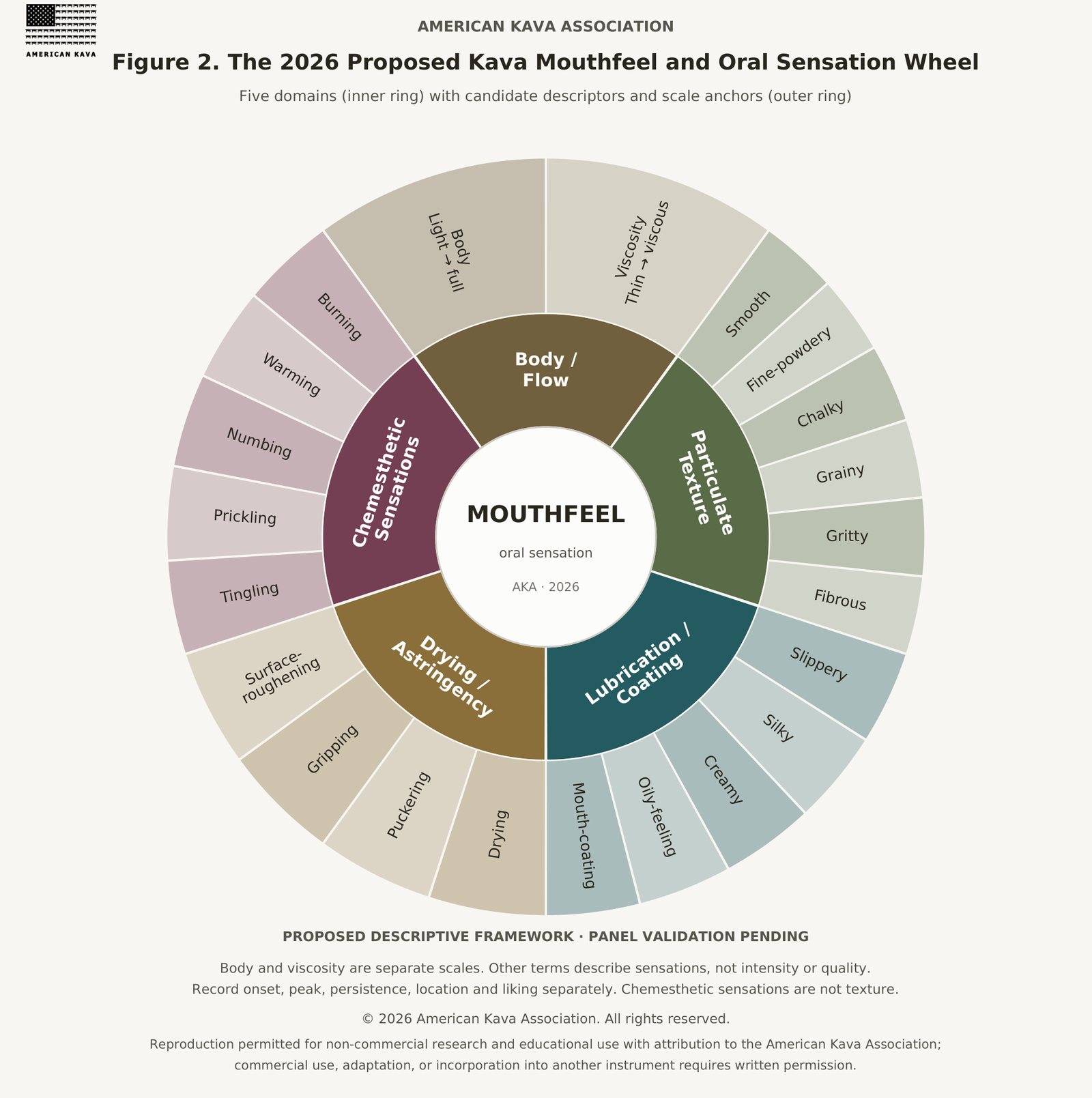
6.4 The temporal and chemesthetic overlay
The temporal overlay records when an attribute appears, changes, and resolves. The terms below define observation windows rather than a mandatory sequence or expected profile; taste, aroma, and oral sensations may occur in any window.
— Onset — first detectable impressions, with latency recorded separately for each attribute.
— Mid-palate — attributes developing during oral exposure, including changes in taste and body.
— Finish — residual impressions after expectoration or swallowing, measured through return to baseline.
— Retro-nasal — aroma perceived through the mouth-to-nose route; recorded across time, not treated as a final stage.
Retronasal aroma, bitterness, numbing, and aftertaste unfold over time. The proposed protocol records each oral sensation and baseline recovery rather than imposing the authors’ practitioner estimates of onset and peak intensity. Clean, lingering, harsh, and metallic describe finish, not safety or a validated quality ranking.
Appearance and visible sediment may set expectations about body, richness, or strength before tasting. Their effects on subsequent ratings are not quantified here. The proposed protocol separates blinded tasting from appearance assessment so that these potential cues are recorded without assuming their direction or magnitude.
6.5 Defects and the boundary of the descriptor set
The wheel encodes no preference: no flavor family is a defect or a target. That position is only defensible if defects are named separately, because the alternative is that faults enter the record as low ratings on legitimate families and the descriptive vocabulary ends up conflating what kava is with what went wrong in handling it. Kava quality standards already carry a defect vocabulary, but they express it almost entirely as material and hygiene criteria rather than as sensory terms. Codex CXS 336R-2020 requires that kava products be “free of visible mould,” “free from soil and foreign materials,” “free of leaves, bark, and/or stems,” and “free from foreign odour,” sets a moisture ceiling of 12 percent for dried product, and requires sealed-container storage for dried product and quick freezing below minus 18 degrees Celsius for fresh product (Codex Alimentarius Commission, 2020). Of those criteria only one, foreign odour, is sensory at all, and it is stated without a single descriptor.
A national standard goes further and names defects as a class of their own. The Fiji kava standard defines three: insect-damaged kava, “Kava that is visibly damaged by insects or contains dead insects”; mouldy kava, “Kava that is visibly affected by mould”; and off-aroma kava, “kava that has a noticeable off or foul aroma”. It requires that “Kava products will have the aroma characteristics of the product” and that the aroma “will be free of extraneous aromas indicating contamination with other plant material, solvents or other volatile matter”, caps moisture at 12 percent and ash at 6.0 percent, requires that filth and other extraneous material be minimised by cleaning the fresh root and then protecting it from further contamination, and provides that a consignment failing one or more applicable requirement “shall be considered ’defective’ and not suitable for sale” (Fiji Ministry of Agriculture, 2017). Three features of that instrument are carried into the framework proposed here. A defect is disqualifying rather than a low score, which is why the screening stage set out below is kept separate from the intensity stage. The aroma clause is written against contamination by solvents and volatile matter, which is the closest any standard comes to the fermented and solvent family named below. And its scope reaches kava used as a food or food ingredient and other products intended for human usage, which is broader than the Codex scope and means its aroma requirements are not confined to the dried root. What it does not do is resolve “off-aroma” into descriptors, and that is the gap this section addresses.
The exporting-nation manuals are more specific about causes, and it is from the causes that a sensory defect set can be derived. The Vanuatu manual states that kava “needs to be dried properly to stop mould and rotting” and “to 12% or less moisture,” warns that “The mould may not be easily visible but can reduce the quality of the kava by affecting the colour and taste,” instructs producers to “Never dry the kava directly on the ground,” holds that kava “should not be dried at more than 70°C (too hot to touch) as it can discolour or have reduced kavalactone,” directs them to “Avoid drying the kava near smoke or other products that may leave any odours or residues” and not to use “copra or cocoa driers as the kava can pick up odours or residues,” and notes that “Kava can be re-dried several times but the quality can deteriorate” (PHAMA, 2013). The Fiji manual gives the same account with a lower ceiling, “no more than 60°C (too hot to touch),” and states the sensory target directly: dried root “should be dry, pale (not yellow) and not have any musty or ’off’ smells,” the prepared drink “should not have any ’off’ tastes,” and dryers “need to be well designed to avoid other quality problems such as smoky odours or damaging the kava because of intense heat.” Material “that is black, old, has insect holes or is mouldy” is identified as poor quality, and material that fails the snap test “should be re-dried thoroughly to ensure it does not go mouldy during storage” (PHAMA, Pacific Community, & University of the South Pacific, n.d.). The two temperature ceilings differ by ten degrees for the same fault, which is recorded here as an unresolved discrepancy between two standards rather than resolved in either direction.
In Tyler Blythe’s preparation and quality-control experience at Root of Happiness, plain kava made from sound, properly processed root and served promptly is not characteristically sour. Marked sourness develops as prepared kava deteriorates after being left standing; a similar fault occurs in beverages made from inadequately dried root or fresh root allowed to deteriorate before extraction. The framework treats this sourness as a processing or storage defect, not an expected cultivar attribute.
Kava-specific microbiology supports a deterioration mechanism. In four freshly prepared kava-bar beverages stored at 4°C and sampled on days 0, 3, and 6, aerobic, lactic-acid-bacterial, and yeast-and-mould counts increased while pH decreased; lactic acid bacteria and Pseudomonas were implicated in spoilage (Dong et al., 2011). An earlier research report proposed that polysaccharide-degrading bacteria release simple sugars that other bacteria can ferment, lowering pH (Li, 2009, pp. 5–6). Together, these findings support microbial acidification as an explanation for souring, rather than a yeast-specific attribution. Here, “fermented” denotes possible microbial deterioration of the carbohydrate-containing material or beverage, not demonstrated alcoholic fermentation; the term does not establish alcohol content.
Figure 3 groups these faults into seven families, each with five granular descriptors. Drawn from quality standards and the authors’ commercial inspection experience, the proposed defect wheel has neither panel validation nor confirmed descriptor-to-compound assignments. Unlike the descriptive flavor wheel, it identifies faults to eliminate.
The seven families, with the handling stage each originates in, are as follows.
— Moldy / musty — musty, mildewed, damp cellar, wet burlap, spore-dusty. Origin: drying that is inadequate, interrupted, or repeated; re-wetting; storage above 12 percent moisture; or soil carryover holding moisture against root tissue.
— Sour / acetic — sour, vinegar, lactic, cheesy or butyric, silage. Associated stages: delayed or inadequate drying, deterioration of fresh root held before extraction, and storage of the prepared beverage. Microbial acidification is supported by the storage evidence; the individual descriptor does not identify the organism or acid involved.
— Fermented / solvent — plastic, petrol or kerosene, solvent or acetone, nail-polish, yeasty or beery. Candidate origins include microbial deterioration of wet material and extraneous chemical contamination. These aroma analogies are distinct from sour taste and do not establish fermentation, ethanol production, or a particular contaminant; volatile analysis is needed to distinguish causes.
— Smoke / chemical — woodsmoke, ashy, creosote, diesel or exhaust, chlorine / sanitizer (bleach-like or disinfectant-like off-flavor or off-odor). These are screening descriptors, not contaminant identifications. Review drying, smoke exposure, packaging, preparation water and cleaning/rinsing records. Chlorine / sanitizer belongs here, not under the intrinsic medicinal or antiseptic-like character in Figure 1; withdraw flagged samples rather than tasting further to confirm the fault.
— Scorched starch — scorched starch, burnt cereal, over-toasted grain, caramel-burnt, scalded. Origin: drying above the temperature ceilings set by the standards, or localized overheating in beds that are not turned.
— Rancid / oxidized — rancid oil, cardboard, painty, waxy-stale, stale nut. Origin: oxidation of lipid in long-stored, repeatedly re-dried, or poorly packaged material. Its compositional basis is measured even though its sensory consequence is not: the root-material nutritional panel gives 2.62 grams of total fat per 100 grams of root material, of which 0.90 grams is polyunsaturated, and polyunsaturated fatty acids are the substrate of the oxidative pathway that yields cardboard, painty, and stale-nut aromas in stored botanicals. The step from that substrate to these descriptors is the authors’ inference and requires targeted oxidation measurements paired with sensory assessment; the microbial-storage findings of Dong et al. (2011) do not test this lipid-oxidation pathway. Distinguished from Nutty / Roasted in Figure 1, a clean toasted-nut character, by cardboard and painty notes that fresh material does not show.
— Soil / dust — dirt, dusty, gritty soil, barnyard, stagnant or swampy. Origin: incomplete washing, drying on bare ground, and the contamination the standards name alongside soil, namely grass, insects, plastic, and animal waste.
Several defect descriptors sit close to language in Figure 1, so intensity alone cannot define the boundary. Mushroomy or earthy wording does not establish fungal growth or residual soil; stale, cellar-like notes or visible deterioration warrant separate inspection. Muddy and peaty impressions should likewise be distinguished from extraneous dirt or grit through preparation and handling records rather than flavor language alone. An acrid or scorched impression warrants separate screening from a toasted or roasted analogy, while camphor-like aroma does not by itself establish smoke exposure or identify a terpene. The defect wheel is therefore a separate screening vocabulary, not simply a high-intensity extension of the flavor wheel. Confirmation of a suspected cause requires evidence beyond the descriptor.
Two further points complete the boundary. Texture and oral sensations are described separately in Figure 2 rather than incorporated into the flavor or defect families. Chalkiness, grit, coating and fibrous texture may inform assessment of preparation, but they do not by themselves identify mishandling or contamination; excessive sediment and other process observations should be recorded alongside the sensory profile. Bitterness, astringency, numbing and earthiness are not automatically handling defects because an assessor dislikes their intensity. Descriptive intensity, liking, process conformity and sample eligibility remain separate judgments.
For panel use the defect set belongs at a screening stage before profiling rather than inside the check-all-that-apply list. A sample carrying any Figure 3 descriptor is not a valid sample for characterizing cultivar or temperature effects, and it should be withdrawn and recorded as withdrawn together with the descriptor that disqualified it. Over time that record is itself informative, because it accumulates the frequency with which each fault reaches the cup. The descriptor set is reproduced as Table A3 in Appendix A for that use.
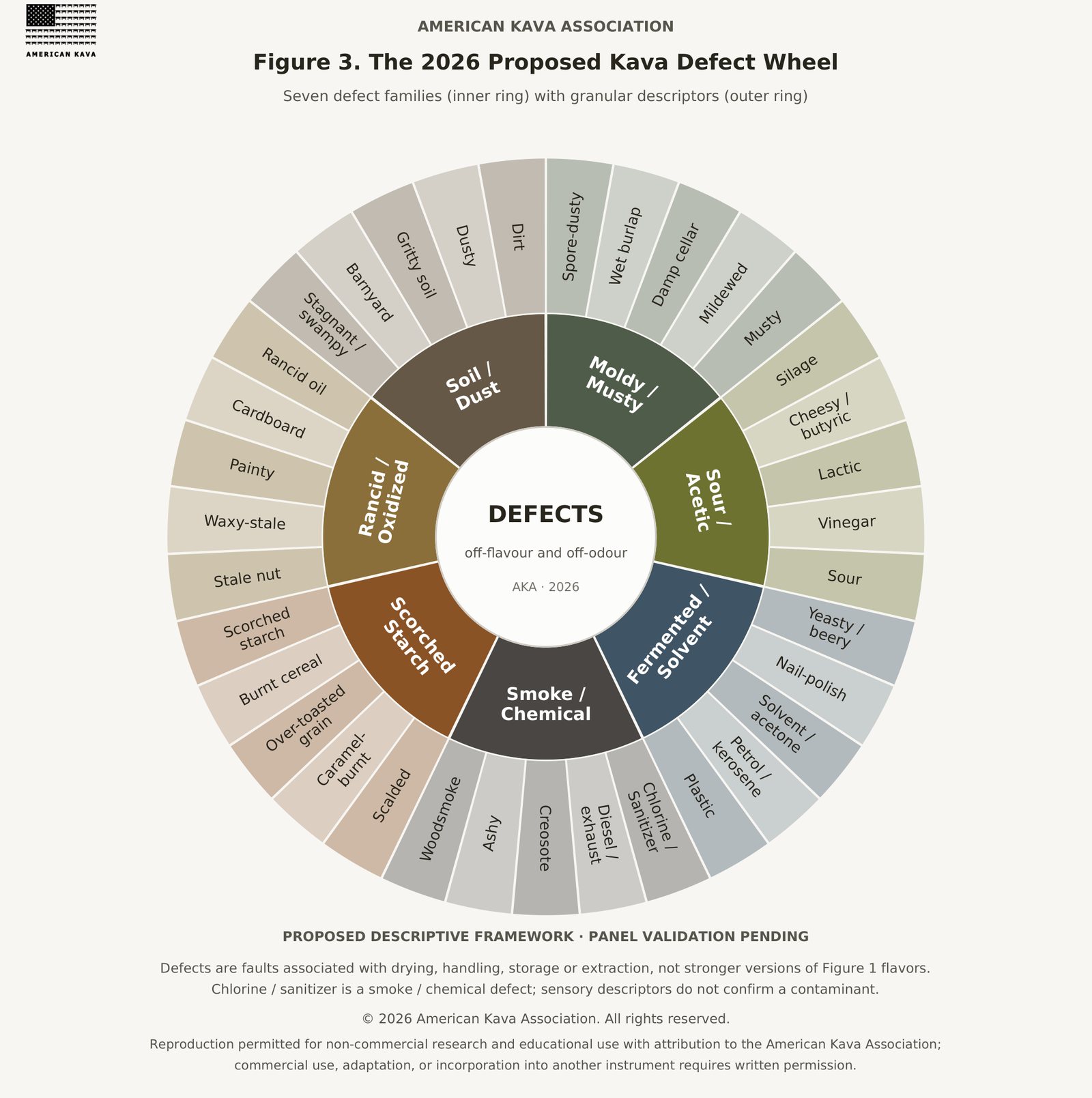
7. Composition of kava root material and of the strained beverage
Compositional data can help contextualize the material being tasted, but a descriptive flavor framework does not require a chemical explanation of each sensory attribute. This section provides supporting food-composition context, not a molecular validation of the wheel. It separates three categories that are routinely conflated in the kava literature: what has been measured in root material, what has been measured in the strained beverage, and what is inherited from a single earlier source and repeated without re-measurement. These distinctions help define the preparation under evaluation without inferring its flavor from composition alone.
7.1 The inherited proximate profile
One compositional profile appears in essentially every authoritative treatment of kava. It is reproduced in Table 5 as it is conventionally given.
| Component | Percentage of dry weight | Status |
|---|---|---|
| Starch | 43 | Inherited from a single 1992 source |
| Fibre | 20 | Inherited from a single 1992 source |
| Water | 12 | Inherited from a single 1992 source |
| Sugars | 3.2 | Inherited from a single 1992 source |
| Protein | 3.6 | Inherited from a single 1992 source |
| Minerals (ash) | 3.2 | Inherited from a single 1992 source; no elemental breakdown published |
| Kavalactones | 3–20 (cultivar- and fraction-dependent) | Widely re-measured; the one well-supported term |
| Lipid / fat | Not reported | Not reported in this profile; measured independently in 2018 (Table 7) |
This profile traces to Lebot, Merlin and Lindstrom, Kava: The Pacific Drug (Yale University Press, 1992). The same text was reissued in 1997 by Healing Arts Press under the title Kava: The Pacific Elixir; it is a retitled reprint rather than a revised edition, and library records give the same collation, so page references are interchangeable between the two and the 1992 attribution is the correct one. The profile is re-quoted, in most cases verbatim and without independent measurement, by Food Standards Australia New Zealand in its kava risk assessment, by the joint FAO and WHO Codex regional standard documentation, by IARC Monograph 108, by the European Medicines Agency, by the United States Food and Drug Administration, and by the PROSEA database. No analytical method, sample description, cultivar identity, or laboratory attribution accompanies the figures in any of these secondary appearances.
Two arithmetic observations follow, and both are the authors’ inference rather than a published finding. The non-kavalactone terms sum to 85.0 percent, which means the profile closes to 100 percent only at a kavalactone content of 15 percent, near the top of the quoted range; at a more typical 10 percent the profile leaves 5 percent unaccounted for. And there is no lipid term at all, despite kavalactones being lipophilic and despite the oily coating repeatedly described in sensory accounts and the proposed mouthfeel descriptors. A measured fat value does exist outside this profile, in the 2018 panel reproduced as Table 7, but it has never been carried back into the profile that the literature reproduces.
7.2 Modern measurement
The first systematic peer-reviewed nutritional study of kava was published in 2025 by Pasinszki, Devi and Krebsz, working on Fijian material from Rotuma, Kadavu, and Vanua Levu. Its principal findings for Rotuma material are given in Table 6.
| Measure | Roots | Rhizomes |
|---|---|---|
| Calorific value (MJ per kg) | 18.19 ± 0.09 | 17.31 ± 0.17 |
| Protein (weight percent) | 3.86 ± 0.70 | 2.33 ± 0.47 |
| Ash (weight percent) | 5.0 ± 1.0 | 3.4 ± 0.6 |
| Sugar and fibre, by difference (weight percent) | 78.8 ± 1.8 | 87.5 ± 1.6 |
Three qualifications apply. The sugar-and-fibre term is a residual computed by difference rather than a measurement, so it absorbs every unmeasured component including lipid. That study reports no fat value, no starch determination, and no individual mineral concentrations, although a separate single-sample panel reporting all three is given below. And the protein figure of 3.86 percent for roots is close to the inherited 3.6 percent, which is a partial corroboration of one term of the 1992 profile.
The same study measured kavalactone content by plant organ, which is directly relevant to the sensory framework because root fraction is a stated driver in five of the seven flavor families.
| Plant organ | Total kavalactones (percent) |
|---|---|
| Root | 12.50 |
| Rhizome | 8.62 |
| Basal stem | 5.08 |
| Leaf | 1.05 |
One earlier analysis reports several of the terms the 2025 study does not. In 2018 the American Kava Association commissioned a full nutritional panel on a single commercial Vanuatu lot composed of 30 percent lateral roots and 70 percent basal stump, and published the laboratory report with the analytical method stated for each analyte (Blythe & Lowin, 2018). It is the only source located that reports a measured fat value for kava root, and it is reproduced as Table 7.
| Analyte | Result per 100 g | Method |
|---|---|---|
| Energy | 351 kcal | 21 CFR part 101.9 |
| Energy from fat | 24 kcal | AOAC |
| Moisture | 8.99 g | AOAC |
| Ash | 4.60 g | AOAC |
| Total fat | 2.62 g | AOAC |
| Saturated | 0.60 g | AOCS |
| Mono-unsaturated | 0.11 g | AOCS |
| Poly-unsaturated | 0.90 g | AOCS |
| Trans fatty acids | Not detected | AOCS |
| Protein | 2.98 g | LECO combustion |
| Carbohydrate, by calculation | 78.81 g | Calculation |
| Dietary fibre | 24.3 g | AOAC |
| Total sugars | 3.00 g | HPLC-RI |
| Fructose | 1.75 g | HPLC-RI |
| Glucose | 0.85 g | HPLC-RI |
| Sucrose | 0.50 g | HPLC-RI |
| Maltose | 0.10 g | HPLC-RI |
| Lactose | Not detected | HPLC-RI |
| Potassium | 1,620 mg | ICP-MS |
| Calcium | 324 mg | ICP-MS |
| Sodium | 42.9 mg | ICP-MS |
| Iron | 4.80 mg | ICP-MS |
| Cholesterol | Not detected | AOAC |
| Vitamin D | Not detected | HPLC |
Four results in that table bear directly on the sensory framework. A measured fat value for kava root exists: 2.62 grams per 100 grams, of which 0.90 grams is polyunsaturated. That is the compositional substrate the rancid and oxidized defect family requires, and it removes the objection that the family was proposed with no lipid in the material to oxidize. Individual sugars are resolved rather than reported as one term, and the 3.00-gram sugar load is dominated by fructose at 1.75 grams rather than by sucrose. Dietary fibre is measured at 24.3 grams per 100 grams rather than inherited at 20 percent, which bears on suspension behaviour, since insoluble fibre is the carrier phase for most of the kavalactone load. And four elements are quantified, with potassium at 1,620 milligrams per 100 grams exceeding sodium, calcium, and iron combined by a wide margin and accounting for most of the 4.60-gram ash term.
Five qualifications constrain how far the table can be taken, and they are limiting rather than formal. It is a single sample from a single lot, reported once, with no replicates and no stated uncertainty on any analyte. The material is a blend of 30 percent lateral root and 70 percent basal stump, so no value in it is attributable to a root fraction, a variable treated here as a driver of five flavor families. The carbohydrate term is obtained by calculation rather than by measurement, so it absorbs the error in every other term, and no starch determination was performed. The report gives no kavalactone content for the sample, so the profile cannot be closed against the one term the literature measures well. And the total-fat figure needs care: an AOAC total-fat determination recovers a lipid extract, and the six major kavalactones are reported to account for approximately 96 percent of the total lipid extract from kava (United States Drug Enforcement Administration, n.d.), so an unknown share of the 2.62 grams may be kavalactone rather than triacylglycerol. For evaluating the proposed oxidation-related defects, the 0.90-gram polyunsaturated figure is the more dependable number, because it is a fatty-acid class determination by an AOCS method rather than a gravimetric extract, and it is fatty-acid unsaturation specifically that the oxidative pathway acts on.
For historical completeness, the earliest proximate analysis located is Gobley’s, reported in 1860 and reproduced by Lebot and Cabalion: 26 percent cellulose, 49 percent starch, 15 percent water, and 4 percent ash comprising approximately 1 percent potassium chloride and 3 percent calcium carbonate. Gobley’s starch value of 49 percent and the inherited 43 percent are of the same order, which is some reassurance about magnitude, but nineteenth-century gravimetric starch determination is not comparable to a modern enzymatic assay and the agreement should not be read as validation.
Gobley’s starch value has one independent nineteenth-century witness. The kava article in the ninth edition of the Encyclopædia Britannica (1882) reports "about 49 per cent. of starch" alongside 2 percent of a resin then called kawin, a yellow essential oil, and the crystalline principle isolated by Morson in 1844 that Gobley named methysticin. That is a second appearance of the same figure in the pharmacognostic literature of the period rather than a second measurement, so it does not add analytical weight; it does establish that 49 percent was the accepted contemporary value.
7.3 The beverage is a suspension, not a solution
The most consequential compositional fact about kava as a beverage is that most of what is in the cup is not dissolved. Kavalactone water solubility has been reported at a total of 13.8 milligrams per 100 millilitres at 21 degrees Celsius, distributed as dihydrokavain 8.1, kavain 2.2, dihydromethysticin 1.5, methysticin 1.2, desmethoxyyangonin 0.5, and yangonin 0.3.
That series should be treated cautiously: its underlying values derive from an unpublished 1997 conference presentation rather than an accessible primary analytical report. Our beverage-state work nevertheless supports the importance of material carried through the screen. Technical White Paper No. 5 used four varieties with the Alu Ball shaker standardized method and a 70-micrometre screen, reporting mean kavalactone transfer of 77.8 percent for the first wash, with retained marc representing 25.0 to 36.2 percent of the charged dry mass (Blythe & Bowman, 2026a, https://doi.org/10.5281/zenodo.22839211). For that first wash, the estimated particle-associated share averaged 89.6 percent and mean strength was 100 milligrams per 125 millilitres. This phase share is calculated from dry-matter transfer and bulk kavalactone concentration, not established by physical separation of dissolved and suspended fractions. The complementary commercial blender method study used three varieties and a 150-micrometre screen and likewise distinguishes measured beverage delivery from model-derived partitioning (Blythe, Bowman, & Masifilo, 2026a, https://doi.org/10.5281/zenodo.22838479).
This resolves an apparent contradiction in the literature, where reported kavalactone transfer efficiencies span from under 3 percent to 85.5 percent. Those are not conflicting measurements of the same quantity. The low figures measure dissolved kavalactone; the high figures measure total kavalactone in the strained drink, dissolved plus suspended. Both are correct, and citing one without the other misrepresents the beverage.
Four consequences follow for sensory work, and they are the reason this section exists in a sensory paper.
— Particle size is a flavor-delivery variable, not merely a texture variable. If most of the active and bitter material is carried on particles, then grind, shear, and filtration determine not only grittiness but also the rate and location of compound release in the mouth.
— Sedimentation changes the drink during the session. A suspension that separates delivers a different composition in the last mouthful than in the first, which is consistent with the traditional practice La Billardière recorded of gathering the settled fibres by hand and with the use of hibiscus mucilage during straining.
— Astringency and bitterness are partly co-located on the same particles. This explains why the two attributes covary in practice and why interventions that reduce one frequently reduce the other, unlike in a true solution.
— Dose and flavor cannot be varied independently by dilution alone. Diluting reduces both, which constrains the design space available to producers and makes physical intervention, as in the cacao precedent, the more promising route.
7.4 What is known about the beverage itself
Beverage solids comprise the dry material carried into the strained drink: fine suspended particles and non-particulate constituents, including soluble kavalactones. Total dry-matter transfer is calculated as initial dry mass minus dried marc; multiplying that transferred mass by 125 divided by the finished beverage volume in millilitres gives grams per 125-millilitre serving. The soluble-kavalactone component is part of this total, not an additional mass to be added again. In Technical White Paper No. 2, the commercial blender method used a 150-micrometre screen and three varieties across ten included preparations. Calculated transfer was 61.16–96.00 grams per 4,000-millilitre batch, or 1.91–3.00 grams per 125 millilitres, representing 69.5–83.8 percent of the starting dry mass. Independently recovered dried beverage residues gave 1.63–3.08 grams per 125 millilitres across the same included preparations. These are distinct mass-balance and direct-residue results. Mean kavalactone transfer was 85.1 percent; agreement between calculated kavalactone delivery and HPLC measurement had a mean absolute relative difference of 2.8 percent (Blythe, Bowman, & Masifilo, 2026a, supplementary Tables 3.1–3.3 and raw mass-balance validation sheets, https://doi.org/10.5281/zenodo.22838479; 2026b, https://www.americankavaassociation.org/study/kavalactone-mass-balance).
Technical White Paper No. 3 used the commercial blender method with a 150-micrometre screen and three varieties at initial extraction-water pH values of 5, 6 and 8, giving nine variety-condition preparations. The recorded starting dry weights and dried-marc weights give 12.50–23.73 grams of dry material transferred per 1,000-millilitre batch, or 1.56–2.97 grams per 125 millilitres, representing 59.3–74.4 percent of the starting dry mass. Direct dried-residue measurements in the three-condition validation subset gave 3.01–3.15 grams per 125 millilitres. That subset covers one of the three varieties; the calculated range covers all nine preparations. One pH 8 preparation was also reported in No. 2 and is not an independent replication (Blythe & Bowman, 2026b, Tables 1, 2 and 7 and accompanying workbook Master Table of weights, https://www.americankavaassociation.org/study/extraction-ph-kavalactone).
Technical White Paper No. 5 used the Alu Ball shaker standardized method with four varieties: 10 grams of dried material, 60-second shaking and a 70-micrometre screen. The first wash transferred a calculated 6.38–7.50 grams of dry material into 900 millilitres of beverage, or 0.89–1.04 grams per 125 millilitres, representing 63.8–75.0 percent of the starting dry mass. These are calculated dry-matter totals, not separately weighed particle fractions. Mean first-wash kavalactone recovery was 77.8 percent and mean concentration was 100 milligrams per 125 millilitres. Each variety-condition combination was represented by one preparation; the ranges above describe the standardized pH 8 first wash (Blythe & Bowman, 2026a, Sections 2.4, 2.6–2.7 and 4 and accompanying workbook Master Table of weights, https://doi.org/10.5281/zenodo.22839211).
These studies establish preparation-specific amounts of beverage dry material. The mass-balance calculation assumes unretained dry matter enters the beverage; unaccounted processing loss can affect that estimate. Direct dried-residue measurement provides a separate determination, and neither method alone physically resolves dissolved from suspended material. The ranges should remain tied to their loading, volume and extraction conditions rather than pooled into a universal kava-solids value (Blythe, Bowman, & Masifilo, 2026a, 2026b; Blythe & Bowman, 2026a, 2026b). The remaining nutritional question is the composition of these solids, including digestible starch, fiber, lipid, protein and ash. Their total mass alone does not establish metabolizable energy per serving.
7.5 Comparative context
Table 8 places kava alongside the comparator beverages. It is included to make the scale of the kava data gap visible rather than to support any nutritional claim.
| Material | Published compositional detail | Extraction into beverage |
|---|---|---|
| Kava root | One inherited proximate profile; one peer-reviewed study measuring protein, ash, and calorific value; one single-sample panel measuring fat, fatty-acid classes, fibre, individual sugars, and four elements; no starch determination and no value resolved by root fraction | Calculated solids, g/125 mL: Technical White Paper No. 2 (3 varieties; 150-micrometre screen), 1.91–3.00; No. 3 (3 varieties; 150-micrometre screen), 1.56–2.97; No. 5 (4 varieties; 70-micrometre screen), 0.89–1.04 for the first wash. Direct residue in No. 2: 1.63–3.08 g/125 mL. Totals include suspended and non-particulate material, not a nutrient breakdown (Blythe & Bowman, 2026a, 2026b; Blythe, Bowman, & Masifilo, 2026a, 2026b). |
| Green arabica coffee | 9.56 percent moisture, 8.75 percent protein, 11.30 percent fat, 4.33 percent ash, 16.29 percent fibre, 335.74 kcal per 100 g | Filter brewing yields 18–22 percent extraction, 1.15–1.35 percent total dissolved solids |
| Cocoa bean | Fully characterized; approximately 55.2 percent fat | Not applicable; consumed as a fat-continuous solid or a formulated suspension |
| Ginger rhizome | 39.7–58.2 percent carbohydrate, 8.3–21.9 percent crude fibre | Not applicable; consumed as an infusion or a formulated carbonated beverage |
| Black tea leaf | Fully characterized | 11–23 mass percent extracted into the infusion |
7.6 Confirmed gaps
The following are stated as gaps because a targeted search of the primary and regulatory literature did not locate the data. They are listed so that they can be closed rather than inherited.
— One measured fat value for kava root exists and it is unreplicated. Table 7 gives 2.62 grams of total fat and 0.90 grams of polyunsaturated fat per 100 grams for one blended lot. No second determination, no fraction-resolved value, and no profile at the level of individual fatty acids has been located, and no oxidative-stability measure of any kind has been published for kava.
— No modern peer-reviewed starch determination has been published. The 43 percent figure rests on the 1992 monograph and the 49 percent figure on an 1860 analysis.
— No starch or fibre split by root fraction has been published, although fraction is known to govern kavalactone content and is a stated driver of five flavor families.
— No full elemental panel has been published. Potassium, calcium, sodium, and iron are quantified for the single sample in Table 7; magnesium, phosphorus, zinc, and the trace elements are not, and no elemental value has been resolved by root fraction or cultivar.
— No complete proximate analysis of the strained beverage was located in the sources reviewed. This gap concerns the nutrient composition of the strained drink, not whether its solids have been measured: our three studies already document recovered beverage solids or calculated dry-matter transfer across multiple varieties (Blythe, Bowman, & Masifilo, 2026a, 2026b; Blythe & Bowman, 2026a, 2026b). The FAO and WHO documentation identifies beverage nutritional composition as an open question.
— No published caloric value per serving exists.
— No quantitative partition of kava bitterness across compound classes has been performed, in contrast to the equivalent work for coffee.
One source that would bear on these questions could not be obtained: the Fiji Agricultural Journal analyses by Duve and Prasad published between 1981 and 1984 are not available online. Codex standard CXS 336R-2020 was subsequently retrieved in full text and informs the discussion of defects and beverage status. It specifies moisture, quality, and packaging requirements but reports no compositional or sensory data, so it does not close any of the gaps listed above.
8. Positioning within non-alcoholic social beverage contexts
Kava occupies a distinctive position in the expanding landscape of non-alcoholic social beverages, bridging traditional ritual and contemporary leisure culture. In kava bars in the United States, Australia, New Zealand, and parts of Europe, kava is served in communal settings that emphasize relaxation, conversation, and presence without the disinhibiting effects associated with alcohol. These venues cultivate a third-space atmosphere comparable to coffeehouses and tea rooms, where patrons gather for extended sessions of low-stakes social interaction, discussion, or quiet reflection. The gradual onset of calm, combined with a complex organoleptic profile, supports prolonged engagement: a single serving encourages slow sipping over an extended period, producing a rhythm distinct from the rapid consumption cycles of caffeinated or sweetened drinks. These venues are not reproductions of a single Pacific model. They are kava cultures in their own right, formed by Pacific diaspora communities, by local patrons with no prior relationship to the plant, and by continuing exchange with producing islands through trade, travel, and kinship. Their conventions of vessel, greeting, pacing, and address are in some cases continuous with Pacific practice, in others locally invented, and in most a negotiation between the two. Describing their sensory expectations, as this section does, is not a claim that they are representative of kava drinking generally, and the Pacific practices from which they draw are neither their origin point nor their standard of correctness.
On sensory and motivational grounds kava aligns with other functional botanical beverages: herbal infusions, kombucha, adaptogenic tonics, and ceremonial cacao or matcha. Like those, it is valued for refreshment and subtle physiological effect rather than for overt stimulation or inebriation. Consumers frequently describe it as promoting openness and ease without impairment, which positions it as an alcohol alternative for sober-curious consumers, for evening wind-down, and for daytime focus. Its earthy, peppery, and numbing character provides a structured bitterness that rewards acquired taste, mirroring the learned-appreciation trajectories documented for coffee, dark chocolate, and hop-forward beer, while the creamy mouthfeel and clean finish deliver a thirst-quenching quality comparable to iced botanical infusions.
In market terms, kava differentiates on sensory depth and on the social occasion it supports. One segment of that market is served by aqueous root-only preparation, whose flavor derives entirely from the root and which suits consumers seeking a minimally formulated drink, in contrast to mocktails and functional sodas built on sweetness and added flavoring. The variability introduced by cultivar, preparation, and service temperature enables personalization: lighter chilled preparations evoke daytime refreshment and green brightness, paralleling cold-brewed tea, while warmer, heavier emulsions support evening use with nutty and woody resonance, closer to spiced chai or drinking chocolate. That range allows kava to span occasions from casual daytime gatherings to ceremonial evenings without overlapping directly with caffeinated energy drinks or sweetened mixers. Root-only preparation is a position within this market rather than a definition of the category. Kava has been combined with other ingredients in the Pacific and in the diaspora for as long as it has been served outside strictly ceremonial contexts, coconut milk being the most familiar case and one this paper treats throughout as a legitimate preparation with distinct and describable sensory consequences. The contemporary kava-plus segment of flavored, botanically blended, and ready-to-drink products continues that practice rather than departing from it, and it raises sensory questions of its own, including how kava’s bitterness and astringency interact with added sweetness and acidity and whether the seven-family structure survives formulation. A scope note is worth making explicit here. Codex CXS 336R-2020 applies to fresh and dried kava products intended for preparation with water and states that it does not apply to the final beverage as such or to kava used as an ingredient in other foods (Codex Alimentarius Commission, 2020). The absence of a standard covering formulated products is therefore a gap in the coverage of the standards, not a judgement about the legitimacy of those products.
Consumer motivations observed in kava-bar settings and online communities emphasize flavor exploration, ritual participation, community connection, and mild physiological calm. These position kava not merely as a substitute but as a beverage category in its own right, one that treats relaxation as an active, sensory-rich practice. As non-alcoholic social drinking continues to grow, kava’s organoleptic character and its long precedent as a communal beverage provide a foundation for broader normalization on the same terms as other globally established botanical traditions.
Prevalence in comparative food-category terms
The sensory and social comparisons above raise a separate question: how widely are these products consumed? Table 9 brings together U.S. indicators for kava and established beverage and food categories. A 2024 consumer report gives an 8 percent past-year screening incidence for kava (Natural Marketing Institute, 2024), while a peer-reviewed survey reports 10.7 percent past-year use (Mamallapalli et al., 2025). Neither is directly comparable with consumption during a single dietary-recall day, household purchasing, or beverage preference. The table therefore identifies the population, observation period and type of measure rather than ranking the categories by apparent popularity.
| Category | Reported figure | Population and measure | Interpretation and source |
|---|---|---|---|
| Kava | 8% | U.S. adults; past-year use, 2024 consumer-panel screening | Report’s screening incidence; a separate summary exhibit says 10%. Not a daily-use estimate (Natural Marketing Institute, 2024). |
| Kava | 10.7% | U.S. survey; past-year use | Non-probability recruitment; final sample of 2,000 enriched for users. Reported prevalence is distinct from the final sample’s user share (Mamallapalli et al., 2025). |
| Coffee | 47.4% | Ages 13–64; consumed in previous 24 hours; NHANES 2017–2018 | Broad category including caffeinated and decaffeinated coffee and coffee drinks (Bi et al., 2023). |
| Tea | 27.7% | Ages 13–64; consumed in previous 24 hours; NHANES 2017–2018 | Includes black, green and herbal teas; sweetened and unsweetened; hot and iced (Bi et al., 2023). |
| Matcha | 9%; 8%; 4% | Regular use: ages 20–39, 40–49 and 50–64, respectively | Survey of 1,000 U.S. adults aged 18–64. “Regular” is not a specified 24-hour or past-year measure (Statista, n.d.). |
| Hot chocolate within dairy-based drinks | 4.9% | Ages 13–64; consumed in previous 24 hours; NHANES 2017–2018 | Combined category also includes flavored milk, eggnog, milkshakes and dairy smoothies. Does not isolate hot chocolate (Bi et al., 2023). |
| Hot chocolate preference | 34% | Adults aged 21+; favorite holiday beverage; December 2020 poll | Preference, not frequency or prevalence of consumption (YouGov, 2020). |
| Hummus | 18% | U.S. households purchasing hummus; Nielsen figure reported in 2013 | Household purchasing, not individual intake. Article does not specify the observation window (Grocery Dive, n.d.). |
| Mexican foods | 13% | Adults aged 20+; consumed on one recall day; NHANES 2017–March 2020 | USDA-defined mixed-dish category; not all Mexican-origin foods or beverages (Sebastian et al., 2024). |
Percentages have different denominators, time windows and survey designs. Rows are contextual benchmarks, not a prevalence ranking or a test of regulatory status. Only the three NHANES 2017–2018 beverage rows use the same study population and recall period.
Matcha is a useful preparation analogue because it is consumed as a suspension of powdered leaf, whereas strained kava retains fine suspended material while removing coarser fibers. The matcha figures in Table 9 describe self-reported regular use within age groups, not all-adult past-year prevalence (Statista, n.d.). Their numerical proximity to the kava estimates does not establish equal prevalence or statistical equivalence.
Hot chocolate illustrates the importance of category definitions. In the analysis by Bi et al. (2023), it falls within dairy-based beverages alongside flavored milk, eggnog, malted milk, milkshakes and dairy smoothies; the category’s 4.9 percent NHANES estimate is not a hot-chocolate-specific prevalence. A separate online 24-hour recall study yielded 14.9 percent for the same broad category, demonstrating how survey design and timing can affect estimates. The 34 percent naming hot chocolate their favorite holiday beverage is a preference measure, not a consumption rate (YouGov, 2020).
Hummus and Mexican foods broaden the comparison beyond beverages. The former is measured here by household purchasing and the latter by individual consumption on one recall day (Grocery Dive, n.d.; Sebastian et al., 2024). These indicators show that established foods need not be consumed by most people every day, but household purchase penetration cannot be substituted for individual prevalence.
The USDA estimate for Mexican foods comes from What We Eat in America, NHANES 2017–March 2020, and concerns specified mixed dishes rather than every food associated with Mexican cuisine (Sebastian et al., 2024). Comparable federal dietary-recall measurement would strengthen the evidence for kava’s consumption frequency, serving size and preparation types.
Coffee, tea and dairy-based beverages provide the most internally consistent comparison within the table because their NHANES estimates use the same age range and recall period: 47.4, 27.7 and 4.9 percent, respectively (Bi et al., 2023). No equivalent daily kava estimate is presented. Multiplying a past-year prevalence estimate by a daily-use proportion from a separately recruited user sample would not create a directly measured or necessarily representative daily prevalence.
The kava surveys use non-probability consumer panels, and the peer-reviewed study’s final sample was deliberately enriched for users; its 10.7 percent estimate must not be confused with the 50 percent user share of that final sample (Mamallapalli et al., 2025). The direction and magnitude of selection bias cannot be inferred from oversampling alone. The 2024 report also gives 8 percent in its screening methodology and 10 percent in a summary exhibit; the screening figure is retained here with that discrepancy noted (Natural Marketing Institute, 2024). These limitations preclude a like-for-like ranking against federal surveillance estimates. The comparison supports a narrower point: widespread daily consumption is not a prerequisite for ordinary food use. Prevalence alone does not establish a product’s safety or legal classification.
9. Implications for producers, venues, and researchers
A shared vocabulary could support staff training, documented lot comparisons, and clearer communication of sensory differences. These are proposed applications, not outcomes demonstrated by intervention trials. Product differentiation, willingness to pay, and revenue effects require separate market studies. Sensory records complement rather than replace identity, composition, hygiene, and contaminant testing or regulatory requirements.
If validation supports reproducible descriptors, the definitions, reference materials, and example profiles could form a training module for venue staff and analysts. Independent-site testing with coded duplicates and prespecified agreement criteria would be needed before treating it as an industry standard.
— Physical formulation variables deserve controlled tests. The chocolate comparison and kava suspension data motivate tests of particle-size distribution, particulate load, filtration cut-off, and matrix composition. They do not establish the dominant source of aversion for every consumer or show that physical changes outperform taste modification.
— Filtration cut-off should be treated as a formulation parameter. Comparisons such as 150-micrometre versus 70-micrometre straining should measure recovered solids, particle-size distribution, grit, astringency, and sedimentation rather than treating visual clarity as the only outcome.
— Shear should be specified rather than maximized. The authors use over-blended to describe preparations they experience as excessively gritty, drying, or bitter. The relevant shear thresholds and sensory effects require testing; the descriptor is not a demonstrated adverse-health mechanism. Record equipment, speed, duration, yield, and particle-size distribution.
— Service temperature is a lever, not a detail. Chilled-and-bright and ambient-and-round are practitioner descriptions to test, not established preference segments. Menus can identify service temperature without claiming a universal optimum.
— Sedimentation should be managed deliberately. Traditional mucilage stabilization and modern agitation practice address the same problem, which is that an unstabilized suspension delivers a changing composition over the course of a session.
— Descriptor vocabulary is a prerequisite for quality improvement, not a marketing layer. Stage 4 of the pattern in Table 3 is missing for kava, and its absence is what prevents process work at stage 3 from being systematic.
— Bitterness should be managed for balance rather than eliminated or maximized. The comparative histories motivate evaluating bitterness in relation to body, aroma, and finish rather than treating intensity as a quality score. The relevant balance should be assessed against material, preparation, and the stated preferences of the drinkers being served, not a single ideal profile.
10. Proposed protocol for a consumer sensory study
This study has not been conducted. The protocol is offered for execution, critique, and replication to test the proposed flavor framework.
10.1 Objectives
— Document flavor and aroma perception across a deliberately varied set of kava materials prepared by specified methods, and test whether the seven proposed flavor families adequately describe that range or require revision.
— Evaluate temperature-dependent preference, testing the bimodal hypothesis that chilled and ambient service produce distinct and separately preferred profiles rather than a single optimum.
— Characterize consumption motivation, distinguishing flavor-driven, refreshment-driven, ritual-driven, and effect-driven motives.
— Test the acquired-liking prediction that liking increases with prior exposure more strongly for bitterness attributes than for astringency and grittiness attributes.
10.2 Panel design
— Sample size. An initial planning target of 100 adult consumers. Final recruitment and stratum sizes will follow a preregistered power analysis using the primary endpoint, pilot variance, within-person correlation, desired power, multiplicity plan, and expected attrition. The target alone does not establish adequate power for subgroup effects.
— Experience stratification. Recruitment in three strata: kava-naïve, defined as no prior consumption; occasional, defined as between one and twenty prior sessions; and experienced, defined as more than twenty prior sessions. Stratification is the design feature that makes the learned-liking prediction testable within a single cross-sectional study.
— Design. Blinded repeated measures, with randomized and counterbalanced sample order across materials and temperatures. Use within-material temperature contrasts and distribute the wider sample set across sessions or balanced incomplete blocks to limit carry-over, fatigue, and cumulative exposure, as specified in Section 10.6.
— Exclusions. Pregnancy, hepatic disease, medication with known interaction potential, and inability to consent. This is a sensory acceptance study and carries no therapeutic intent.
— Ethics. Independent ethics review and written informed consent before recruitment; clinician-reviewed screening for contraindications and interaction risks; disclosure of beverage composition and measured exposure; and study-specific limits on aliquot size, number of samples, and cumulative exposure. Consent must communicate relevant interaction risks without making therapeutic claims. Expectorating versus swallowing will be recorded, with predefined adverse-event monitoring and stopping procedures. These participant protections do not turn the paper into a toxicological or clinical safety review.
10.3 Sample preparation
— Material. A spectrum-oriented set comprising fresh Kali-ISA, dried Kali-ISA, a Vanuatu kava, a Fijian kava, and a Hawaiian fresh-frozen kava. Specify cultivar identity where known, origin, harvest and processing history, lot, root fraction, peeling status, and measured kavalactone profile and concentration for each material. Geographic labels identify sampling sources, not chemotypes or uniform national flavor profiles. Include lateral-root material, chips with anatomical source documented, and defined blends of both where matched material is available. Record blend proportions on a stated mass and moisture basis, and characterize powder grind separately from the 150-micrometre strainer aperture. Before sensory testing, preregister the dry-powder sieve method, mass fractions retained, and acceptance range established in the pilot; use matched grind distributions for comparisons intended to isolate cultivar or root-fraction effects. No measured powder-size distribution is supplied by the bar recipe alone.
— Method. For dry powder, use one-half pound and six US quarts of total added water. Divide the water into two equal three-quart portions, each initially at 38 degrees Celsius; hand-mix and squeeze the same retained root material through a 150-micrometre bag for two minutes per extraction, then combine the liquid fractions. This is the two-extraction bar method in Section 5.1, not the shaker procedure in Technical White Paper No. 5. Fresh-frozen material follows Technical White Paper No. 2 as specified in Section 5.3 and Appendix B. For unfrozen fresh Kali-ISA, use the same extraction sequence without a thawing step, explicitly recording this adaptation and the starting condition of the homogenate.
— Verification. Measure kavalactone concentration and total solids in every served batch, and allocate temperature conditions from the same homogenized batch within each preparation pathway. Record yield and exposure rather than assuming equal concentration from nominal root-to-water ratios.
— Conditions. Two service-temperature bands, chilled at 4 to 10 degrees Celsius and ambient at 20 to 25 degrees Celsius. Before recruitment, select and preregister one target and tolerance within each band; measure actual aliquot temperatures and control time from preparation to service. Test both temperatures within each preparation pathway rather than confounding cold service with one method and ambient service with the other.
— Presentation. Opaque vessels and dim or coloured lighting to suppress visual and particulate expectation cues, with a separate unblinded appearance-rating stage conducted after the blinded tasting.
— Palate control. Specify a rinse and provisionally allow at least fifteen minutes between samples, extending the interval until oral sensation has returned to the participant’s recorded baseline. Confirm or revise this rule in the pilot; fifteen minutes is not an established universal washout. Reduce samples per session or use separate sessions if persistent numbing or astringency prevents recovery.
— Material-state comparisons. Include fresh and dried Kali-ISA as a matched-cultivar comparison where provenance permits, alongside the Hawaiian fresh-frozen material. Document root fraction, lot, moisture, freezing and thawing history where applicable, and time from maceration to service. Dry-root mass and fresh-root wet mass are not equivalent loading measures. Unless material state and extraction method are independently varied, differences describe the combined material-and-method pathways and cannot be attributed to drying, freezing, cultivar, or origin alone.
The proposed material set seeks breadth of sensory expression rather than treating one noble cultivar or one lot as representative of kava. Temperature comparisons remain within a material and homogenized batch. Comparisons of lateral roots, chips, and blends should use the same cultivar and harvest lot where possible, with blend proportions fixed before testing. Chips describe a processed form and must not be assumed to identify basal tissue unless provenance establishes that anatomy. Where factors cannot be matched, report the comparison as a product-profile contrast rather than isolating a causal cultivar, geographic, or root-fraction effect. A single lot cannot establish a cultivar-wide or national profile; subsequent independent lots and culturally situated preparation studies remain necessary. Inclusion of any material is contingent on applicable research permissions and the participant protections in Section 10.2, not on favorable flavor or a cultivar label alone.
10.4 Sensory and behavioural measures
— Hedonic ratings. Nine-point hedonic scale for overall liking, and separately for aroma, flavor, mouthfeel, and aftertaste, so that the tactile channel can be analyzed independently.
— Descriptive profiling. Check-all-that-apply against a descriptor list built from the 35 outer-ring terms in Figure 1 plus distractors, with the Figure 2 mouthfeel and oral-sensation vocabulary recorded separately using Table A2. Rate body and viscosity on separate anchored scales, and record selected descriptor intensities independently of liking. Just-about-right scales for bitterness, astringency, thickness, numbing intensity and earthiness address consumer preference rather than descriptive validation.
— Temporal measures. Time-intensity or temporal-dominance-of-sensations capture for numbing and astringency, with onset, peak, duration, and return to baseline recorded separately. Their relative persistence will be measured rather than assumed.
— Green and cucurbit descriptors. Where a fresh arm is run, the check-all-that-apply list should retain the cucumber, watermelon rind, green and vegetal terms unmodified, so that the informal consumer reports are tested rather than repeated.
— Refreshment measures. Validated thirst-quenching and refreshment items, rated before and after consumption.
— Motive and intent scales. Consumption-intent items and a motive battery covering flavor, refreshment, ritual, social connection, and effect.
— Open-ended response. Free description before the check-all-that-apply list is shown, to capture descriptors the proposed lexicon omits. This is the principal mechanism by which the proposed flavor framework can be falsified.
10.5 Statistical analysis
— Within-material temperature comparisons using mixed-effects models with participant as a random effect and temperature, sample identity, and experience stratum as fixed effects. Account for batch, session, order, and incomplete-block allocation as supported by the design. Estimate separate material-state or root-fraction effects only from comparisons that control the other factors.
— Descriptor frequency analysis with correspondence analysis to test whether the seven-family structure emerges from consumer data.
— Penalty analysis on just-about-right data to identify which attributes drive down liking when out of range.
— Drivers-of-liking modelling by partial least squares regression of hedonic ratings on descriptor and just-about-right data, run separately by experience stratum.
— Preference segmentation by cluster analysis, since a bimodal temperature preference will appear as segments rather than as a mean effect.
— Pre-specified primary endpoint, analysis plan, and multiplicity handling registered before data collection.
Analysis of the experience-stratum interaction is the test of the acquired-liking prediction: if learned liking operates as the comparative literature indicates, the difference in bitterness penalty between naïve and experienced strata should exceed the difference in astringency and grittiness penalty.
10.6 Separate descriptive-panel and chemical validation
Consumer acceptance and trained descriptive reliability answer different questions. In a separate prospective phase, train assessors using agreed definitions and accessible food or aroma references, then evaluate the spectrum-oriented material set in Section 10.3, with coded duplicate preparations across at least three sessions in randomized order. Rate aroma and taste separately from the five Figure 2 domains; test whether assessors distinguish body from viscosity, particle roughness from surface-roughening, and tingling from numbing. Elicit open-ended descriptions before presenting the proposed vocabulary. Reference materials, assessor selection, training duration, scale anchors, observation times and panel size must be specified before testing. The wheels are starting vocabularies: terms may be split, merged, added or rejected.
The authors propose fresh Kali-ISA to test the pine and medicinal expression they observe in that material, and dried Kali-ISA to test the woodsy-pine expression they observe after drying. Vanuatu, Fijian, and Hawaiian fresh-frozen samples, together with lateral-root, chip, and blended-fraction preparations, broaden the range over which the vocabulary can be challenged. These are sampling rationales and practitioner observations, not predetermined panel outcomes; assessors should receive neutral sample codes rather than cultivar-linked flavor expectations. Pine and medicinal descriptors must be allowed to occur in any sample, and their absence from either Kali-ISA preparation would be informative rather than treated as an assessor error.
The full material-by-fraction-by-temperature set need not be served in one sitting. Distribute samples across counterbalanced sessions or a balanced incomplete-block design, with sample allocation and exposure limits preregistered. Use the broad trained-panel phase to test descriptor coverage and a balanced consumer allocation to examine liking without requiring every consumer to taste every combination. Record material, fraction or blend, preparation batch, temperature, assessor, and session in the analysis; include relevant interactions only where the design supports their estimation. Final sample-size calculations must reflect this expanded design, and chemically matched exposure should not be assumed from equal beverage volumes.
For continuous intensity ratings, preregister an intraclass-correlation model appropriate to the crossed sample-by-assessor design, specifying absolute agreement versus consistency and single-assessor versus panel-mean reliability; report confidence intervals and replicate-session effects. For binary descriptor selections, use a multi-rater agreement statistic appropriate to nominal data, with raw agreement and descriptor prevalence reported alongside it, rather than applying pairwise Cohen’s kappa to an entire panel. Consumer correspondence analysis can explore the family structure, but does not by itself establish trained-panel reproducibility.
Pair sensory samples with validated liquid-chromatographic quantification of individual kavalactones using UV/DAD or mass-spectrometric detection, and headspace GC-MS or GC×GC-MS for volatiles. Use authentic standards where available, state identification confidence, and distinguish calibrated concentration from relative peak area. Prespecified mixed models or multivariate analyses may test associations across cultivars, lots, and methods with multiplicity control and independent validation. Correlation is not causation; omission/reconstitution work and confirmation of tentative constituents such as RT49 remain subsequent steps.
11. Limitations
— No new panel data for this framework. The seven-family structure has not been tested. Wang et al. (2025) provide direct sensory findings for their tested preparation, but those findings do not establish reproducible recognition of every descriptor or validate the organization of the present wheels.
— Historical sources are not sensory data. The historical accounts were produced by observers without controlled conditions, without cultivar or preparation records, and frequently with argumentative purpose. They evidence a reception pattern, not beverage properties.
— Transmission-chain uncertainty in quotation. Later editions, translations, optical character recognition, and promotional trade histories introduce wording uncertainty. Specific doubts are flagged in the text.
— Selection asymmetry in the historical record. Historical accounts differ in purpose and evaluation. Rauwolf’s favorable coffee description, discussed in Section 4.1, cautions against presenting early reception as uniformly aversive. The apparent balance of praise and aversion is partly shaped by who wrote, why they wrote and which accounts survive.
— Compositional evidence is thin, largely inherited, and unreplicated. The single measured fat value rests on one unreplicated blended sample, and there is no modern starch determination, no full elemental panel, and no proximate analysis of the beverage. The proposed sensory mechanisms therefore rest on plausible chemistry rather than on measured kava composition in several places.
— Preparation specificity. Conclusions about mouthfeel and particulate behaviour derive principally from shaker-bottle, blender, and hand-squeezed aqueous preparations of dried root. Fresh-root, coconut-milk, and Hibiscus-strained preparations are described but not characterized.
— Cultural and geographic scope. The framework draws largely on United States kava-bar practice and export-market material. Pacific contexts are treated through historical and ethnographic sources, not contemporary fieldwork. Validation with Pacific Island and diaspora consumers is therefore a central research priority.
— No product-specific safety or market-authorization determination. The statutory food definitions and processing precedents discussed here do not establish safety, GRAS status, or lawful marketing for a particular kava product. Hepatic safety, clinical dosing, drug interactions, and the Pacific kava paradox require a separate review. The sensory protocol concerns aqueous beverages, not a comparison with solvent-based extracts; chemical and clinical equivalence are not assumed. Participant protections and sensory acceptability do not establish safety.
— Practitioner knowledge is not measurement. The authors’ preparation, flavor, and service observations inform the framework but are not controlled sensory data.
Individual variation and chemical uncertainty. Sensitivity to bitterness and astringency, prior exposure, expectation, cultural vocabulary, and oral-sensation recovery may differ substantially among participants. The framework is not calibrated for any cultivar class. Chemical diversity across cultivars, root fractions, material states, and preparations limits transfer of a profile from one sample to another. Published compound profiles, computational docking, and the unpublished Veda report provide unequal kinds of evidence; none establishes a universal sensory mechanism. Veda’s tentative identifications require confirmation, and its ISA analysis does not constitute a separate Kali-ISA assay.
12. Future research priorities
The priorities below are ordered by the ratio of expected information gain to cost, with one exception placed first because it conditions the interpretation of every other item on the list.
— Cross-cultural consumer panels, treated as the first priority. Compare Pacific Island, diaspora, and export-market consumers to examine learned liking, culturally specific vocabulary, and whether the seven-family structure accommodates rather than obscures local sensory distinctions.
— Proximate and lipid analysis of kava root by fraction and cultivar, and of its oxidative stability. This would replicate the fat and fatty-acid determinations of Table 7 on fraction-separated material, add profiling at the level of individual fatty acids, and add a peroxide value or TBARS measure with a volatile aldehyde panel on material held under defined storage conditions, alongside a modern enzymatic starch determination and a full elemental panel. It closes or narrows five of the identified compositional gaps in a single study and provides the first direct test of the proposed rancid and oxidized defect family.
— Proximate analysis of the strained beverage, for which no complete determination was located in the sources reviewed and which the FAO and WHO documentation identifies as an open question.
— Quantitative partition of kava bitterness across compound classes, on the model of the coffee work by Frank and colleagues, to establish whether kavalactones actually dominate kava bitterness or whether, as in coffee, the dominant contributors are elsewhere.
— Execution of the proposed sensory protocol, including the separate trained-panel and instrumental phase, replicate reliability, and revision or falsification of the seven-family structure. Matched sensory and chemical testing should examine cultivar observations such as the ISA medicinal profile.
— Particle-size intervention trial, manipulating filtration cut-off and shear systematically and measuring bitterness, astringency, grittiness, and liking. This is the direct test of the prediction drawn from cacao processing.
— Multi-cultivar descriptive analysis with a trained panel, using fresh Kali-ISA, dried Kali-ISA, Vanuatu and Fijian materials, and Hawaiian fresh-frozen kava, together with matched lateral-root, chip, and defined blended-fraction preparations. Test the authors’ observed pine/medicinal expression in fresh Kali-ISA and woodsy-pine expression in dried Kali-ISA without cueing assessors to those expectations. Expand to independent lots and additional cultivars before generalizing beyond the sampled products.
— Longitudinal exposure study, following naïve consumers across repeated sessions, which is the only design that can measure the learned-liking trajectory directly rather than inferring it from cross-sectional strata.
— Characterization of Hibiscus tiliaceus mucilage as a suspension stabilizer, which has both a traditional basis and a plausible commercial application.
— Composition of peel and bark relative to peeled root from the same lot, covering total polyphenols, flavokavains and kavalactones. Peeling is mandatory for some plant fractions under the Vanuatu and Fiji standards and is not applied uniformly to others, yet its effect on the sensory profile has never been measured. This is a single analytical comparison against material any producer already holds.
— Paired sensory and volatile characterization of fresh against dried material of the same cultivar and lot, and of peel against peeled root. Headspace gas chromatography–mass spectrometry could identify chemical candidates associated with fresh/green and earthy impressions. Chemical profiling alone would not establish sensory causation; targeted omission or reconstitution experiments would remain a separate mechanistic research task, beyond validation of the descriptive wheel.
— Integration with exposure research, so that sensory-driven consumption patterns, including serving size, session duration, and repeat serving, can inform intake estimation carried out by others.
13. Conclusions
Kava is consumed in beverage form, in communal settings, by people who discuss its flavor. The scientific literature has treated it almost exclusively as a pharmacological agent, and the resulting absence of sensory and consumer data has left a reductive narrative in place by default rather than by evidence.
The historical record does not support the view that kava is uniquely unpalatable. It shows that outsider descriptions of kava follow the standard rhetorical form of early modern beverage reporting, in which a repellent sensory analogy is paired with a conceded efficacy claim, and that coffee and cacao received the same treatment in the same period. Benzoni’s 1565 account of cacao records a complete acquired-taste trajectory, from disgust through constrained exposure to functional appreciation with the bitterness still acknowledged, four centuries before the experimental literature described the same process.
The contemporary sensory comparison makes a stronger point than historical tolerance alone. Earthy, woody, piney and spicy notes are explicitly praised in coffees scoring 94–97 points, where they contribute to complexity and distinction rather than count automatically as defects (Coffee Review, 2019a, 2019b, 2019c). Chocolate and tea vocabularies likewise recognize overlapping nutty, vegetal, floral, woody and spicy qualities (Barry Callebaut, 2019, n.d.; International Tea Masters Association, n.d.). These are familiar dimensions of food and beverage appreciation. Their presence in kava can therefore be a reason to select and enjoy a preparation, not simply a drawback to endure for its effects. The comparison does not assign coffee scores to kava; it establishes why kava’s own balance, character and sensory diversity warrant evaluation on their merits.
The record also indicates where technical work can help. Coffee processing changes bitterness and aroma, while cacao illustrates physical modification of bitterness, astringency and texture through pressing, particle-size reduction and fat distribution. Kava presents a related problem in an aqueous matrix: our shaker-bottle mass-balance study estimated that roughly nine-tenths of beverage kavalactones were particle-associated, a result requiring direct physical fractionation to confirm (Blythe & Bowman, 2026a). Ginger offers a complementary lesson. Familiarity and established culinary use can coexist with intense chemesthesis, and harm from an adulterated preparation need not define the whole plant. These comparisons support separating sensory character, processing and preparation-specific safety assessment.
CO₂ extraction makes the cocoa-press comparison a present technological opportunity rather than a historical metaphor. It separates recoverable kava constituents from bulk root solids, and published characterization demonstrates that a similar kavalactone profile can be retained (Petersen et al., 2019). Additional fractionation can target flavokavains A and B where that is the intended specification. Decaffeinated and instant coffee supply the complementary precedent: selective extraction and extensive transformation do not, by themselves, extinguish food identity. These are process choices within kava product development, not grounds by themselves for denying kava identity. Their value should be judged through compositional characterization and matched sensory comparisons of the resulting beverages.
The three proposed wheels offer a coordinated starting point for systematic description: Figure 1 organizes flavor, Figure 2 distinguishes mouthfeel and oral sensations, and Figure 3 supports separate defect screening. The central contribution is a practical vocabulary for appreciating kava as a food beverage for its sensory character, with relaxing effects secondary rather than definitional to this framework. Chemical findings and proposed mechanisms from earlier studies inform this vocabulary without establishing the molecular cause of each descriptor. Producers, venues and researchers can test and refine it to accommodate regional, cultivar and cultural variation without ranking descriptive profiles, and expand it when drinkers report character it does not contain. The defect set is confined to faults associated with drying, handling, storage or extraction. None of the three wheels is presented as a panel-validated instrument.
Kava’s sensory character is a legitimate and tractable subject of food science. Its parallels with coffee, chocolate and tea support approaching it as a flavorful beverage in its own right, rather than defining it by unfamiliarity or physiological effects alone. The next step is to test the proposed vocabulary across diverse preparations and drinking communities, establishing which qualities drinkers recognize, prefer and seek out.
Scope
This paper addresses the sensory characterization, comparative reception history, composition, and food identity of kava as a beverage. Its discussion of food definitions and processing precedents is distinct from a determination of product-specific safety, therapeutic efficacy, GRAS status, or market authorization. Nothing in it should be construed as guidance on the safe use of kava.
Use of Generative Artificial Intelligence
Generative artificial intelligence was used in the preparation of this manuscript. Claude Opus 4.6 (Anthropic) was used to compile study data into tabular form, to construct the manuscript tables, and to perform arithmetic checks of the reported calculations. All compiled values and derived calculations were independently verified by the authors against the source records. ChatGPT 5.2 (OpenAI) was used for grammar and language editing only. No data were generated, imputed, or interpreted by generative artificial intelligence.
Conflicts of interest
The authors are commercially engaged in the kava sector, including retail supply, product development, and kava-bar operation, and are affiliated with the American Kava Association, which publishes this paper. Tyler Blythe holds ownership interests in Root of Happiness and Kali Kava, which are commercially involved in kava retail, cultivation and propagation; Jeffrey Bowman is affiliated with Nakava LLC, a kava business in Boca Raton, Florida. Douglas LaRose is the executive director of the Kava Coalition, a trade organization for kava. Practitioner observations drawn from that experience are distinguished from measured data and cited literature. Technical White Papers No. 2, No. 3, and No. 5 and the 2018 nutritional panel reproduced as Table 7 are association publications or association-held materials involving the first author. Tyler Blythe, through Root of Happiness, commissioned the unpublished 2022 Veda Scientific analysis discussed here.
Funding
No external funding was received for the preparation of this paper.
Data and materials
No new experiments or sensory panels were conducted for this paper. The previously collected Veda Scientific report is unpublished, held by Tyler Blythe / Root of Happiness, and identified by samples received 22 July 2022 and batch T220723A-630-AMA; requests to inspect it should be directed to the corresponding author. It is not represented as a peer-reviewed publication or a public dataset. Every historical quotation is attributed to the edition consulted, with a retrieval location where a digitized text was used. The flavor, mouthfeel and oral-sensation, and defect wheels derive from the corresponding descriptor sets presented here in Tables A1–A3; generating scripts, figure PDFs and descriptor tables are available from the association on request.
The 2018 nutritional panel reproduced as Table 7 is a commissioned commercial laboratory report. The signed report, identified by sample PV-R092418 and laboratory sample number 54802, is held by the American Kava Association and is available from the corresponding author on request.
Author contributions
Conceptualization and sensory framework, T.B.; historical and comparative research, T.B. and D.L.; preparation and service characterization, T.B. and J.B.; composition review, T.B.; drafting, T.B.; review and editing, all authors.
Acknowledgements
The authors acknowledge the Pacific Island communities whose cultivation, preparation, and social practice constitute the knowledge base on which this paper depends, and whose descriptive vocabulary long predates any of the frameworks discussed here.
Editorial process
Tyler Blythe is the founder of the American Kava Association, which publishes this journal, and is the journal's Editor-in-Chief; he handled this manuscript. Before acceptance the manuscript underwent Computational Manuscript Review (CMR; see editorial policies) and was then accepted on the editor's decision. No editorial review independent of the authors took place. Corrections, if any, are issued as dated notices linked from this page; the version of record is not amended silently.
References
Acosta, J. de. (1880). The natural and moral history of the Indies (E. Grimston, Trans.; C. R. Markham, Ed.; Vol. 1, Books I–IV). Hakluyt Society. (Translation originally published 1604; Spanish original 1590). Page facsimile retrieved from https://archive.org/details/naturalmoralhist60acosrich/page/n306
Albin, K. C., & Simons, C. T. (2010). Psychophysical evaluation of a sanshool derivative (alkylamide) and the elucidation of mechanisms subserving tingle. PLoS ONE, 5(3), e9520. https://doi.org/10.1371/journal.pone.0009520
Anonymous Conqueror. (1556). Relatione di alcune cose della Nuova Spagna. Venice. Quoted in Coe, S. D., & Coe, M. D. (2013), p. 84.
Ashraf-Khorassani, M., Taylor, L. T., & Martin, M. (1999). Supercritical fluid extraction of Kava lactones from Kava root and their separation via supercritical fluid chromatography. Chromatographia, 50, 287–292. https://doi.org/10.1007/BF02490830
Bacon, F. (1626). Sylva sylvarum: Or a naturall historie. William Lee.
Barry Callebaut. (2019, January 22). Let’s TALK taste. https://www.barry-callebaut.com/en-US/trends-insights/lets-talk-taste
Barry Callebaut. (n.d.). Chocolate tasting ritual [Consumer Chocolate Sensory Wheel]. https://www.barry-callebaut.com/sites/default/files/2019-01/the_we_live_taste_chocolate_tasting_ritual.pdf
Bautista, D. M., Sigal, Y. M., Milstein, A. D., Garrison, J. L., Zorn, J. A., Tsuruda, P. R., Nicoll, R. A., & Julius, D. (2008). Pungent agents from Szechuan peppers excite sensory neurons by inhibiting two-pore potassium channels. Nature Neuroscience, 11(7), 772–779. https://doi.org/10.1038/nn.2143
Beltrán, L. R., Dawid, C., Beltrán, M., Levermann, J., Titt, S., Thomas, S., Pürschel, V., Satalik, M., Gisselmann, G., Hofmann, T., & Hatt, H. (2017). The effect of pungent and tingling compounds from Piper nigrum L. on background K+ currents. Frontiers in Pharmacology, 8, 408. https://doi.org/10.3389/fphar.2017.00408
Benzoni, G. (1857). History of the New World (W. H. Smyth, Trans.). Hakluyt Society. (Original work published 1565). Transcription retrieved from https://dcc.newberry.org/?p=14389
BfArM. (2019, December 23). Medicinal products containing kava-kava: Risk of severe liver damage. Federal Institute for Drugs and Medical Devices. https://www.bfarm.de/SharedDocs/Risikoinformationen/Pharmakovigilanz/EN/RV_STP/g-l/kavakava.html
Bi, X., Davis, B. J. K., Barraj, L. M., Srinivasan, D., Mahadev, P., Mathew, P., Mishra, D., Scrafford, C. G., Tran, N. L., & Jack, M. M. (2023). Beverage consumption patterns among U.S. adolescents and adults from a new 24-h beverage recall survey compared to the National Health and Nutrition Examination Survey (NHANES) 2017–2018. Nutrients, 15(16), 3561. https://doi.org/10.3390/nu15163561
Bingham, H. (1847). A residence of twenty-one years in the Sandwich Islands. Hezekiah Huntington.
Blount, H. (1636). A voyage into the Levant. Andrew Crooke.
Blythe, T. (2026). A documented history of kava in California: Migration, commerce and regulation, 1815–2026 (2nd ed.). American Kava Association. https://www.americankavaassociation.org/study/history-california
Blythe, T., & Bowman, J. (2026a). Standardized preparation and extraction efficiency of traditional aqueous kava beverages: A comparative mass-balance analysis of three American and one Papua New Guinea kava variety prepared with the Alu Bottle Shaker® system (Technical White Paper No. 5, version 1.0) [Preprint]. American Kava Association. Zenodo. https://doi.org/10.5281/zenodo.22839211
Blythe, T., & Bowman, J. (2026b). What pH does, and does not, do: Extraction efficiency and phase partitioning in acidified and alkaline short warm-water kava extraction (Technical White Paper No. 3, version 1.0a) [Exploratory white paper]. American Kava Association. https://www.americankavaassociation.org/study/extraction-ph-kavalactone
Blythe, T., & Lowin, T. (2018). Kava nutritional facts. American Kava Association. (Laboratory report on sample PV-R092418, Vanuatu kava, 30 percent laterals and 70 percent basal stump; received 22 November 2018, published online 28 November 2018.)
Blythe, T., Bowman, J., & Masifilo, M. (2026a). Quantitative mass-balance determination of kavalactone transfer, partitioning, and chemotype behavior in American-grown kava (Piper methysticum) beverages (version 1.0) [Preprint]. Zenodo. https://doi.org/10.5281/zenodo.22838479
Blythe, T., Bowman, J., & Masifilo, M. (2026b). Where the kavalactones go: A mass balance of the American kava beverage. American Kava Association Technical White Paper No. 2. https://www.americankavaassociation.org/study/kavalactone-mass-balance
Bott Spillius, E. (1982). Power and ritual: The kava ceremony in Tonga. In N. Gunson (Ed.), Studies in Pacific history. Australian National University.
Brunton, R. (1989). The abandoned narcotic: Kava and cultural instability in Melanesia. Cambridge University Press.
Budiman, I., Wahyudi, F., Yunardi, & Meilina, H. (2021). Studi fermentasi biji kopi menggunakan enzim proteolitik. Jurnal Serambi Engineering, 6(4), 2228–2235. https://ojs.serambimekkah.ac.id/jse/article/download/3466/2614
Coffee Review. (2007, November). Yemen Mocha [Batdorf & Bronson; 87 points]. https://www.coffeereview.com/review/yemen-mocha-2/
Coffee Review. (2019a, April). Café Granja La Esperanza Sudan Rume Natural [PT’s Coffee Roasting Co.; 95 points]. https://www.coffeereview.com/review/cafe-granja-la-esperanza-sudan-rume-natural/
Coffee Review. (2019b, September). GNEP-01 Elida Geisha Green Tip Natural, Best of Panama [Willoughby’s Coffee & Tea; 97 points]. https://www.coffeereview.com/review/best-of-panama-gnep-01-elida-geisha-green-tip-natural/
Coffee Review. (2019c, April). Sumatra Tano Batak [Gracenote Coffee Roasters; 94 points]. https://www.coffeereview.com/review/sumatra-tano-batak-9/
Coffee Review. (2020, February). Kona SL34 [Kona Farm Direct; 90 points]. https://www.coffeereview.com/review/kona-sl34/
Coffee Review. (2023, March). Colombia Gesha Spirits Semi-Washed Anaerobic [PERC Coffee Roasters; 93 points]. https://www.coffeereview.com/review/colombia-gesha-spirits-semi-washed-anaerobic/
Coffee Review. (2024, December). Espresso Bella Crema [Coffee By Design; 93 points]. https://www.coffeereview.com/review/espresso-bella-crema-2/
Coffee Review. (n.d.-a). How Coffee Review works. https://www.coffeereview.com/how-coffee-review-works/
Coffee Review. (n.d.-b). Our team. https://www.coffeereview.com/our-team/
Cárdenas, D. (2013). Let not thy food be confused with thy medicine: The Hippocratic misquotation. e-SPEN Journal, 8(6), e260–e262. https://doi.org/10.1016/j.clnme.2013.10.002
Cheng, D., Lidgard, R. O., Duffield, P. H., Duffield, A. M., & Brophy, J. J. (1988). Identification by methane chemical ionization gas chromatography/mass spectrometry of the products obtained by steam distillation and aqueous acid extraction of commercial Piper methysticum. Biomedical & Environmental Mass Spectrometry, 17(5), 371–376. https://pubmed.ncbi.nlm.nih.gov/3207926/
Cheung, C., Baker, J. D., Byrne, J. M., & Perrault, K. A. (2022). Investigating volatiles as the secondary metabolome of Piper methysticum from root powder and water extracts using comprehensive two-dimensional gas chromatography. Journal of Ethnopharmacology, 294, 115346. Published online 6 May 2022. https://pubmed.ncbi.nlm.nih.gov/35533912/
Codex Alimentarius Commission. (2020). Regional standard for kava products for use as a beverage when mixed with water (CXS 336R-2020; amended 2023). Food and Agriculture Organization of the United Nations & World Health Organization. Retrieved from https://www.fao.org/fao-who-codexalimentarius/sh-proxy/en/?lnk=1&url=https%253A%252F%252Fworkspace.fao.org%252Fsites%252Fcodex%252FStandards%252FCXS%2B336R-2020%252FCXS_336Re.pdf
Coe, S. D., & Coe, M. D. (2013). The true history of chocolate (3rd ed.). Thames & Hudson.
Colmenero de Ledesma, A. (1652). Chocolate: Or, an Indian drinke (J. Wadsworth, Trans.). J. G. Retrieved from https://www.gutenberg.org/files/21271/21271-h/21271-h.htm
Deihl, J. R. (1932). Kava and kava-drinking. Primitive Man, 5(4), 61–68. https://doi.org/10.2307/3316234
Deli Business. (2019, October 1). The dip that keeps on giving. Deli Business. (Household penetration figure attributed to the USA Dry Pea & Lentil Council.) Retrieved from https://delibusiness.com/the-dip-that-keeps-on-giving/
Dong, J., Kandukuru, P., Huang, A. S., & Li, Y. (2011). PCR-DGGE analysis of bacterial community dynamics in kava beverages during refrigeration. Letters in Applied Microbiology, 53(1), 30–34. https://doi.org/10.1111/j.1472-765X.2011.03065.x
Dong, S., Zhong, Y., & Huang, C.-R. (2018). How do non-tastes taste? A corpus-based study on Chinese people’s perception of spicy and numbing food. In Proceedings of the 32nd Pacific Asia Conference on Language, Information and Computation (pp. 858–866). Association for Computational Linguistics. https://aclanthology.org/Y18-2001.pdf
Drewnowski, A., & Gomez-Carneros, C. (2000). Bitter taste, phytonutrients, and the consumer: A review. American Journal of Clinical Nutrition, 72(6), 1424–1435. https://doi.org/10.1093/ajcn/72.6.1424
Díaz-Guerrero, P., Panzani, S., Sanmartin, C., Muntoni, C., Taglieri, I., & Venturi, F. (2025). “Pepper”: Different spices, one name—Analysis of sensory and biological aspects. Molecules, 30(9), 1891. https://doi.org/10.3390/molecules30091891
Ellis, W. (1829). Polynesian researches during a residence of nearly six years in the South Sea Islands (Vols. 1–2). Fisher, Son & Jackson.
European Centre for Disease Prevention and Control. (2022, July 15). 15 July update: Monophasic Salmonella Typhimurium outbreak linked to chocolate products. https://www.ecdc.europa.eu/en/news-events/15-july-update-monophasic-salmonella-typhimurium-outbreak-linked-chocolate-products
European Commission. (n.d.). Cadmium in chocolate. https://food.ec.europa.eu/system/files/2019-03/cs_contaminants_catalogue_cadmium_chocolate_en.pdf
European Medicines Agency. (n.d.). Assessment report on Piper methysticum G. Forst., rhizoma. Committee on Herbal Medicinal Products.
European Parliament and Council. (1999). Directive 1999/4/EC of 22 February 1999 relating to coffee extracts and chicory extracts (consolidated text, 18 November 2013). Official Journal of the European Communities, L 66, 26–29. https://eur-lex.europa.eu/legal-content/EN/TXT/HTML/?uri=CELEX:01999L0004-20131118
Felter, H. W., & Lloyd, J. U. (1898). King’s American dispensatory. Ohio Valley Co. Monograph “Piper Methysticum — Kava-Kava” retrieved from https://www.henriettes-herb.com/eclectic/kings/piper-meth.html
Fernández de Oviedo, G. (1959). Historia general y natural de las Indias (Vol. 1). Ediciones Atlas. (Original work published 1535). Quoted in Coe, S. D., & Coe, M. D. (2013), pp. 110, 112.
Fiji Ministry of Agriculture. (2017). The Fiji kava standard 2017: Piper methysticum Forst. f. Suva, Fiji. Prepared with the assistance of the Pacific Horticultural and Agricultural Market Access program, the Pacific Community’s Pacific Agriculture Policy Project, and the University of the South Pacific. Retrieved from https://phamaplus.com.au/wp-content/uploads/2017/03/Fiji_Kava_Standard_ecopy.pdf
Firth, R. (1936). We, the Tikopia: A sociological study of kinship in primitive Polynesia. George Allen & Unwin.
Food and Agriculture Organization of the United Nations & World Health Organization. (2016). Discussion paper on the development of a regional standard for kava products used as a beverage when mixed with water. Retrieved from http://www.fao.org/3/a-i5770e.pdf
Food Standards Australia New Zealand. (n.d.). Proposal P1057 supporting document 1: Kava — risk and technical assessment. Retrieved from https://www.foodstandards.gov.au/sites/default/files/food-standards-code/proposals/Documents/P1057%20SD1.pdf
Ford, C. S. (1967). Ethnographical aspects of kava. In D. H. Efron, B. Holmstedt, & N. S. Kline (Eds.), Ethnopharmacologic search for psychoactive drugs (pp. 162–173). U.S. Department of Health, Education, and Welfare. https://archive.org/stream/ethnopharmacolog00efro_0/ethnopharmacolog00efro_0_djvu.txt
Forster, G. (1777). A voyage round the world in His Britannic Majesty’s sloop, Resolution. B. White.
Forster, J. R. (1778). Observations made during a voyage round the world. G. Robinson.
Foster, H. L. (1927). A vagabond in Fiji. Dodd, Mead and Company.
Frank, O., Blumberg, S., Kunert, C., Zehentbauer, G., & Hofmann, T. (2007). Structure determination and sensory analysis of bitter-tasting 4-vinylcatechol oligomers and their identification in roasted coffee by means of LC-MS/MS. Journal of Agricultural and Food Chemistry, 55(5), 1945–1954. https://doi.org/10.1021/jf0632280
FratiniVergano. (2024, October 7). A German court repeals the withdrawal of the marketing authorisation of kava-containing medicinal products: Noble kava is not a chimera! Trade Perspectives, 18. https://www.fratinivergano.eu/static/upload/1/1/24.10_.07_TP_18-2024_.pdf
Gerard, J. (1597). The herball, or generall historie of plantes. John Norton.
Gerard, J. (1633). The herball or generall historie of plantes (T. Johnson, Rev. ed.). Adam Islip, Joice Norton and Richard Whitakers.
Gregg, F. B., Jr. (2003). Kava-kava root composition and associated methods (U.S. Patent No. 6,541,044 B1). https://patents.google.com/patent/US6541044B1/en
Grocery Dive. (n.d.). The next steps for U.S. hummus adoption. Grocery Dive. (Household penetration figure attributed to Nielsen; the article carries no byline or publication date.) Retrieved from https://www.grocerydive.com/news/the-next-steps-for-us-hummus-adoption/537048/
Hawai’i Department of Health. (2024, January 23). Generally recognized as safe (GRAS) determination for ’awa. Retrieved from https://health.hawaii.gov/food-drug/files/2024/01/DOH-GRAS-Determination-for-Awa.pdf
Hope, G., & Storey, D. (2010). Kava and chicha: A comparison of masticated beverage traditions. Griffith University. Retrieved from http://hdl.handle.net/10072/43895
Houghton, J. (1699). A discourse of coffee, read at a meeting of the Royal Society. Philosophical Transactions, 21(256), 311–317. https://royalsocietypublishing.org/doi/10.1098/rstl.1699.0056. Sociability passage consulted in University of California, Irvine Libraries, Coffee & culture, p. 14: https://www.lib.uci.edu/sites/all/docs/exhibits/checklist-coffee.pdf
Huang, T.-T., Gu, P.-P., Zheng, T., Gou, L.-S., & Liu, Y.-W. (2022). Piperine, as a TAS2R14 agonist, stimulates the secretion of glucagon-like peptide-1 in the human enteroendocrine cell line Caco-2. Food & Function, 13(1), 242–254. https://doi.org/10.1039/d1fo02932k
International Agency for Research on Cancer. (2016). Kava extract. In Some drugs and herbal products (IARC Monographs, Vol. 108). Retrieved from https://www.ncbi.nlm.nih.gov/books/NBK350450/
International Tea Masters Association. (n.d.). ITMA tea aroma wheel. https://teamasters.org/itma-tea-aroma-wheel/
John Arthur and Co. (1887, January 5). Kava! Kava! Kava! What is it? [Advertisement]. Daily News (London), p. 4.
Kava (cava or ava). (1944). In Encyclopaedia Britannica (Vol. 13, p. 299). Encyclopaedia Britannica, Inc. Cited from the reference list of Ford (1967).
Kava Coalition. (2025). Harmonized multinational kava standards (2025): Guidance on testing, sampling and quality control procedures for products derived from Piper methysticum (Version 1.1; cover dated November 2024). https://www.kavacoalition.org/kava-industry-standards
Kava in a new way. (1920, November 6). Sausalito News, p. 10. California Digital Newspaper Collection, University of California, Riverside, item SN19201106.2.82. Retrieved from https://cdnc.ucr.edu/?a=d&d=SN19201106.2.82
Kava. (1882). In Encyclopædia Britannica (9th ed., Vol. XIV, p. 18). Adam & Charles Black. Transcription retrieved from https://en.wikisource.org/wiki/Encyclop%C3%A6dia_Britannica,_Ninth_Edition/Kava
Kava. (1911). In H. Chisholm (Ed.), Encyclopædia Britannica (11th ed., Vol. 15, p. 700). Cambridge University Press. Transcription retrieved from https://en.wikisource.org/wiki/1911_Encyclop%C3%A6dia_Britannica/Kava
Keesing, F. M. (1941). The South Seas in the modern world. John Day Company.
Kilham, C. S. (1996). Kava: Medicine hunting in paradise. Healing Arts Press.
Kuchta, K., Schmidt, M., & Nahrstedt, A. (2015). German kava ban lifted by court: The alleged hepatotoxicity of kava (Piper methysticum) as a case of ill-defined herbal drug identity, lacking quality control, and misguided regulatory politics. Planta Medica, 81(18), 1647–1653. https://doi.org/10.1055/s-0035-1558295
La Billardière, J. J. H. de. (1800). Voyage in search of La Pérouse (Vol. 2). John Stockdale. (Original work published 1798). Retrieved from https://en.wikisource.org/wiki/Voyage_in_Search_of_La_P%C3%A9rouse/Volume_2/Chapter_12
LaRose, D. (2010). Hawaiian Kava Center: Hiwa (September 15); Vanuatu Kava Store: Malekula Magic (September 1). Kavasseur [2010 review archive]. http://kavasseur.blogspot.com/2010/
Lebot, V., & Cabalion, P. (1988). Kavas of Vanuatu: Cultivars of Piper methysticum Forst. (Technical Paper No. 195). South Pacific Commission. Retrieved from https://horizon.documentation.ird.fr/exl-doc/pleins_textes/divers14-07/26842.pdf
Lebot, V., Merlin, M., & Lindstrom, L. (1992). Kava: The Pacific drug. Yale University Press.
Lebot, V., Merlin, M., & Lindstrom, L. (1997). Kava: The Pacific elixir: The definitive guide to its ethnobotany, history, and chemistry. Healing Arts Press. (Retitled reprint of Lebot, Merlin & Lindstrom, 1992).
Lennertz, R. C., Tsunozaki, M., Bautista, D. M., & Stucky, C. L. (2010). Physiological basis of tingling paresthesia evoked by hydroxy-alpha-sanshool. Journal of Neuroscience, 30(12), 4353–4361. https://doi.org/10.1523/JNEUROSCI.4666-09.2010
Li, Y. (2009, February). Enhancing the microbiological quality and safety of Hawaii’s food supply. CTAHR Research News, 5(2). Kava subsection, pp. 5–6. University of Hawaii at Manoa. https://www.ctahr.hawaii.edu/site/downloads/crn/CTAHR_Research_News_Feb_09.pdf
LiverTox. (2018, April 10). Kava kava. In LiverTox: Clinical and research information on drug-induced liver injury. National Institute of Diabetes and Digestive and Kidney Diseases. https://www.ncbi.nlm.nih.gov/books/NBK548637/
Mamallapalli, J., Henderson, A., Berthold, E., Yoon, S. L., Ray, D., Lowe, M., & Grundmann, O. (2025). Prevalence and use patterns of kava (Piper methysticum) in a US nationally representative sample. Journal of Ethnopharmacology, 355(Pt A), 120617. https://doi.org/10.1016/j.jep.2025.120617
Marradón, B. (1618). Diálogo del uso del tabaco y de los polvos de sahumerio y chocolate. Seville. Quoted in Coe, S. D., & Coe, M. D. (2013), p. 134.
Masi, C., Dinnella, C., Monteleone, E., & Prescott, J. (2015). The impact of individual variations in taste sensitivity on coffee perceptions and preferences. Physiology & Behavior, 138, 219–226. https://doi.org/10.1016/j.physbeh.2014.10.031
Mayhew, H. (1851). London labour and the London poor. Retrieved from https://www.gutenberg.org/files/55998/55998-h/55998-h.htm
Mead, M. (1928). Coming of age in Samoa: A psychological study of primitive youth for western civilisation. William Morrow & Company.
Mitchell v. Greinetz, 235 F.2d 621 (10th Cir. 1956). Retrieved from https://www.casemine.com/judgement/us/5914c9faadd7b049347f6c83
National Center for Complementary and Integrative Health. (n.d.). Kava: Usefulness and safety. https://www.nccih.nih.gov/health/kava
National Coffee Association. (n.d.). Lifecycle of coffee. https://www.ncausa.org/About-Coffee/10-Steps-from-Seed-to-Cup
Natural Marketing Institute. (2024). Kava insights study: Detailed report (Project No. 246129). Kava Coalition. (Online survey of 1,000 past-twelve-month kava users and 1,000 non-users, fielded 23 September to 4 October 2024; non-probability panel recruitment.)
Nestlé. (n.d.). NESCAFÉ instant coffee production. https://www.nescafe.com/mena/en-ae/coffee-culture/coffee-knowledge/instant-production
Nolden, A. A., McGeary, J. E., & Hayes, J. E. (2016). Differential bitterness in capsaicin, piperine, and ethanol associates with polymorphisms in multiple bitter taste receptor genes. Physiology & Behavior, 156, 117–127. https://doi.org/10.1016/j.physbeh.2016.01.017
Oberverwaltungsgericht für das Land Nordrhein-Westfalen [OVG NRW]. (2015, February 25). Widerruf der Zulassung von Kava-Kava-Arzneimitteln rechtswidrig [Revocation of authorizations for kava-kava medicinal products unlawful]. Press release concerning cases 13 A 1371/14 et al. https://www.ovg.nrw.de/behoerde/presse/pressemitteilungen/01_archiv/2015/12_150225/index.php
Office of Environmental Health Hazard Assessment. (2019). Final statement of reasons: Adoption of new section 25704, exposures to listed chemicals in coffee posing no significant risk. California Environmental Protection Agency. https://oehha.ca.gov/sites/default/files/media/downloads/crnr/fsorcoffee060719.pdf
Parascandola, J. (1995). The Public Health Service and Jamaica ginger paralysis in the 1930s. Public Health Reports, 110(3), 361–363. https://stacks.cdc.gov/view/cdc/64212/cdc_64212_DS1.pdf
Pasinszki, T., Devi, R., & Krebsz, M. (2025). Nutritional and kavalactone composition of Piper methysticum from Fiji. Horticulturae, 11(12), 1456. https://doi.org/10.3390/horticulturae11121456
Pereira, J. (1854). The elements of materia medica and therapeutics (Vol. 2, 3rd American ed.). Monograph 122, Chavica Roxburghii, Miquel.—Common long pepper. Transcription retrieved from https://www.henriettes-herb.com/eclectic/pereira/piper-long.html
Petersen, G. E., Tang, Y., & Fields, C. (2019). Chemical and in vitro toxicity analysis of a supercritical fluid extract of Kava kava (Piper methysticum). Journal of Ethnopharmacology, 235, 301–308. https://doi.org/10.1016/j.jep.2019.01.032
Pfeiffer, C. C., Murphree, H. B., & Goldstein, L. (1967). Effects of kava in normal subjects and patients. In D. H. Efron, B. Holmstedt, & N. S. Kline (Eds.), Ethnopharmacologic search for psychoactive drugs (pp. 155–161). U.S. Department of Health, Education, and Welfare.
PHAMA (Pacific Horticultural and Agricultural Market Access Program), Pacific Community, & University of the South Pacific. (n.d.). Fiji kava quality manual. Retrieved from https://pafpnet.spc.int/attachments/article/779/Fiji-Kava-Quality-Manual.pdf
PHAMA (Pacific Horticultural and Agricultural Market Access Program). (2013). Kava quality manual: For the export of kava from Vanuatu. Commonwealth of Australia. Retrieved from https://phamaplus.com.au/wp-content/uploads/2023/11/KAVAMAN-WEB-A4-ENGLISH-01-27May13-1.pdf
PHAMA (Pacific Horticultural and Agricultural Market Access Program), Pacific Community, & Vanuatu Kava Industry Association. (2016). The national quality standard for kava export: Vanuatu. https://phamaplus.com.au/wp-content/uploads/2024/07/Vanuatu_Quality_Standard_ecopy.pdf
Priestley, J. (1772). Directions for impregnating water with fixed air. J. Johnson.
PROSEA. (n.d.). Piper methysticum Forst. f. Plant Resources of South-East Asia. Retrieved from https://prosea.prota4u.org/view.aspx?id=614
Republic of Vanuatu. (2002). Kava Act No. 7 of 2002. Section 6. https://biosecurity.gov.vu/images/Export/kava-act-2002.pdf
Robinson, E. F. (1893). The early history of coffee houses in England. Kegan Paul, Trench, Trübner. Retrieved from https://archive.org/details/earlyhistoryofco00robi
Sahagún, B. de. (1961). Florentine Codex: General history of the things of New Spain. Book 10: The people (A. J. O. Anderson & C. E. Dibble, Eds. & Trans.), p. 93. School of American Research and University of Utah. Passage reproduced in the University of Oregon Online Nahuatl Dictionary, “tlaquetzalli”: https://nahuatl.wired-humanities.org/content/tlaquetzalli
Sahlins, M. D. (1962). Moala: Culture and nature on a Fijian island. University of Michigan Press.
Salehi, B., Zakaria, Z. A., Gyawali, R., Ibrahim, S. A., Rajkovic, J., Shinwari, Z. K., Khan, T., Sharifi-Rad, J., Ozleyen, A., Turkdonmez, E., Valussi, M., Tumer, T. B., Fidalgo, L. M., Martorell, M., & Setzer, W. N. (2019). Piper species: A comprehensive review on their phytochemistry, biological activities and applications. Molecules, 24(7), 1364. https://www.mdpi.com/1420-3049/24/7/1364
Samoa. (2018). Food (’Ava) Regulations 2018 (PHAMA-distributed text). https://phamaplus.com.au/wp-content/uploads/2024/07/Samoa_Ava_Regulations-Final_ecopy.pdf
Sandys, G. (1673). A relation of a journey begun an. Dom. 1610 (7th ed.). (Original work published 1615).
Sears, Roebuck & Co. (1900). Kava kava: A home made temperance drink of the purest ingredients (item No. 6717). In Catalogue No. 110: Consumers guide, fall 1900. Quoted from a photograph of the physical page. The volume is identified as the Fall 1900 Consumers Guide by Library of Congress record LCCN 71129093, https://lccn.loc.gov/71129093; no openly viewable scan exists.
Sebastian, R. S., Crawford, S. B., Goldman, J. D., & Moshfegh, A. J. (2024). Consumption of Mexican food by U.S. adults: What We Eat in America, NHANES 2017–March 2020 (Food Surveys Research Group Dietary Data Brief No. 64). U.S. Department of Agriculture, Agricultural Research Service. Retrieved from https://www.ars.usda.gov/ARSUserFiles/80400530/pdf/DBrief/64_Mexican_Food_Consumption_by_Adults_1720.pdf
Sedgewick, A. (2020). Coffeeland: One man’s dark empire and the making of our favorite drug. Penguin Press. ISBN 9781594206153. https://www.penguinrandomhouse.com/books/316748/coffeeland-by-augustine-sedgewick/. Page citations refer to the 2020 hardcover edition.
Specialty Coffee Association. (n.d.). Q Grader. https://sca.coffee/education/q-grader
Spices and Other Natural Seasonings and Flavorings, 21 C.F.R. § 182.10. Retrieved from https://www.law.cornell.edu/cfr/text/21/182.10
Statista. (n.d.). Matcha: The occasional beverage? Statista Consumer Insights. (Survey of 1,000 United States respondents aged 18 to 64; no publication date stated.) Retrieved from https://www.statista.com/chart/36488/share-of-us-respondents-who-consume-matcha-or-have--never--heard-of-it/
Stein, L. J., Nagai, H., Nakagawa, M., & Beauchamp, G. K. (2003). Effects of repeated exposure and health-related information on hedonic evaluation and acceptance of a bitter beverage. Appetite, 40(2), 119–129. https://doi.org/10.1016/S0195-6663(02)00173-3
Swiss Water. (n.d.). Our coffee decaffeination process. https://www.swisswater.com/pages/coffee-decaffeination-process
Teschke, R., & Lebot, V. (2011). Proposal for a kava quality standardization code. Food and Chemical Toxicology, 49(10), 2503–2516. https://doi.org/10.1016/j.fct.2011.06.075
The women’s petition against coffee. (1674). Retrieved from https://en.wikisource.org/wiki/The_Women%27s_Petition_Against_Coffee
Titcomb, M. (1948). Kava in Hawaii. Journal of the Polynesian Society, 57(2), 105–171. https://www.jstor.org/stable/20703155
Tregear, E. (1891). The Maori-Polynesian comparative dictionary. Lyon and Blair. Cited from the quotation and page reference given in Wilson (1996), p. 485; the original was not consulted.
U.S. Food and Drug Administration. (2023). Kava kava (Piper methysticum). Retrieved from https://www.fda.gov/media/169556/download
U.S. Food and Drug Administration. (n.d.). Pure and highly concentrated caffeine. https://www.fda.gov/food/information-select-dietary-supplement-ingredients-and-other-substances/pure-and-highly-concentrated-caffeine
Ukers, W. H. (1922). All about coffee. Tea and Coffee Trade Journal Company. https://www.gutenberg.org/ebooks/28500 Chapter 28 transcription: https://ukersallaboutcoffee.wordpress.com/chapter28/
United States Code. (2026). Federal Food, Drug, and Cosmetic Act, 21 U.S.C. § 321(f), (gg): Definitions of food and processed food. Office of the Law Revision Counsel, U.S. House of Representatives. https://uscode.house.gov/view.xhtml?req=granuleid:USC-prelim-title21-section321&num=0&edition=prelim
United States Drug Enforcement Administration, Diversion Control Division. (n.d.). Kava (Drug and Chemical Evaluation Section fact sheet). Retrieved from https://www.deadiversion.usdoj.gov/drug_chem_info/kava.pdf
University of California, Irvine Libraries. (n.d.). Coffee & culture [Exhibition checklist; includes the 1921 advertisement “Coffee, An Aid to Factory Efficiency”]. Retrieved from https://www.lib.uci.edu/sites/all/docs/exhibits/checklist-coffee.pdf
Vasquez, K. (2024, August 29). How is coffee decaffeinated, and is it safe to drink? Chemical & Engineering News, 102(27). https://cen.acs.org/food/food-science/coffee-decaffeinated-safe-drink/102/i27
Veda Scientific. (2022). Analysis of four samples by GC×GC-MS: Technical report prepared for Root of Happiness [Unpublished commissioned technical report; samples received 22 July 2022; batch T220723A-630-AMA]. Held by Tyler Blythe / Root of Happiness; see Data and materials.
Vieux, F., Maillot, M., Rehm, C. D., & Drewnowski, A. (2019). Tea consumption patterns in relation to diet quality among children and adults in the United States: Analyses of NHANES 2011–2016 data. Nutrients, 11(11), 2635. https://doi.org/10.3390/nu11112635
Wang, J., Wang, S., Jiang, Z., Liang, M., Li, D., Zhang, J., Cheng, C., Fan, W., Shi, Q., Zhang, Q., & Chai, G. (2025). Molecular insights into the flavor chemistry of Kava (Piper methysticum): Integrating sensory evaluation, chemical analysis, and computational docking. Food Bioscience, 74, 107916. https://doi.org/10.1016/j.fbio.2025.107916
Waterhouse, J. (1866). The king and people of Fiji. Wesleyan Conference Office.
Whymper, R. (1921). Cocoa and chocolate: Their chemistry and manufacture (2nd ed.). J. & A. Churchill. Retrieved from https://archive.org/stream/dli.bengal.10689.1394/10689.1394_djvu.txt
Williams, J. (1837). A narrative of missionary enterprises in the South Sea Islands. J. Snow.
Wilson, D. (1996). Kava on the marae in Aotearoa. In J. Lynch & F. Pat (Eds.), Oceanic studies: Proceedings of the First International Conference on Oceanic Linguistics (Pacific Linguistics C-133, pp. 483–499). Australian National University. https://doi.org/10.15144/PL-C133.483
World Health Organization [WHO]. (2007). Assessment of the risk of hepatotoxicity with kava products. https://iris.who.int/bitstream/handle/10665/43630/9789241595261_eng.pdf
Xiao, H., Wang, X., Zhang, Y., Wang, C., Dang, B., Ji, Y., & Wei, Y. (2025). Method for separating flavokawain and kavalacton (European Patent No. EP 4 491 253 B1). https://data.epo.org/publication-server/rest/v1.2/publication-dates/2025-11-26/patents/EP4491253NWB1/document.pdf
Xing, C., Hecht, S., Lu, J., Upadhyaya, P., Murphy, S., Leitzman, P., Narayanapillai, S., & Balbo, S. (2020). Kava derived therapeutic compounds and methods of use thereof (U.S. Patent No. 10,624,943 B2). https://patents.google.com/patent/US10624943B2/en
Yeomans, M. R., Spetch, H., & Rogers, P. J. (1998). Conditioned flavour preference negatively reinforced by caffeine in human volunteers. Psychopharmacology, 137(4), 401–409. PMID 9676901.
Yin, Y., Dong, Y., Vu, S., Yang, F., Yarov-Yarovoy, V., Tian, Y., & Zheng, J. (2019). Structural mechanisms underlying activation of TRPV1 channels by pungent compounds in gingers. British Journal of Pharmacology, 176(17), 3364–3377. https://doi.org/10.1111/bph.14766
YouGov. (2020, December 3). Hot chocolate is America’s favorite holiday beverage. YouGov. (Weighted poll of 1,000 United States adults aged 21 and older; approximate margin of error 3.3 percent.) Retrieved from https://business.yougov.com/content/33354-hot-chocolate-americas-favorite-holiday-beverage
Zellner, D. A., Rozin, P., Aron, M., & Kulish, C. (1983). Conditioned enhancement of human’s liking for flavor by pairing with sweetness. Learning and Motivation, 14(3), 338–350.
“Sichuan’s signature is now legal again.” (2005, July 27). The New York Times. https://www.nytimes.com/2005/07/27/dining/sichuans-signature-is-now-legal-again.html
Appendix A. Proposed kava sensory lexicon
Tables A1–A3 accompany Figures 1–3 respectively: flavor, mouthfeel and oral sensation, and defects. These are proposed vocabularies rather than validated instruments. Flavor profiling and oral-sensation recording are separated from defect screening, and open-ended responses are used to identify missing or ambiguous descriptors.
Table A1. Proposed kava sensory lexicon: descriptor set represented in Figure 1, formatted for use as a check-all-that-apply list.
| Family | Descriptors |
|---|---|
| Earthy / woody | Woodsy; rooty; muddy or peaty; bark-like; mushroomy |
| Nutty / roasted | Cashew or almond; peanut or peanut skin; hazelnut; toasted grain; cacao or cocoa powder |
| Bitter / medicinal | Quinine-like; antiseptic or medicinal; dark chocolate; coffee-esque; aspirin-like |
| Spicy / peppery | Peppery; spicy; tingling; clove-like; ginger-adjacent |
| Piney / resinous | Piney; sap or resin; eucalyptus; evergreen; camphor-like |
| Herbal / floral | Herbal or hay; grassy; floral (rose, lavender); minty; tea-like |
| Fresh / green | Green; cucumber; watermelon rind; vegetal; chlorophyll |
| Mouthfeel (parallel layer) | See Figure 2 and Table A2: body and flow; particulate texture; lubrication and coating; drying and astringency; chemesthetic sensations. These are not additional flavor families. |
| Temporal (parallel overlay) | Onset; mid-palate; finish; retro-nasal evolution |
Table A2. Proposed kava mouthfeel and oral-sensation lexicon accompanying Figure 2. Definitions are operational candidates for panel testing, not compound assignments or quality grades.
| Domain | Attribute | Working definition |
|---|---|---|
| Body and flow | Body | Perceived fullness or substance; rate from light to full independently of viscosity. |
| Body and flow | Viscosity | Perceived resistance to liquid movement; rate from thin to viscous. Thick is a synonym for the high end. |
| Particulate texture | Smooth | Little or no particulate interruption; not a general judgment of pleasantness. |
| Particulate texture | Fine-powdery | Diffuse fine-particle impression without distinguishable coarse grains. |
| Particulate texture | Chalky | Fine-powder-like texture with dry coating; record component sensations where distinguishable. |
| Particulate texture | Grainy | Individually distinguishable small granules. |
| Particulate texture | Gritty | Distinct particles felt as hard or abrasive; does not identify sand or soil. |
| Particulate texture | Fibrous | Thread-like, strand-like or fragmentary material rather than granules. |
| Lubrication and coating | Slippery | Easy sliding between oral surfaces while the beverage is present. |
| Lubrication and coating | Silky | Fine, even glide without obvious particulate interruption; a provisional composite term. |
| Lubrication and coating | Creamy | Combined fullness, smoothness and soft lubrication; does not establish fat content. |
| Lubrication and coating | Oily-feeling | Oil-like slickness on oral surfaces, distinct from fullness or buttery aroma. |
| Lubrication and coating | Mouth-coating | Residual film or layer after liquid removal; record persistence separately. |
| Drying and astringency | Drying | Perceived loss of oral wetness or lubrication. |
| Drying and astringency | Puckering | Tightening or drawing-together sensation in oral surfaces. |
| Drying and astringency | Gripping | Increased drag or resistance between moving oral surfaces. |
| Drying and astringency | Surface-roughening | Oral surfaces feel rougher on contact; distinguish from particles where possible. |
| Chemesthetic sensations | Tingling | Fine buzzing or pins-and-needles-like sensation. |
| Chemesthetic sensations | Prickling | Distinct localized points of sharp stimulation rather than diffuse buzzing. |
| Chemesthetic sensations | Numbing | Subjective reduction or dulling of ordinary oral sensation; separate from tingling. |
| Chemesthetic sensations | Warming | Heat-like oral sensation; record actual serving temperature separately. |
| Chemesthetic sensations | Burning | More intense heat-like or stinging sensation; not a desired exposure endpoint. |
For each selected attribute, record intensity separately from liking, and record onset, peak, persistence, recovery and location where relevant. Do not force uncertain roughness into a particulate or astringency category. Creamy, silky and chalky are composite candidates; merge or remove terms that assessors cannot distinguish consistently. The table does not prescribe a universal numbing duration or a fixed between-sample recovery interval.
Table A3. Proposed kava defect lexicon: descriptor set represented in Figure 3, with the handling stage each family originates in, formatted for use as a pre-profiling screening checklist.
| Defect family | Descriptors | Originates in |
|---|---|---|
| Moldy / musty | Musty; mildewed; damp cellar; wet burlap; spore-dusty | Drying; storage |
| Sour / acetic | Sour; vinegar; lactic; cheesy or butyric; silage | Fresh-root holding; slow drying; beverage storage |
| Fermented / solvent | Plastic; petrol or kerosene; solvent or acetone; nail-polish; yeasty or beery | Wet holding or storage; possible contamination |
| Smoke / chemical | Woodsmoke; ashy; creosote; diesel or exhaust; chlorine / sanitizer (bleach-like or disinfectant-like off-flavor or off-odor) | Drying method; packaging; preparation water; cleaning/rinsing |
| Scorched starch | Scorched starch; burnt cereal; over-toasted grain; caramel-burnt; scalded | Drying temperature |
| Rancid / oxidized | Rancid oil; cardboard; painty; waxy-stale; stale nut | Storage duration; packaging |
| Soil / dust | Dirt; dusty; gritty soil; barnyard; stagnant or swampy | Washing; drying surface |
Table A3 carries the same proposed status as Tables A1 and A2. It is derived from the causes named in published quality standards and from practitioner inspection experience, with no panel validation and no analytical confirmation of any individual descriptor. It is intended for defect screening rather than for the check-all-that-apply list. Record mouthfeel and oral sensations using Table A2 and process observations separately; a texture term alone does not establish a handling defect. Where an assessor reports a fault the table does not contain, record the term verbatim for subsequent review.
Appendix B. Standard preparation procedure for sensory work
The two pathways below correspond to Section 10.3: the authors’ two-extraction hand-mixed dry-powder method, and fresh-frozen short warm-water extraction following Technical White Paper No. 2. They are not interchangeable recipes. Unfrozen fresh material uses the latter extraction sequence without thawing, with that adaptation recorded. The preparation record must identify the material and root fraction or blend, and distinguish total added water from recovered beverage volume.
Materials and specification
— Sample identities from the set in Section 10.3: fresh and dried Kali-ISA, Vanuatu and Fijian materials, and Hawaiian fresh-frozen material, with lateral-root, chip, and defined mixed-fraction variants where available. Record cultivar, lot, origin, anatomical fraction, processing, and kavalactone profile and concentration; hold identity and lot constant within each controlled comparison.
— Dry pathway: powder prepared from the specified lateral roots, chips, or blend, with anatomical source, peeling status, blend proportions, and grind or sieve fractions documented. Preregister the sieve method and pilot-established grind acceptance range before sensory testing, and match grind where it would otherwise confound cultivar or fraction comparisons. Fresh/fresh-frozen pathway: document cultivar, root fraction, lot, moisture, homogenization, and any freezing/thawing history; deviations from the source material in Technical White Paper No. 2 must be identified.
— Potable water of stated source, with pH and total dissolved solids recorded, since extraction pH is a documented variable.
— Dry pathway: hand-mixing vessel and 150-micrometre straining bag. Fresh/fresh-frozen pathway: Vitamix 5200 and 150-micrometre nylon bag. Both pathways require calibrated weighing and temperature measurement, a timer, and volume measurement. Strainer aperture is not a substitute for measuring the starting powder’s particle-size distribution.
Procedure
— Dry pathway: weigh one-half pound (approximately 226.8 grams) of powder. Divide six US quarts of total added water (approximately 5.678 litres) into two equal three-quart portions (approximately 2.839 litres each), each starting at 38 degrees Celsius. Scaling must preserve both the total loading of approximately 39.94 grams per litre and the equal division of water between extractions. Record actual quantities; these are added-water volumes, not finished yield.
— Dry pathway: hand-mix and squeeze the root material in the 150-micrometre bag for two minutes in the first water portion; retain that liquid fraction. Re-extract the same retained root material in the second, fresh water portion, again squeezing for two minutes. Combine both liquid fractions and measure recovered volume. Record the timed squeezing endpoint, operator, starting and ending temperatures, and deviations; do not introduce an additional untimed pressing step. Total squeezing time is four minutes across two extractions.
— Fresh-frozen pathway: thaw 454 grams of frozen homogenate at 23 degrees Celsius for approximately ten hours. For unfrozen fresh material, omit thawing and record harvest-to-processing time and starting temperature as an adaptation of the source procedure. Add 1,250 millilitres of filtered tap water at 38 degrees Celsius and pH 8; blend on high for 30 seconds, transfer to the 150-micrometre nylon bag, and hand-knead for approximately 40 seconds until flow slows to about one drop per second (Blythe, Bowman, and Masifilo, 2026b).
— Fresh-frozen pathway: repeat on the retained material for three extraction cycles in total, each with 1,250 millilitres of fresh water and the same blending and straining conditions. Pool the fractions and measure volume. Technical White Paper No. 2 recovered 4,000 millilitres from 3,750 millilitres of added water plus root moisture; do not top up to that volume or assume the same recovery without recording a protocol modification.
— For both pathways, record strained volume and marc wet mass. If measuring dry-mass retention, specify the drying method and moisture endpoint; Technical White Paper No. 2 used 38 degrees Celsius for 48 hours to 3 percent moisture or less, verified by a moisture analyzer. Do not equate fresh wet mass with dry-root loading.
— Homogenize the strained beverage immediately before dispensing, and record the time from preparation to service. Kava sediments, and an unhomogenized sample is not the sample that was prepared.
— Bring aliquots to the assigned service temperature and hold for a stated equilibration period.
— Retain a sample from every batch for kavalactone and total-solids determination.
Records to accompany every batch
— Cultivar, lot, origin, chemotype, and total kavalactone content of the root.
— Preparation pathway; root mass on the stated wet or dry basis; measured moisture where available; added water volume or mass; ratio; water temperature and pH; mixing or blending time; number of cycles; strainer aperture; and kneading or pressing endpoint.
— Strained volume, marc wet and dry mass, and calculated dry-mass retention.
— Measured kavalactone concentration and total solids in the served beverage.
— Service temperature, time from preparation to service, and vessel type.
How to cite
Blythe, T.; LaRose, D.; Bowman, J. The Organoleptic Spectrum of Kava: From Aversion to Appreciation in Comparative Beverage History. J. Am. Kava 2026, 2, 009. https://journalofamericankava.org/articles/organoleptic-spectrum
Please cite this version of record. The earlier preprint (10.5281/zenodo.22839874) is superseded by it.